Our Town: Peaceful in Pleasantville a.k.a New London
New London is a small community built on deep family roots, longtime friendship
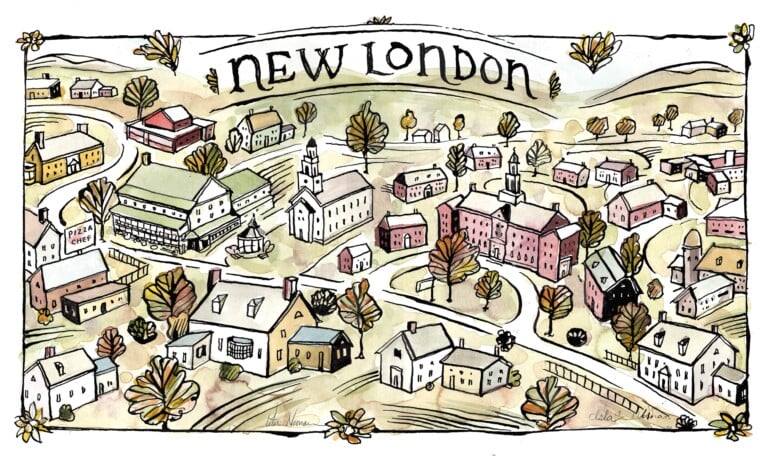
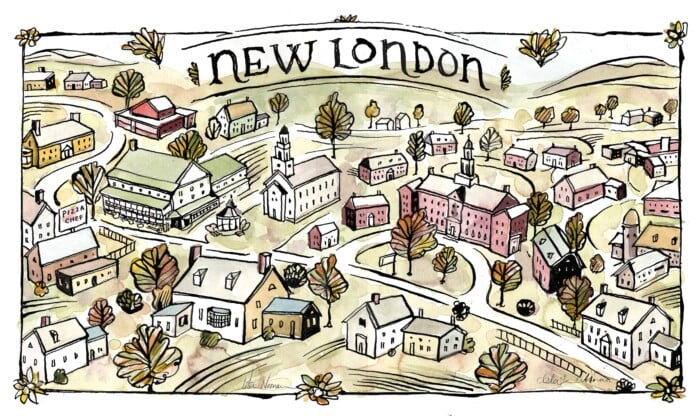
New London’s placid, leafy Main Street features plenty of places to sit on the town green and sip a coffee, go for a stroll, or, most importantly, meet residents eager to talk about why they love living here.
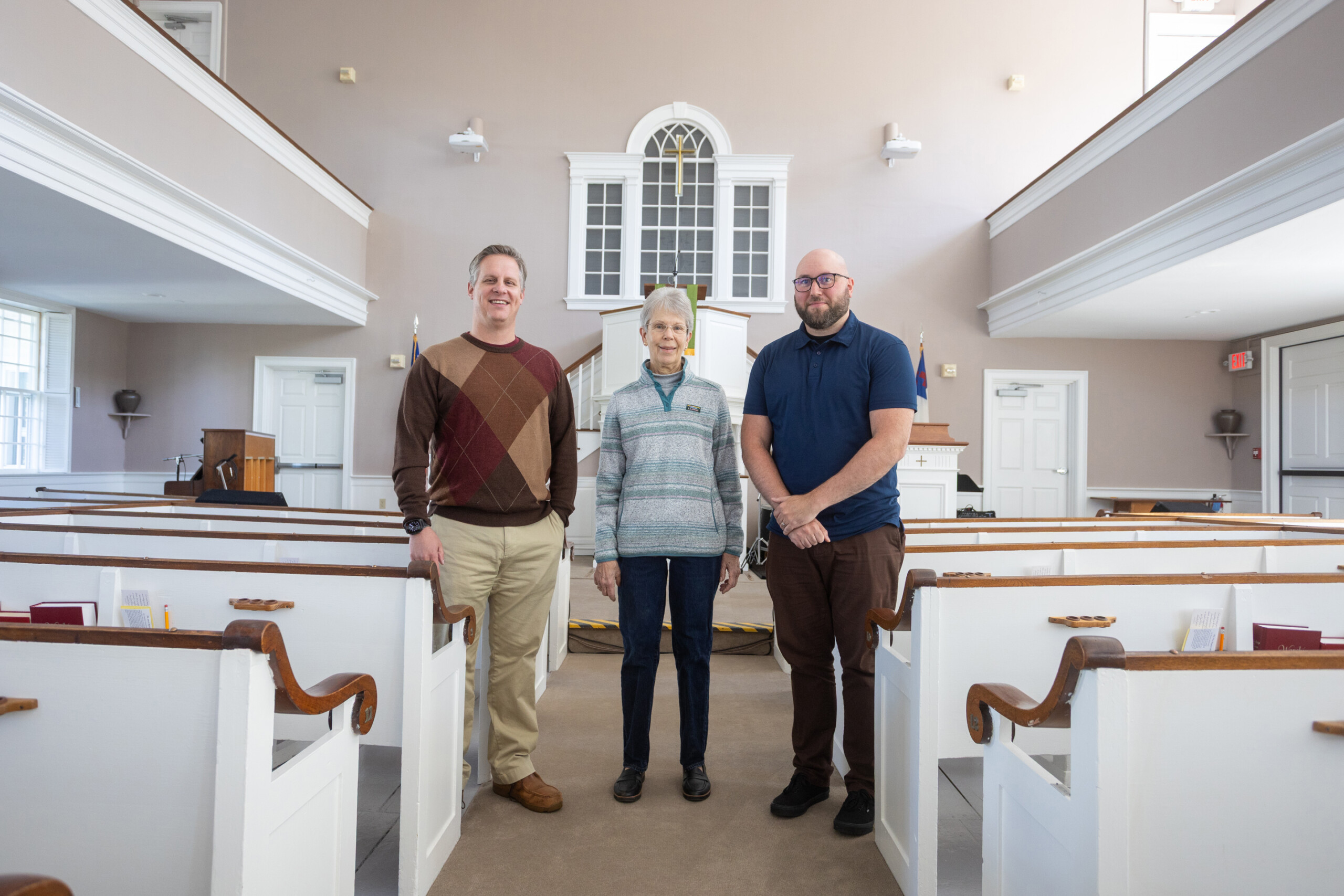
From left, pastor Charles Glidewell, archivist Marilyn Soper, and assistant pastor Timothy Smith, inside the sanctuary at First Baptist Church in New London.
With a population of roughly 4,400, New London’s community circles intersect often, and have shaped its history through generations of families who have created strong bonds.
Resident and Town Administrator Ashley Seybold is grateful to be part of the community.
“I like to refer to New London as Pleasantville,” Seybold says with a smile. “We are very lucky. We have a group of residents that are well educated, well informed, and very reasonable. So, we love that.”
Seybold mentioned some highlights: The New London Barn Playhouse is the oldest, continuously operating summer theater in New Hampshire and one of the oldest in the country, while the New London Historical Society’s 15 buildings are on New Hampshire’s Register of Historic Places.
“Being able to give back to the community that gave so much to me — and to help shape its future — feels like coming full circle. I’m incredibly grateful for the opportunity to serve the town I love,” Seybold writes.
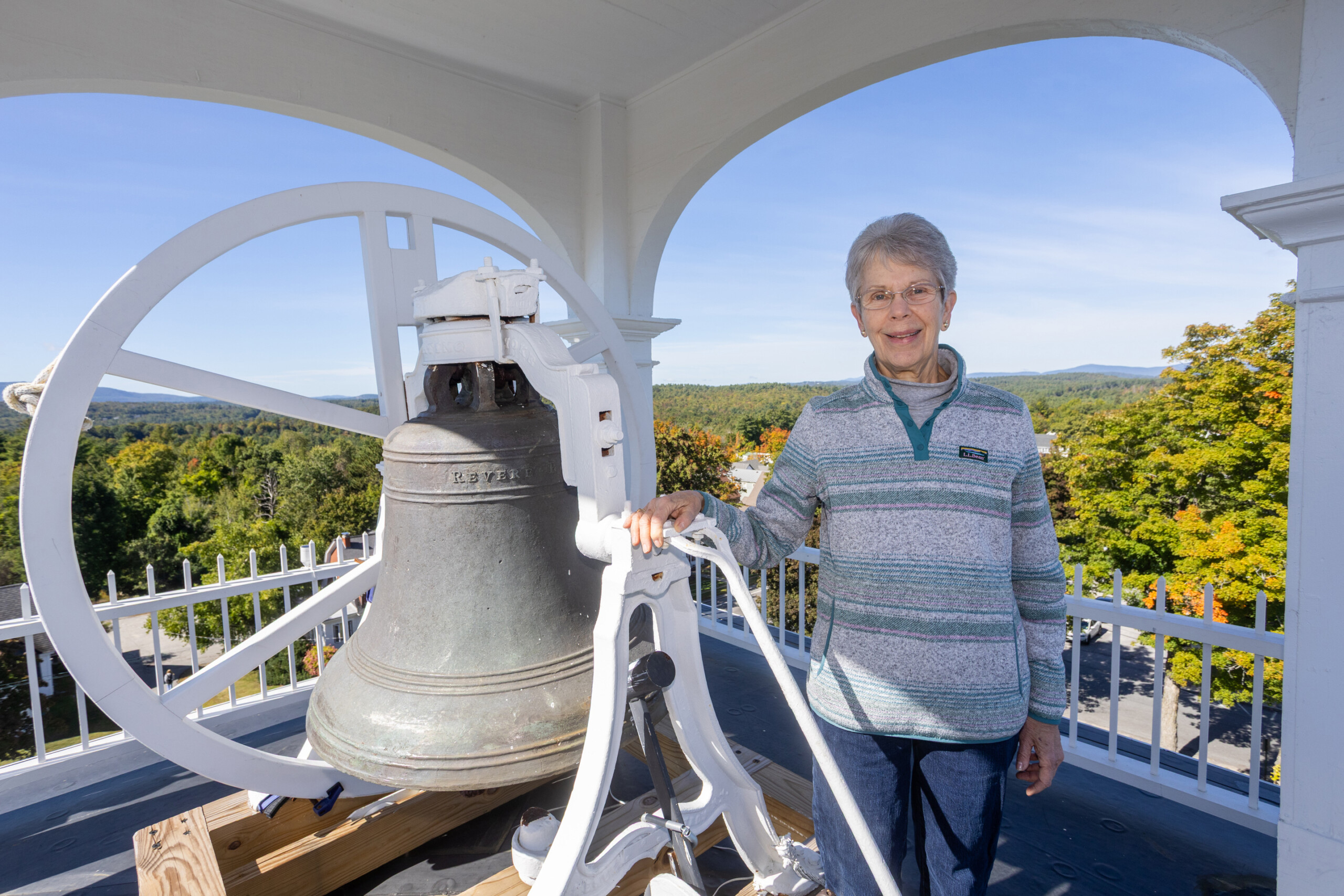
Marilyn Soper, archivist at the First Baptist Church in New London, is photographed by the church’s Revere Boston bell.
Seybold’s family and another local one, the Kidders, are closely intertwined, she says. Her grandparents, Bud and Ade Lauridsen, lived on Knights Hill Road, where the first Town Meeting was held. The house was later sold to family friends Bill and Marilyn Kidder. Bill Kidder founded the historical society in 1954 with his best friend, Bud Lauridsen.
The Kidders’ two grandsons work in town government. Putnam is New London’s recreation director, while Will is a third-generation town clerk.
Will Kidder, who is also director of the Ice House Museum, another New London time capsule, says Bud Lauridsen and Bill Kidder were highly influential in town.
“They are responsible for a lot of why New London is what it is today,” he says.
The Ice House Museum, founded by Bill Kidder, grew from his circa-1911 garage, the first in town. Kidder Garage was a lot of things: a Ford dealership, a gas station, a place to store the fire engine, and the center of town.
In the 1950s, Bill Kidder bought the nearby Ice House building to store autos and other Americana memorabilia during the winter.
But Kidder was also town clerk for nearly 40 years, a state representative, head of the NH Appropriations Committee, and started the town’s first bank.
“There’s a lot of deep history here,” Will Kidder adds.
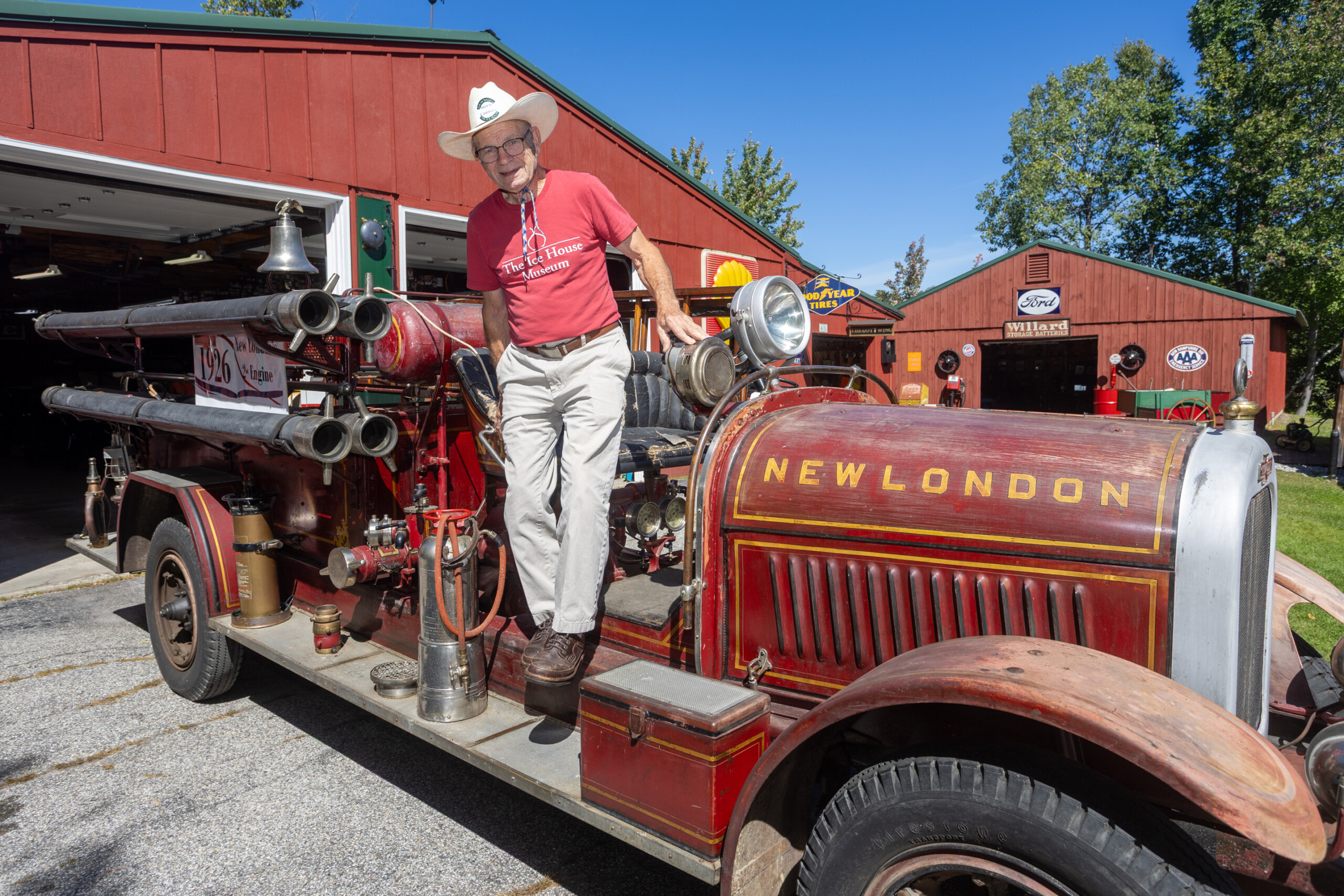
Greeter Storm Connors of New London, stands on a 1926 2nd Engine used by the town at The Ice House Museum in New London.
So naturally, politics and automobile maintenance intermingled at Kidder Garage.
“My grandfather would be standing there, polishing brass … while he was dealing with whatever the hot topic at the Appropriations Committee was,” Will Kidder says.
Someone who does all of that must surely know how to fix a broken gasket, people thought, so when the garage closed in 1980, it became a de facto hub for all things historic. Residents who soon got wind of Kidder’s expanding collection left half-broken items with Bill for tinkering, polishing and fixing, instead of dropping them off at the dump.
Kidder wanted to preserve this local history. Before his death in 2005, he made arrangements to establish it as a nonprofit museum. Its eight buildings are filled with cars and other machines: including six Model Ts (Bill Kidder was a big fan of Fords), tools, parts, steam whistles, washing machines, early fire engines, New London’s first movie projector and part of the old town jail.
Today there are “tens of 1000s certainly, maybe hundreds of 1000s (of items) if you actually started counting,” Will Kidder estimates.
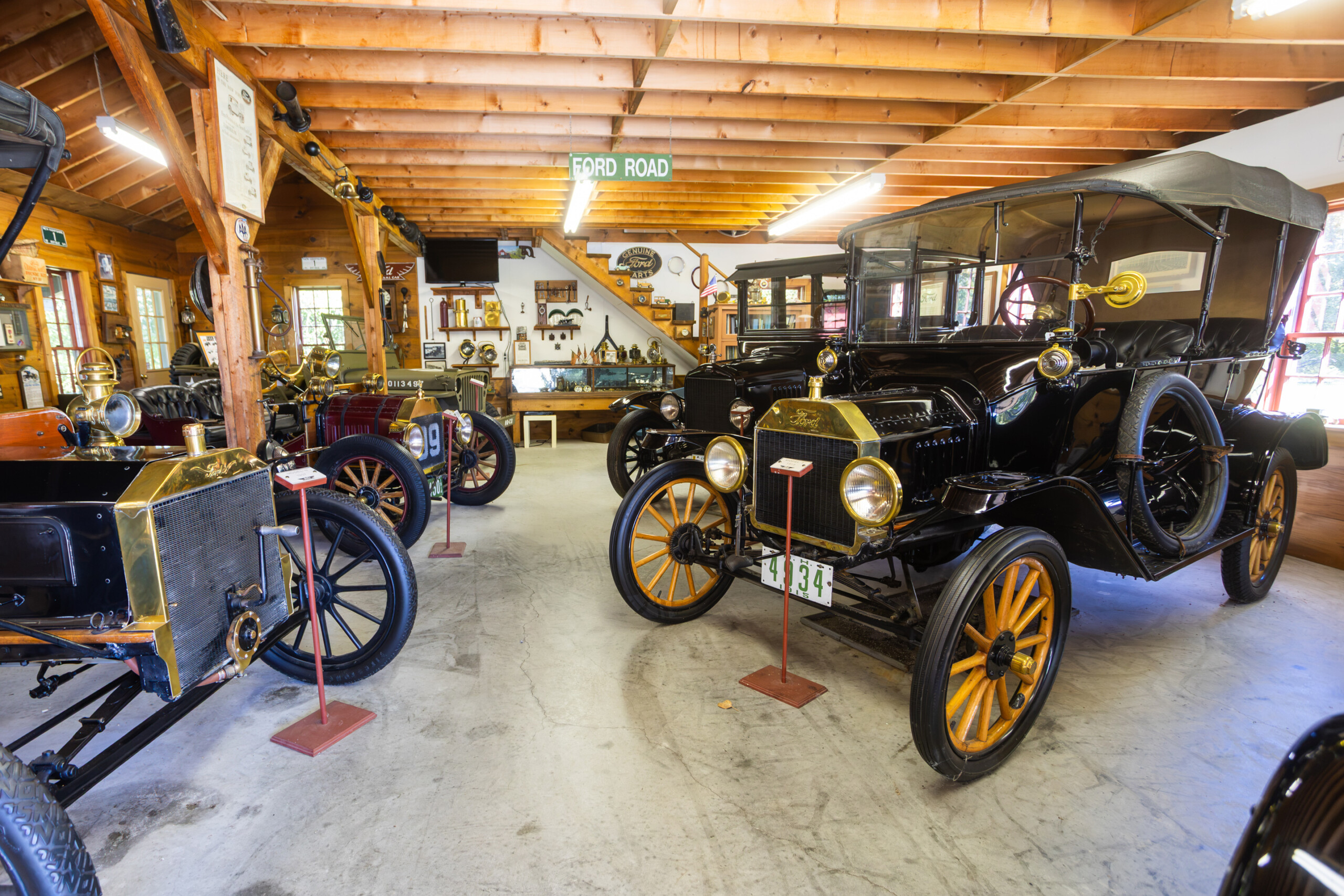
A Ford 1915 Model T, right, is pictured as part of the collection on display at The Ice House Museum in New London.
About 5,000 to 10,000 people visit annually, and it’s free to visit. It’s mostly volunteer-run by other “tinkerers by nature,” Kidder says.
During the museum’s “Cars and Coffee” events on Saturdays once or twice a month, visitors can bring their cars (old or new,) and chat with other auto enthusiasts. Kidder’s grandfather would be pleased.
“He would be very, very happy that people are standing around enjoying their cars, talking about them, meeting new friends, that sort of community aspect of it,” Kidder says.
Momentous anniversaries are often coveted in small towns, and right now, New London is in the midst of several, including planning for the town’s 250th celebration in 2029.
And this year, the Tracy Memorial Library on Main Street, is celebrating its 100th.
Town archivist Jim Perkins has been preparing a talk at the library about the building’s 100th anniversary dedication. While not a true New London native, Perkins is as close as they come.
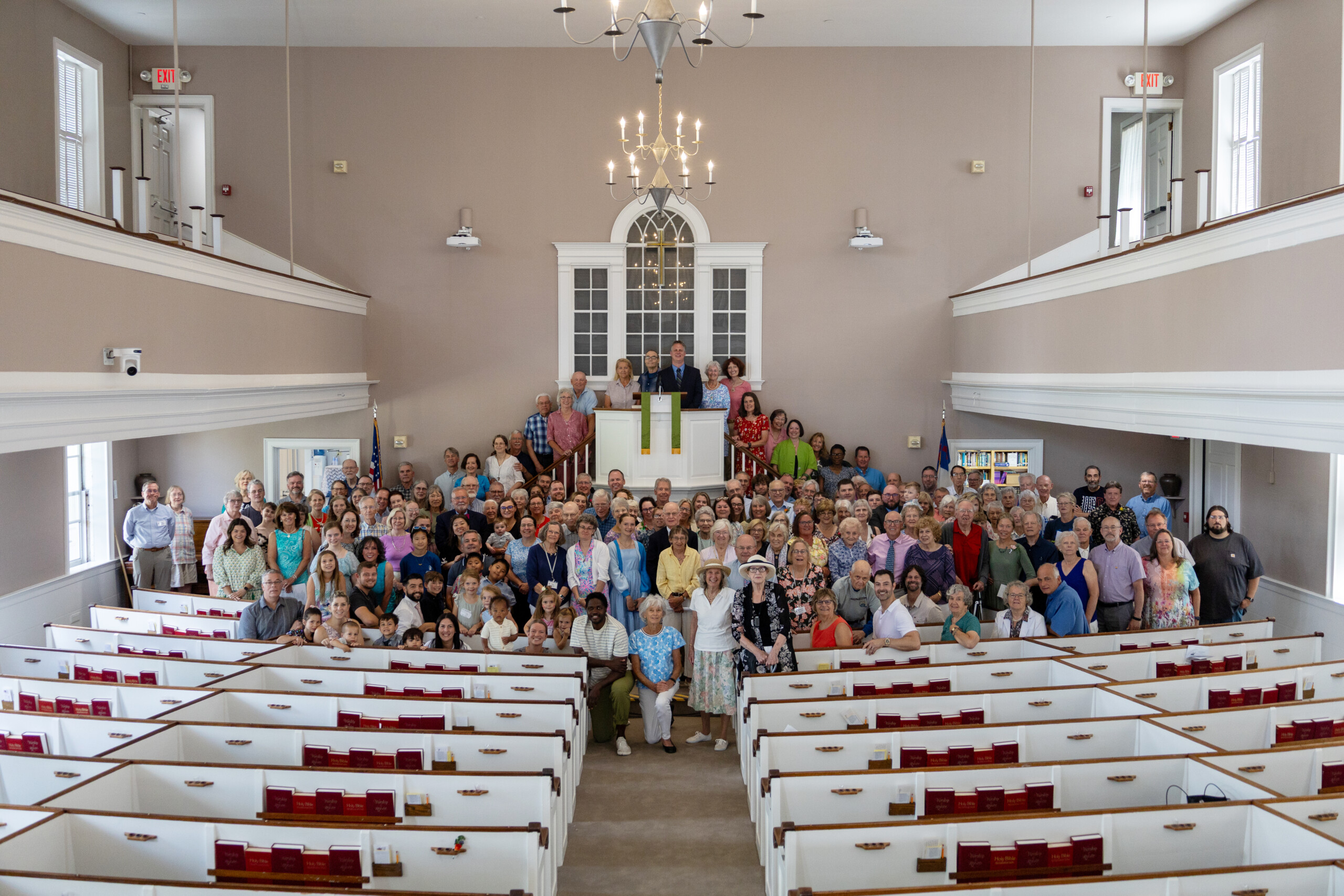
Members of New London’s First Baptist Church congregation gather in the sanctuary as part of the church’s 200th anniversary this summer. Photo courtesy Nicholas Doughty / OTG Aerial
“I have known the town, off and on, since I was 5. We moved here from Back Bay about 33 years ago,” writes Perkins, who recalled fond memories of raising his children here.
“Our children were both born in town (before the local hospital closed the birthing center). One highlight of their childhood was being able to cross country ski across fields and woodland paths from our house to their elementary school. Otherwise, they walked a mile to school in all weather. It’s that kind of town,” Perkins writes.
Yet another milestone; the First Baptist Church celebrated its 200th anniversary this summer.
Church member, volunteer and resident Marilyn Soper has been researching and archiving the building’s history.
“I’m a relatively new member of this church, and it’s only because I’m interested in history that I jumped in with both feet,” says Soper, who joined the church in 2010 soon after moving here.
The two-day celebration included a physical timeline of the church and plenty of group photos, and a historic marker commemorates its legacy as the oldest church in town.
Weekly historical updates have been folded into their church bulletins every week throughout the year. The inserts will be published in a commemorative book in 2027.
“I enjoy digging into history and organizing records so that they can be more easily found,” Soper says.
Soper’s volunteer work has mostly been a solo project, but she doesn’t mind.
“It helps to be fully retired, and it helps to love digging into history and spending hours on the computer,” Soper says.
And she’s uncovered a lot.
Built in 1826, the church’s post and beam construction was forged using hand-powered tools, a pattern from Asher Benjamin’s 1797 book “The Country Builder’s Assistant,” and wood likely sourced from local lumberyards. The cost: Nearly $3,000.
To cover the price tag, parishioners bought their pews — a common fundraising method at the time.
“If you were going to be a worshiper at the church, you bought a pew. You knew that pew number 9 was yours, and that you had paid $25 for that pew,” Soper says.
Churchgoers also raised money for another vital piece: a Revere bell, housed in the church steeple and likely brought up from Boston’s North End by cart. Soper says it’s the only Revere bell in the Kearsarge region.
Going to such great heights for the perfect toll was not uncommon, she says.
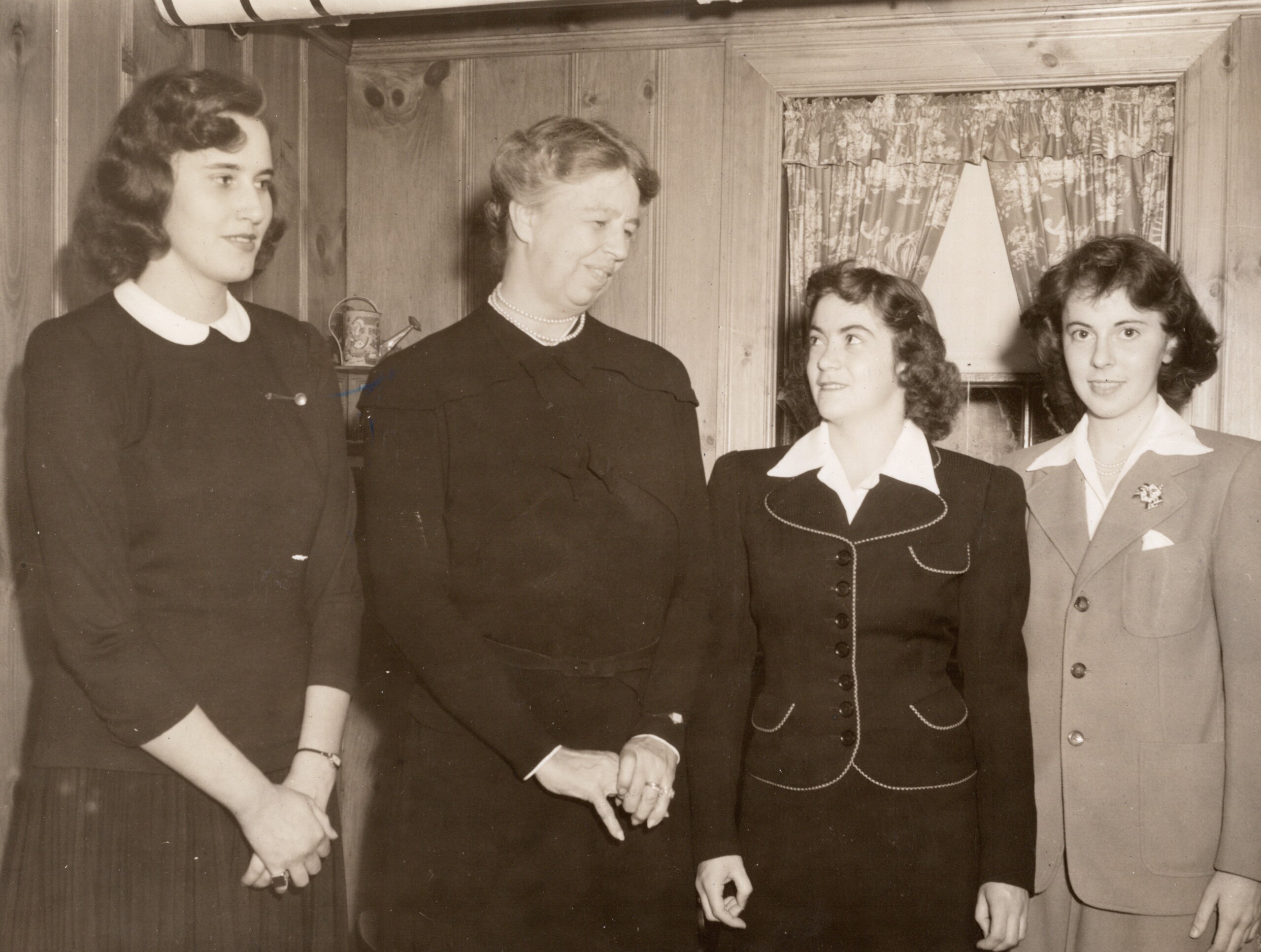
Former first lady Eleanor Roosevelt, second from left, stands with students from the then all-girls Colby Junior College during a visit to the school in October, 1941. Archivist Morgan Wilson says the visit was likely part of Roosevelt’s national speaking tour. Roosevelt spoke at the First Baptist Church on women in defense. Photo courtesy/ Cleveland Colby Colgate Archives, Colby-Sawyer College
“A Revere bell was considered the best bell you could have. The Revere bells rang true. So, they would go as far as they needed to get a bell,” Soper says.
But the first one, a 600-pounder, wasn’t quite up to snuff.
“It sounded too tiny. So, they raised more money, and they returned that bell to Boston, and they came back with one that weighs 1,043 pounds,” Soper says. The extra nearly 450 pounds did the trick.
Another church event Soper has researched was a visit from first lady Eleanor Roosevelt on Oct. 18, 1941.
Roosevelt spoke to about 600 people there on women in defense. The visit was organized and sponsored by Colby-Sawyer College, then Colby Junior College, at the time an all-girls school.
But the event might not have been possible unless residents worked together.
Colby-Sawyer College archivist and systems librarian Morgan Wilson says there was not enough space back then to hold the large crowds expected for a visit from the first lady. Contacting the First Baptist Church for help was a “very common” practice, Wilson says.
“(The church) was the largest auditorium in New London. The college and the First Baptist Church had a very close relationship,” writes Wilson, of Penacook, who was a Colby Sawyer College undergrad before becoming its systems librarian.
Wilson believes it was Roosevelt’s only visit to the town and was likely part of a national lecture tour.
Roosevelt also documented her visit to New London and spoke on its welcoming nature in her nationally syndicated news column “My Day,” writing:
“It was a gray and rainy day, but the few patches of brilliant color stood out all the more vividly because of the atmosphere … My audience in the lovely old church was a very responsive and delightful group. We spent the night with Dr. and Mrs. H. Leslie Sawyer, who were very kind hosts. What a difference a long night’s sleep in the country does to one’s outlook on the world,” Roosevelt says.
Soper agrees that collaborations between the school and the church have continued
for decades.
“(They) were so closely connected by families that worked at the college and worshiped at the church,” Soper says.
Born and raised in Manchester, Soper and her husband moved here to retire, but were also partly motivated by Soper’s love of skiing. She remembers visiting New London’s now-closed King Ridge ski area.
“It was very popular when I was a young skier. My mother and father would bring us up from Manchester to ski here,” Soper says.
“We’ve been living in small towns most of our married life,” Soper says.
Soper also spends lot of time in her flower garden, and enjoys living where everything is conveniently located, in a quiet atmosphere.
“There is not as much traffic except in the summertime, and we can stay closer to home,” Soper says.
Will Kidder also appreciates New London’s pleasant landscapes and outdoor recreation, but says he’s probably biased.
“I also have deep roots here. I’m not sure somebody could have a much stronger feeling and sense of community than I do about New London, just because of how long we’ve been here and how intimately involved my family has fortunately been,” he says.
Soper says small-town living is a great way to meet other residents.
“You get to know people better. There are people who like the city. It’s fun to go down and visit,” Soper says. “But I always feel better when I come home and can relax and enjoy the space that we have here.”