When the Unexpected Becomes Life Saving
AI Enhances Lung Cancer Detection at Elliot Health System

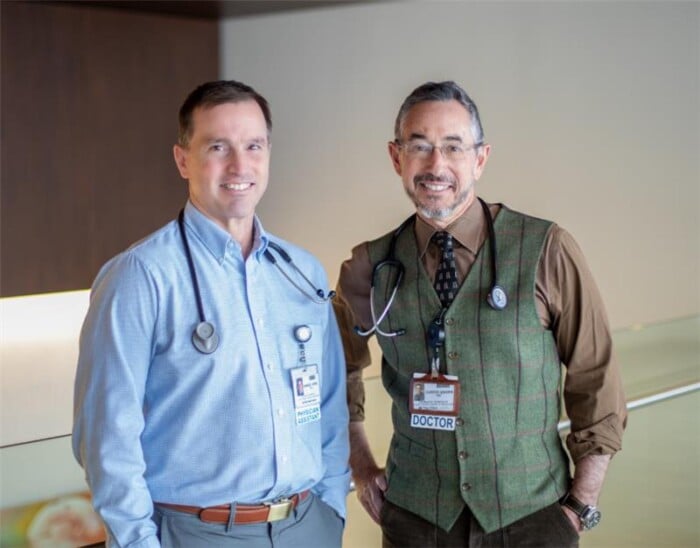
Physician Assistant Danny Taffe, left, pictured with thoracic surgeon Dr. Curtis Quinn, both of Elliot Thoracic Surgery in Manchester, NH.
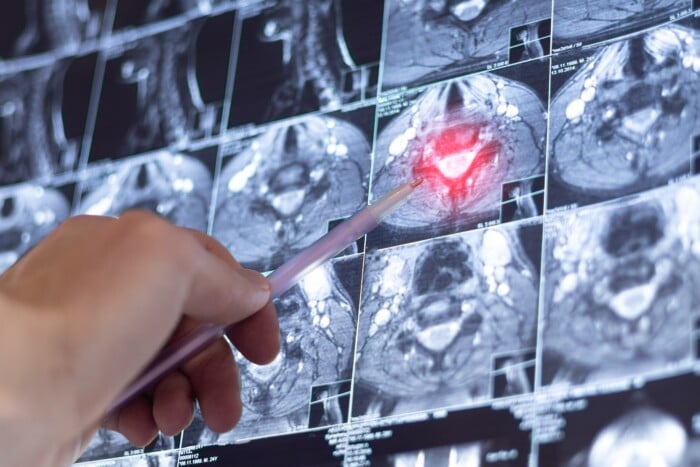
Sometimes an accident saves a life. For at least one Elliot Hospital patient, a chest injury that brought them to the emergency department turned out to be a blessing in disguise. A CT scan ordered to assess their injury revealed something unexpected: a small spot on the lung — an incidental lung nodule finding, meaning it was discovered by chance rather than through a targeted search. That spot turned out to be an early-stage lung cancer.
“A lung nodule is a small density within the lung tissue, which may range from a few millimeters up to a few centimeters in diameter,” said Danny Taffe, a physician assistant in the Elliot Thoracic Surgery department. “They occur in about 10% of all scans.” These nodules require follow-up; while many are harmless—caused by scarring, infection, or inflammation—some, like in this patient, can indicate lung cancer.
Lung cancer is the leading cause of cancer-related deaths in the United States, responsible for about 1 in 5 cancer deaths. Unfortunately, lung cancer often causes no symptoms until it reaches an advanced stage. As such, it is often detected late, which is why incidental findings like nodules matter. (Oncology Issues/ACCC)
AI increases adherence to lung nodule monitoring recommendations
Taffe found during a quality review of emergency department care that more than half of patients who were identified were not completing the recommended follow-ups for incidental nodules. In the stress of an acute illness or injury, these unrelated nodules often received little attention, exacerbated by a lack of mechanisms to ensure follow-up care.
In the wake of this quality project, Taffe helped champion a coordinated effort to ensure appropriate follow-up for lung nodules, resulting in the launch of a lung nodule clinic in early 2025. Using an artificial intelligence module built for Elliot Health System’s electronic health record, Epic, all radiologists’ reports are reviewed for mention of lung nodules, and those reports are flagged and reported to lung screening coordinators.
The lung screening coordinators review the report and use the nationally accepted “Fleischner Guidelines” to sort lower-risk nodules from intermediate- and high-risk nodes. Lower-risk nodules are communicated to the patient’s primary care provider or the patient directly, along with recommendations for further follow-up. Higher-risk nodules are reviewed by one of Elliot Hospital’s experts. High-risk nodules are often referred directly for biopsy, while complex indeterminate nodules are referred to a monthly clinical conference for multi-specialty review.
The monthly clinical conference, chaired by Taffe, is composed of a radiologist, a pulmonologist, a radiation oncologist, and a thoracic surgeon. The group makes a consensus recommendation to the patient and PCP, which may range from reassurance to a recommended follow-up image/schedule to biopsy or referral to a specialty.
Since its launch, the AI module report has flagged some 3,600 patients with lung nodules in need of monitoring, and the nodule clinic staff have reached all but 16 patients for follow-up care.
“We realized that as a fully integrated health system, we needed to ensure our patients are getting the follow-up they need,” Taffe said. “If these nodules are cancers, we want to discover them early when they’re small and more easily treatable, rather than at a late stage when patients are coming back to us with weeks to months to live, and there is little we can do to alter that course.”
Earlier detection improves outcomes for lung cancer patients
Identification and tracking of incidental lung nodules can mean patients with lung cancer who are outside screening guidelines and asymptomatic are diagnosed sooner.
Lung cancer screening guidelines have been developed to look for cancer in those deemed to be high-risk – people aged 50 and older who are or were smokers—unfortunately, only 16% of people who qualify were scanned in 2022, according to the American Lung Association (ALA). Furthermore, lung cancer doesn’t just affect those in the high-risk category.
According to Taffe, between 50% and 80% of new lung cancers found every year are in patients who would not qualify for screening. By using the AI module to ensure patients at the Elliot with incidental lung nodules receive follow-up care, the team has found 13 cases of lung cancer, including the patient who came to them with a chest injury.
In the example of the patient that came to the emergency room with the chest injury, since the nodule was found in an early stage, and having not yet spread to other organs, surgeons were able to remove the cancer.
“We believe that we have likely cured that patient of cancer,” Taffe said. “That’s really rewarding.”
The difference in survival is significant. Early-stage lung cancer has a five-year survival rate of better than 64%, which is for cancer confined to a single nodule, the ALA reports. However, advanced-stage lung cancer, which has spread and might require chemotherapy/immunotherapy in addition to surgery or radiation therapy, has a five-year survival rate of fewer than 10%. The average across all cancer stages is about 26%. Programs that shift more diagnoses into the early-stage category, like Elliot Health System’s, significantly improve patient outcomes.
“It’s a dramatic difference,” Taffe said. “Incidental nodules are potentially incredibly important in looking for and making sure that we catch cancers as early as possible.”
AI helps bridge an information gap so experts can get to work
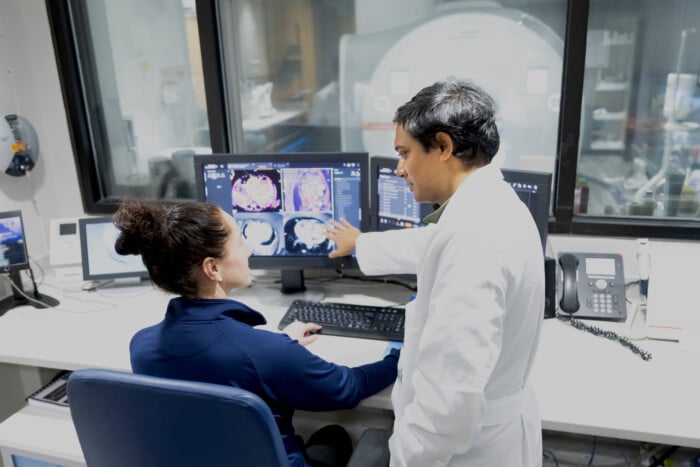
The AI module the Elliot uses includes a large language model (LLM) which is integrated into the electronic health records system. It does not read radiology images directly or make recommendations on follow-up frequency. Instead, it reviews the radiologists notes across the system on scans that match predetermined criteria to include any X-ray or CT scan that shows part or all of the chest. Scans ordered by lung cancer specialists to evaluate cancer are excluded to avoid duplication.
The AI module does not diagnose cancer, replace radiologists or clinicians, nor does it decide who needs a biopsy. It is there to ensure nothing is overlooked.
“We’re using our expertise, our lung cancer specialists, to make those decisions, not putting it in the hands of an AI module,” Taffe said. “But the AI module is helping us right now to make sure that no nodule goes unevaluated.”
With a clear handoff of recommendations sent to primary care providers, patients have been more likely to receive the follow-up care they need. And since most nodules are benign, patients can receive care from their usual doctor while waiting to see a specialist. “The pulmonology department, and Dr. Mohammad Mirza(chair) in particular, have been supportive and integral to this product,” Taffe said. “Many of these patients would otherwise be referred to pulmonology, which would contribute to longer wait times and backlogs for them.”
Reducing your risk for lung cancer
While identifying and tracking incidental lung nodules is one component of preventing advanced lung cancer, there are other ways to maintain your health without a trip to the emergency room.
Smoking cessation is among the most important things you can do to prevent lung cancer.
“It’s never too late to quit smoking,” Taffe said. “It remains the leading risk factor, even though there are plenty of lung cancers that are found in non-smokers.”
If you are or were a smoker, and you fall into the high-risk category, it is important to keep up to date with annual low-dose CT scans as recommended by U.S. Preventive Services Task Force. Taffe hopes to see these guidelines adjusted in the future to better cover those who are presenting with lung cancer.
“I’m excited for potential modifications of the screening criteria to allow us to screen more patients,” he said. “I’m excited for increasing recognition that screening is important and does save lives to try to boost our screening rate, ideally to 100%, but I’ll take 50% at this point. And then I’d like to see more hospitals invest in incidental lung nodule programs to systematically make sure these small incidental nodules are getting the appropriate follow-up.”
And if you do have a lung nodule, listen to your doctor’s recommendations, and keep up with your monitoring plan. The sooner you know whether a nodule is cancerous or not, the better the outcomes can be, potentially adding years to your life.
To learn more, visit ElliotHospital.org/ThoracicSurgery