The Future of Breast Imaging
As one of the nation’s few National Cancer Institute Comprehensive Cancer Centers, Dartmouth Cancer Center advances medicine through research and clinical trials.
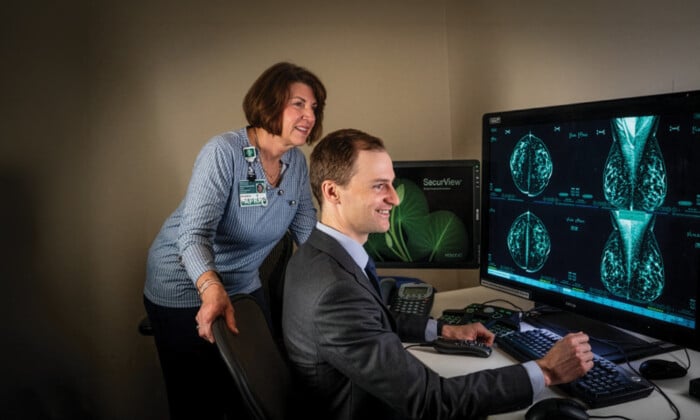
As one of the nation’s few National Cancer Institute Comprehensive Cancer Centers, Dartmouth Cancer Center advances medicine through research and clinical trials. Physician researcher Roberta M. diFlorio-Alexander, MD, MS, is a Dartmouth Health radiologist specializing in women’s imaging and breast cancer research. Here, she highlights a couple of clinical trials aimed at advancing breast imaging.
“Breast magnetic resonance imaging (MRI) is the most sensitive breast imaging exam and provides exquisite soft tissue detail. However, it has some drawbacks, including the need for intravenous (IV) contrast and a moderately high false positive rate (identifying abnormalities that are not cancer). We have several studies in progress to improve breast MRI by combining MRI with other technologies:
Detecting breast cancer without injections or radiation: A type of MRI called dynamic contrast-enhanced MRI requires an injection of a special dye called gadolinium, which may have safety risks. In this project, we want to develop and evaluate the combination of two technologies: near-infrared spectroscopy, which uses harmless near-infrared light to gather information about breast tissue, with current MRI imaging platforms. Our goal is to create a combined system that accurately detects breast cancer without contrast injections or ionizing radiation, and to explore whether the combination performs as well as current methods. If successful, this new approach could offer a safer and more comfortable way to diagnose breast cancer.
Microwave + MRI for improved diagnosis: This study aims to improve the accuracy of breast MRI by combining breast MRI with microwave imaging in a technique referred to as “simultaneous Microwave and Magnetic Resonance Imaging” (sMMRI). The new system will gather additional information about breast tissue using microwaves at the same time as the MRI. This extra information will be precisely matched with the MRI images to differentiate non-cancerous abnormalities from cancerous ones. The microwave technology is also relatively inexpensive, which could help make this new approach more accessible. If successful, we will have a working sMMRI system ready for larger studies to see how well it can diagnose breast abnormalities.
Ultimately, we want to achieve faster, safer, and more accurate diagnoses with fewer false alarms and less stress for patients,” diFlorio-Alexander explains.