Breast Density and Cancer: Is There a Connection?
Dartmouth Cancer Center breast cancer experts decode breast density: what it means, why dense breasts are challenging to read on a mammogram, and when to consider supplemental screening options.
Nearly half of all women have dense breasts. In September 2024, the U.S. Food and Drug Administration (FDA) began requiring that mammogram
reports include a determination of breast density, which should be described as either “not dense” or “dense.”
But when a mammogram report says you have “dense” breasts, it can raise a lot of questions. Does it mean you’re more likely to get breast cancer? Will a mammogram still detect cancer? Should you have additional screening?
For Carol Huntley-Smith, APRN, a general surgery advanced nurse practitioner at Dartmouth Cancer Center in Keene, these questions are a routine part of caring for patients with breast cancer, as well as those with concerns such as a breast lump or family history of breast cancer. She answers by opening conversations with her patients about breast anatomy and how breast density is determined.
In basic terms, breast tissue is composed of lobules (which produce milk), ducts (which deliver milk to the nipples), “fibroglandular” or fibrous tissue (which gives breasts their structure and shape), and fat (which fills the remaining space).
“It’s normal for breasts to feel lumpy and bumpy, but breast density isn’t determined by how breasts feel or look,” Huntley-Smith says. “Instead, it’s a measurement made by a radiologist based on the ratio of fibroglandular tissue to fat in your breast tissue as seen on a mammogram.”
Breast density levels
Huntley-Smith explains that there are four levels of breast density, with two categorized as dense and two as non-dense:
Extremely Dense (Category D): This is the highest density category, with breast tissue that is mostly fibroglandular. About 10% of women fall into this category.
Heterogeneously Dense (Category C): This category has more fibrous than fatty tissue. About 40% of women have heterogeneously dense breasts.
Scattered Fibroglandular Density (Category B): The ratio is slightly more fibrous than fatty in this category. About 40% of women fall into this category.
Mainly Fatty (Category A): This is the least dense category, where the breasts appear darkest on a mammogram. About 10% of women are in Category A.
Breast density and mammograms
As far as imaging goes, mammograms are the most effective way to detect breast cancer, and what radiologists and the Society of Breast Imaging recommend annually. However, increased breast density can make it more difficult for radiologists to accurately interpret mammograms.
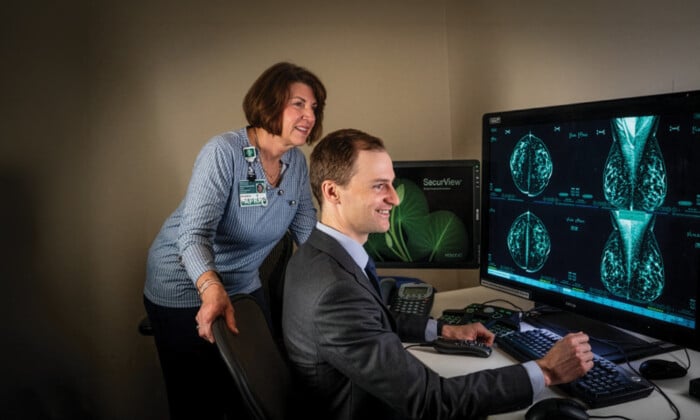
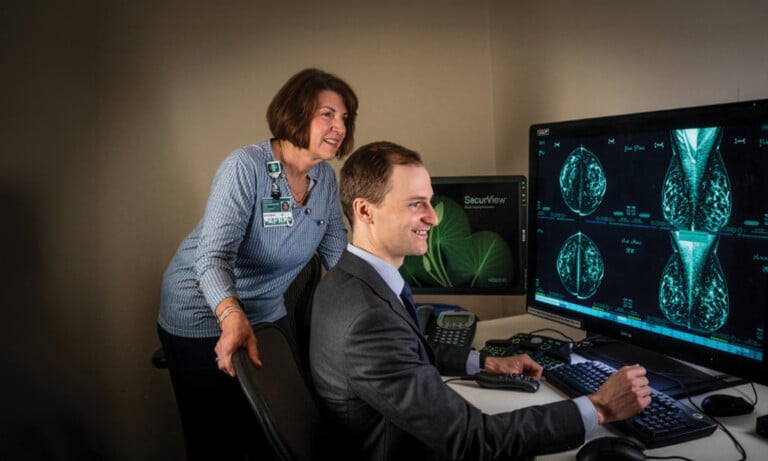
Dartmouth Health Radiologist Mark W. Johnson, MD, specializes in reading mammograms. He explains that the fibroglandular tissue of dense breasts appears white on a mammogram, and cancer also appears white. This can make it challenging to spot potentially concerning white areas, such as tumors, against the white background of dense breast tissue.
“While the majority of women with dense breasts never develop breast cancer, increasing density is one of many factors that increases risk,” Johnson says. “And increased density also goes along with a decreased sensitivity of mammography.” This means that in dense breasts, there’s a slightly higher chance that a mammogram might miss something.
Supplemental screening options
Because of the challenges in screening dense breasts, supplemental screening may be recommended in addition to mammograms. Supplemental screening options currently available at Dartmouth Health include:
Breast MRI: For individuals at high risk of breast cancer, a full breast MRI may be recommended. MRI is more sensitive than a mammogram and can often detect abnormalities at an earlier stage. However, full breast MRIs are costly, and insurance coverage can be a challenge.
Abbreviated Breast MRI: A shorter version of the full MRI is offered to those who have no significant risk factors for breast cancer other than heterogeneously (Category C) or extremely dense (Category D) breast tissue. The abbreviated version has about the same sensitivity and specificity as a full breast MRI. While insurance coverage is improving, abbreviated breast MRI may not always be covered. At this time, in 2026, the scan may result in an out-of-pocket cost of around $500.
Contrast-Enhanced Mammography (CEM): An emerging technology, CEM involves the injection of contrast media like that used in a computed tomography (CT) scan. It has similar benefits to MRI.
Which type of screening do you need?
In addition to the FDA’s recent requirement to disclose breast density statuses on mammogram reports, for those described as “dense,” the report summary should include suggestions about other imaging tests that may be helpful.
Providers also sometimes use risk models like the Tyrer-Cuzick risk model, which incorporates breast density along with other factors, to calculate an individual’s risk of breast cancer and make recommendations for screening types and frequency.
“For patients with no family history, whose own risk of breast cancer is less than 15 percent, typically an annual screening mammogram is suggested,” Johnson says. “Patients at 15% to 20% risk are in an intermediate zone. Because there may be challenges obtaining insurance coverage for a full breast MRI, we also offer abbreviated MRI. Patients who are greater than 20% are in a higher risk category. We may follow these patients with mammography alternating with MRI every six months.”
Decisions around breast cancer screening frequency and type are individual and are best discussed with your primary care provider or a breast specialist.
Learn more
Understanding breast density is crucial for breast health and for early detection when cancer is most treatable. The most important step is knowing your own breast density, understanding your personal risk, and talking with your healthcare provider about whether routine mammography is enough or whether supplemental screening makes sense for you. The American Cancer Society also offers an excellent guide to understanding breast density and mammograms.
“Get comfortable with what your own breasts look like and feel like so that if there is a change, you can tell somebody,” Huntley-Smith says.
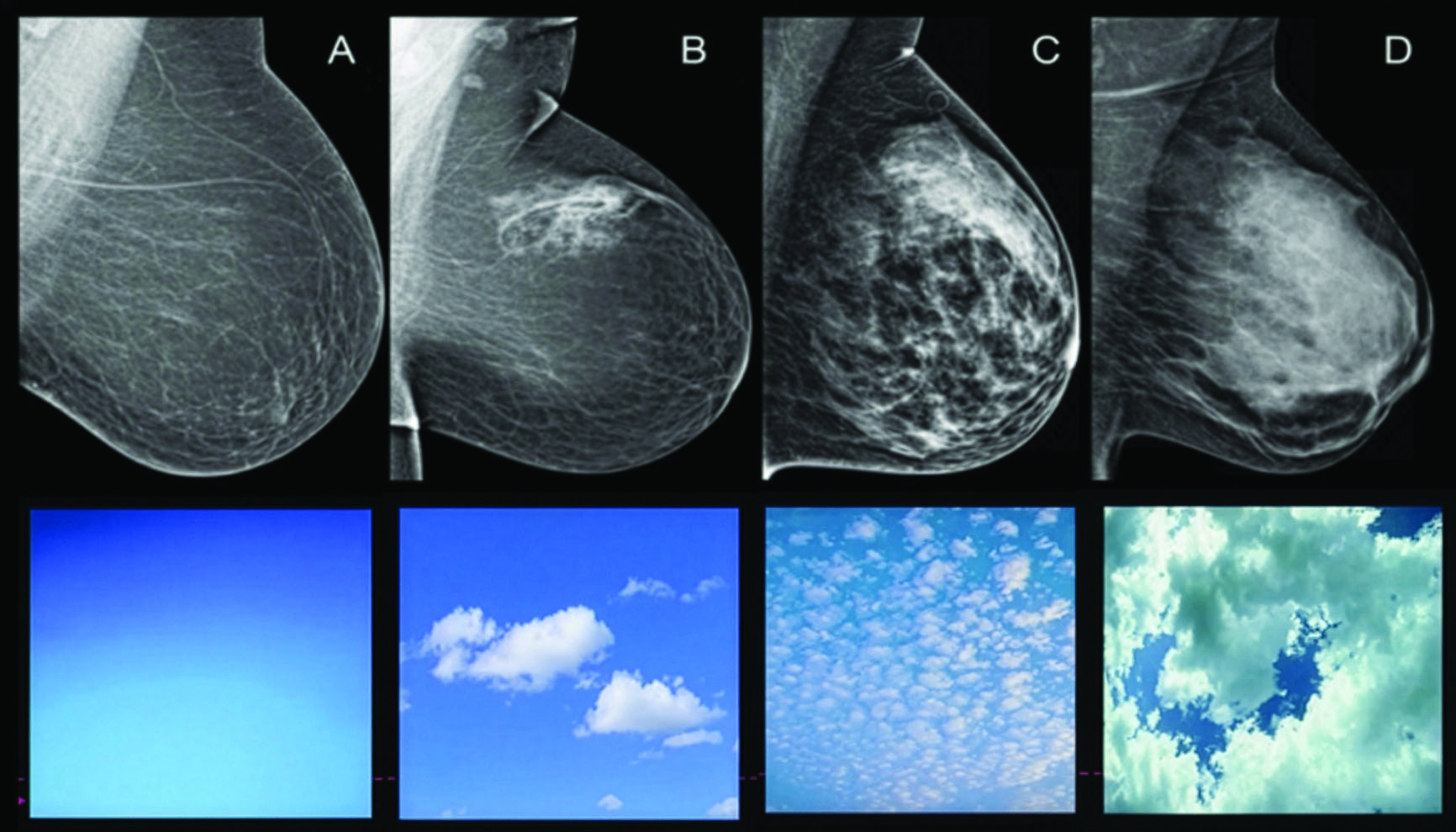 Mammogram reports are now required to include a person’s breast density information and potential for increased risk of breast cancer. “This change was likely to invoke many more questions to providers,” says Petra J. Lewis, MBBS, FAAR, FACR, Breast Imaging Section Chief at Dartmouth Hitchcock Medical Center. She created a visual analogy to help providers explain breast density categories.
Category A: The breasts are almost entirely fatty; Category B: There are scattered areas of fibroglandular density; Category C: The breasts are heterogeneously dense, which may obscure small masses; Category D: The breasts are extremely dense, which lowers the sensitivity of mammography.