WDYK: Piloting the Albacore
A young boy’s dream and an old man’s nightmare
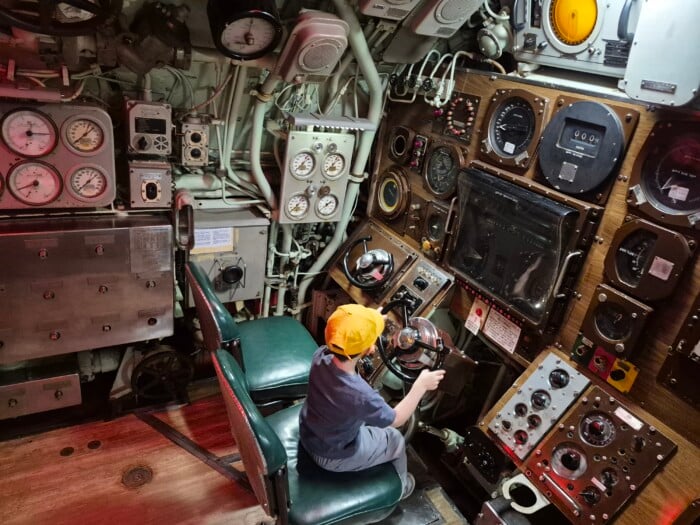
The submarine’s commanding officer gave the order to “Dive, Dive, Dive!” so I pushed the yoke forward and began working levers, flipping switches and turning knobs. The captain, now peering through the periscope, yelled excitedly, “Watch out for the whale!” I turned the rudder hard, missing the giant creature by inches. “That was close,” the captain said. “We almost had whale guts splattered all over our windshield.”
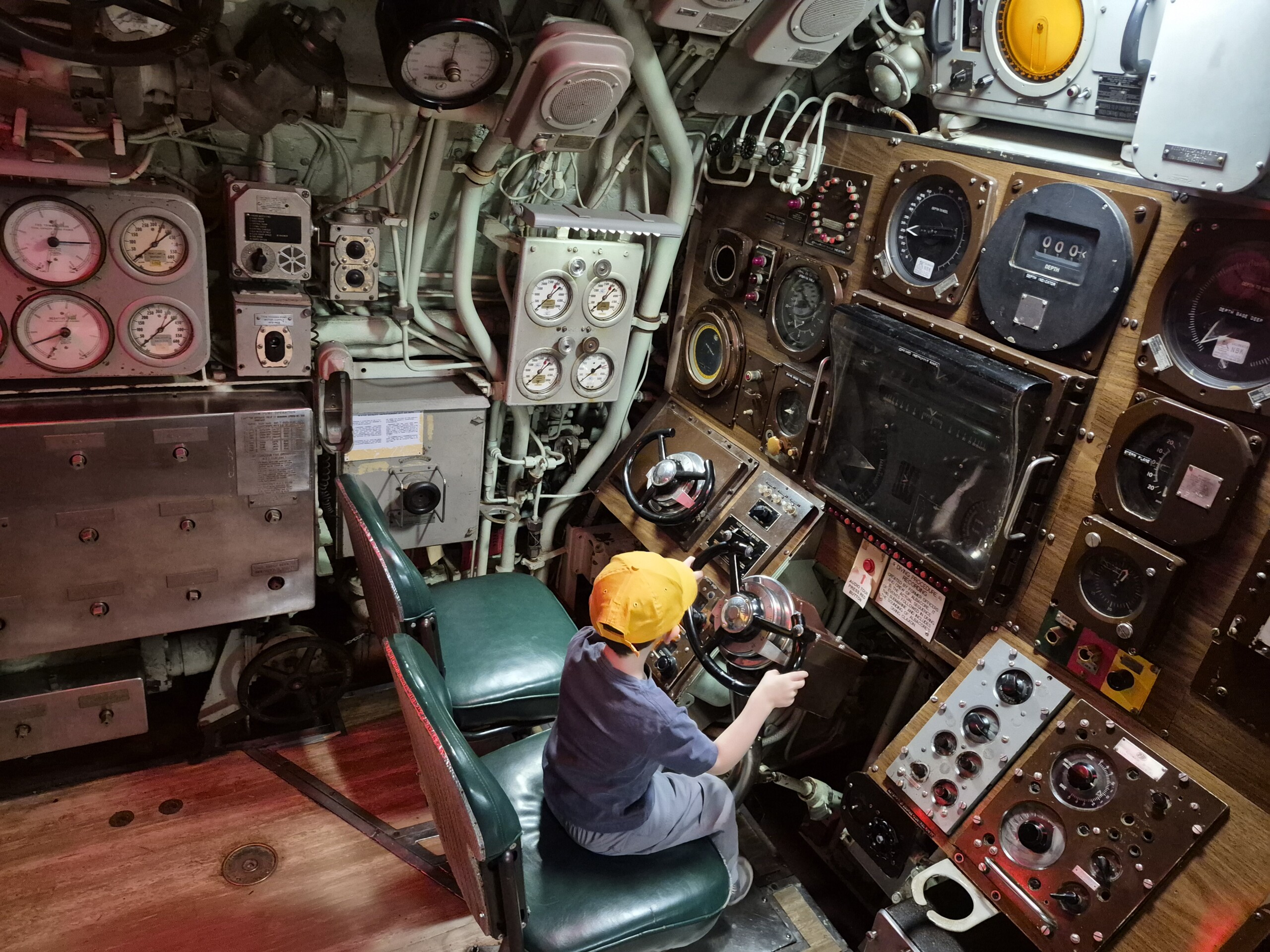
Marshall Hudson’s grandson assumes command of the USS Albacore and pilots her through imaginable peril.
I’m at Albacore Park, a National Historic Landmark in Portsmouth featuring the historic research submarine USS Albacore, which is now a public museum. My 4-year-old grandson and I are exploring the submarine on a self-guided tour; he quickly assumed the role of commander and began barking out orders. His imagination is in overdrive, and he is thrilled to be hands-on in an actual submarine, albeit a decommissioned and stationary one.
The submarine doesn’t have a windshield and is permanently mounted on dry ground, a long way from any meandering whales, so the near-miss windshield splatter occurred only in my grandson’s imagination. I’m delighted he is enjoying himself, but keeping up with him in these cramped quarters isn’t easy for this not-as-flexible grandfather.
“Quick! Get to the engine room, we need more power!” he yelled and took off running down the narrow passage toward the back of the sub. The passageway weaves over and around complicated-looking stainless-steel machines, and through gray hatch doors with low overheads and high thresholds. Little kids and skinny sailors might be able to clear these obstacles on the run, but I had to fold up like an accordion to bend through the hatch … and I still banged my head and scraped my shin.
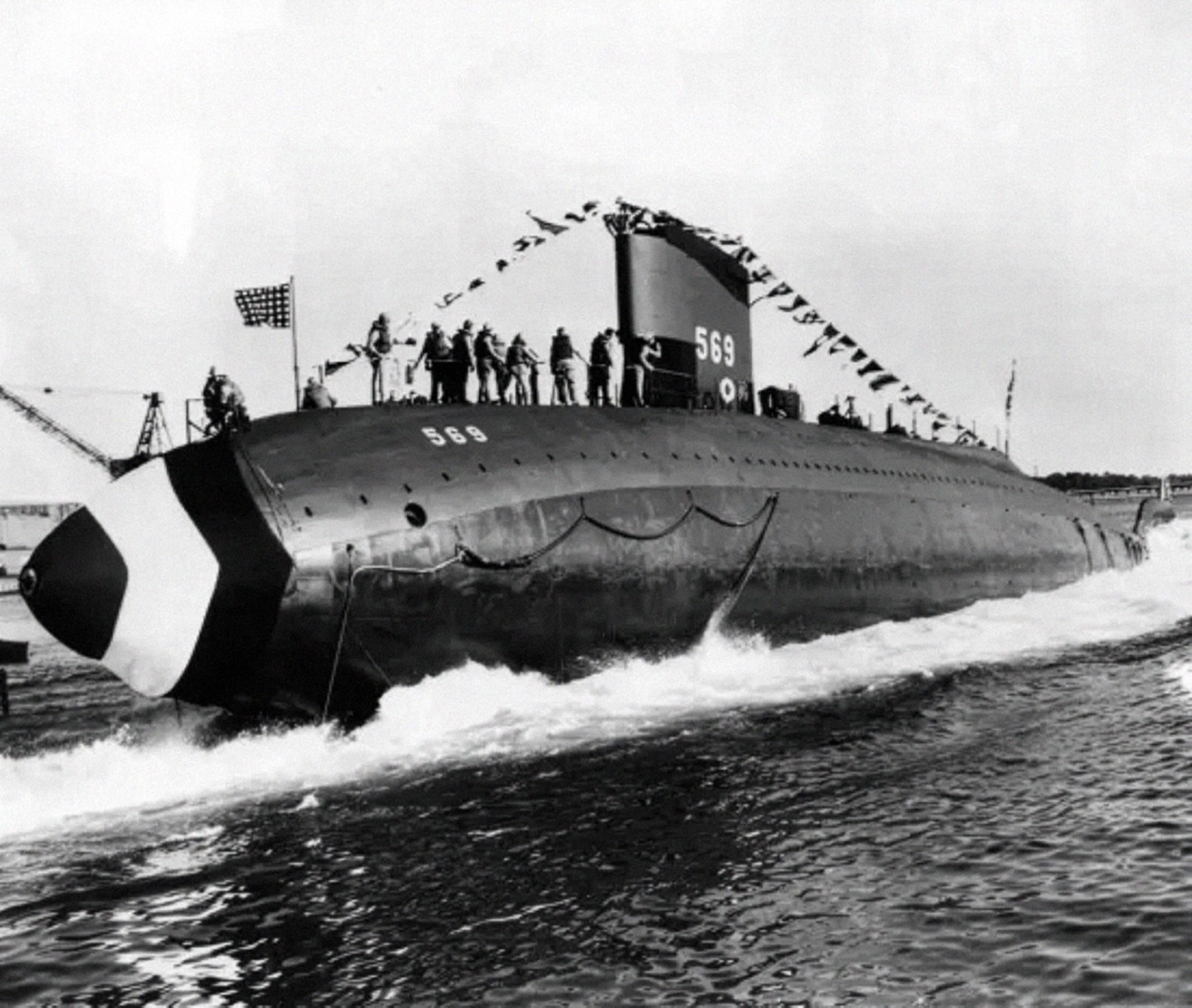
The USS Albacore launches in August 1953 at the Portsmouth Naval Shipyard. Photo Courtesy National Archives
This submarine, christened USS Albacore (AGSS 569), was built at the Portsmouth Naval Shipyard, launched in 1953, and served as a research vessel. It was used for testing control and propulsion systems, sonar equipment, dive brakes, escape mechanisms and other innovative equipment. When outfitted with high-capacity silver-zinc batteries, Albacore could outrun a contemporary nuclear submarine. In 1966, the Albacore set the record as the world’s fastest submarine by attaining an underwater speed of nearly 40 miles per hour.
In 1972, the USS Albacore was decommissioned and placed in reserve at the Naval Inactive Ship Maintenance Facility in Philadelphia. Ten years later, an effort began to return the Albacore to her New Hampshire birthplace for permanent display. In 1984, the sub was towed from Philadelphia back to the Portsmouth Naval Shipyard.
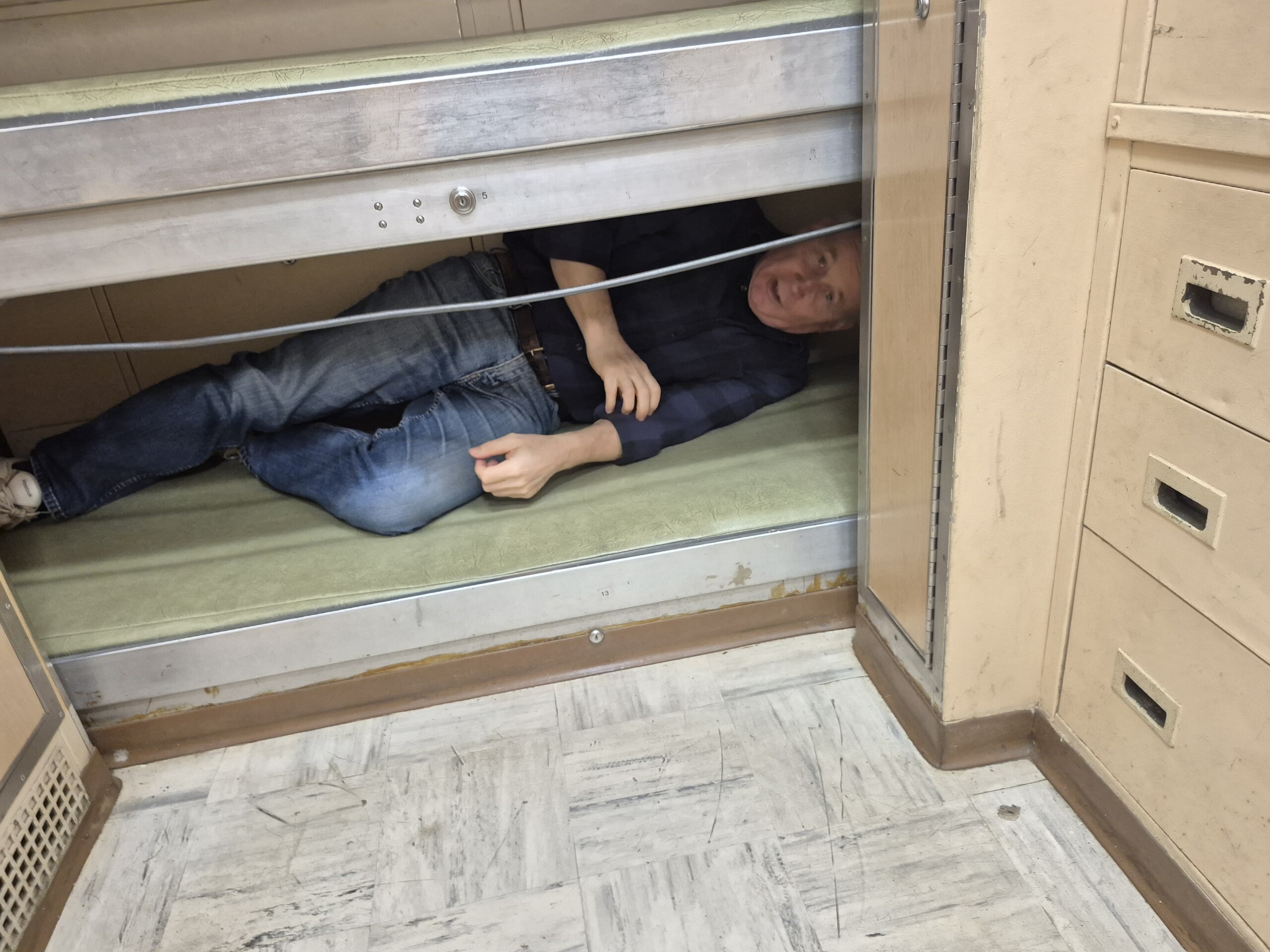
Marshall Hudson tries out a bunk in the cramped quarters of the Goat Locker.
To get the Albacore from the Piscataqua River to its new home on dry ground, it was necessary to remove a railroad trestle, cut through a four-lane highway and dredge a channel to the end of a constructed marine railway. Gaining permission to do all this required over 20 permits and approvals, including a sign-off by then-President Ronald Reagan.
The challenge of getting the Albacore to its new home, a quarter-mile from the river and some 27 feet above sea level, was solved by constructing a marine railway. The Albacore would be floated onto a specially designed railcar that would then be moved on rollers over twin tracks. A heavy-duty winch would pull the submarine out of the water and up a ramp. Complicating this move was the fact it needed to be done at the highest tide of the month.
In May, 1985, the Albacore began maneuvering through the dismantled railroad bridge and four-lane highway cut. By October, 1985, she was settled onto a concrete cradle in a dry basin at what is now Albacore Park. Visitors can go inside this historical submarine, look through the periscope, explore the control room, engineering spaces, bunkrooms and more. Recordings by former crew members play over speakers throughout the sub. Voices share personal stories of their time aboard the submarine.
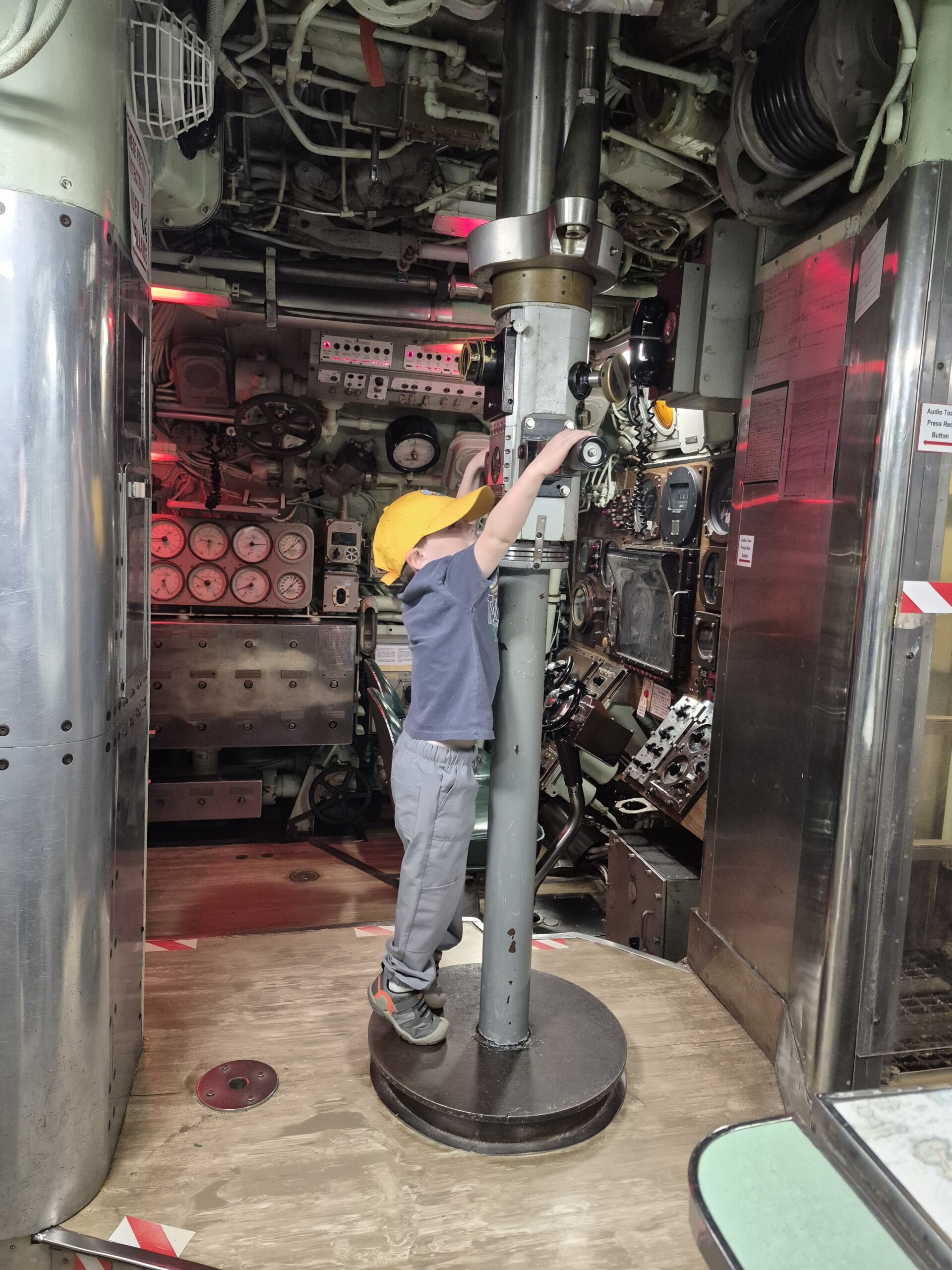
Using the periscope to check for whales is a difficult duty assumed by this young submarine captain.
With pretend screwdrivers and make-believe wrenches, my grandson and I fixed the malfunctioning “master-blaster” in Albacore’s engine room. With the “super-power speed” now restored to the stationary ship, we headed back to the control room. Along the way we stopped at the galley and mess hall. These terms are too generous for the tiny kitchenette with three small tables squeezed into an area the size of a minivan.
I noticed the tables had chessboards
permanently painted on them, indicating that when not serving meals, this area was also the ship’s recreation room. I find that hard to imagine. If there were more than three or four others in here with me, I’d feel claustrophobic; yet a narrative tells me the Albacore carried a crew of 40 to 50 sailors and fed four meals a day right here. Old black and white photos depict sailors packed shoulder to shoulder around these tables eating or holding mission briefings.
Whereas the galley was uncomfortably claustrophobic, the bunkroom was a nightmare for me. Bunks were racked three-high in an area the size of an office cubicle, with a less than 6-foot ceiling. There is zero privacy here and little personal space. A recording reveals this area is nicknamed the “goat locker” and was a stateroom for mid-rank officers. Too tiny for me, its space is luxurious when compared with enlisted men’s quarters. Enlisted sailors slept 10 to a room in narrow bunks packed so closely together that when walking sideways down the center aisle, you’d still bump into beds on both sides.
My grandson easily scampered into one of the middle berths and pretended to happily fall asleep. I struggled to crawl into a lower rack and once in, felt like I was inside a coffin with the lid closed. Sleeping would have been impossible for me.
Visiting the Albacore taught me I would not have done well as a submariner, but I also got to enjoy seeing it through the excitement of a 4-year-old who loved every minute of it. If you know any youngsters with high-speed imaginations or a mechanical aptitude for fixing invisible “master-blasters,” take them to see the USS Albacore. And if they give the order to dive the submarine … watch out for meandering whales.