Digging Up History
Strawbery Banke's ield school is solving archeological mysteries at Colonel Paul Wentworth House in Rollinsford
The trash doesn’t lie,” says Salem State University archeology professor Emerson “Tad” Baker. “Trash tells the truth.”
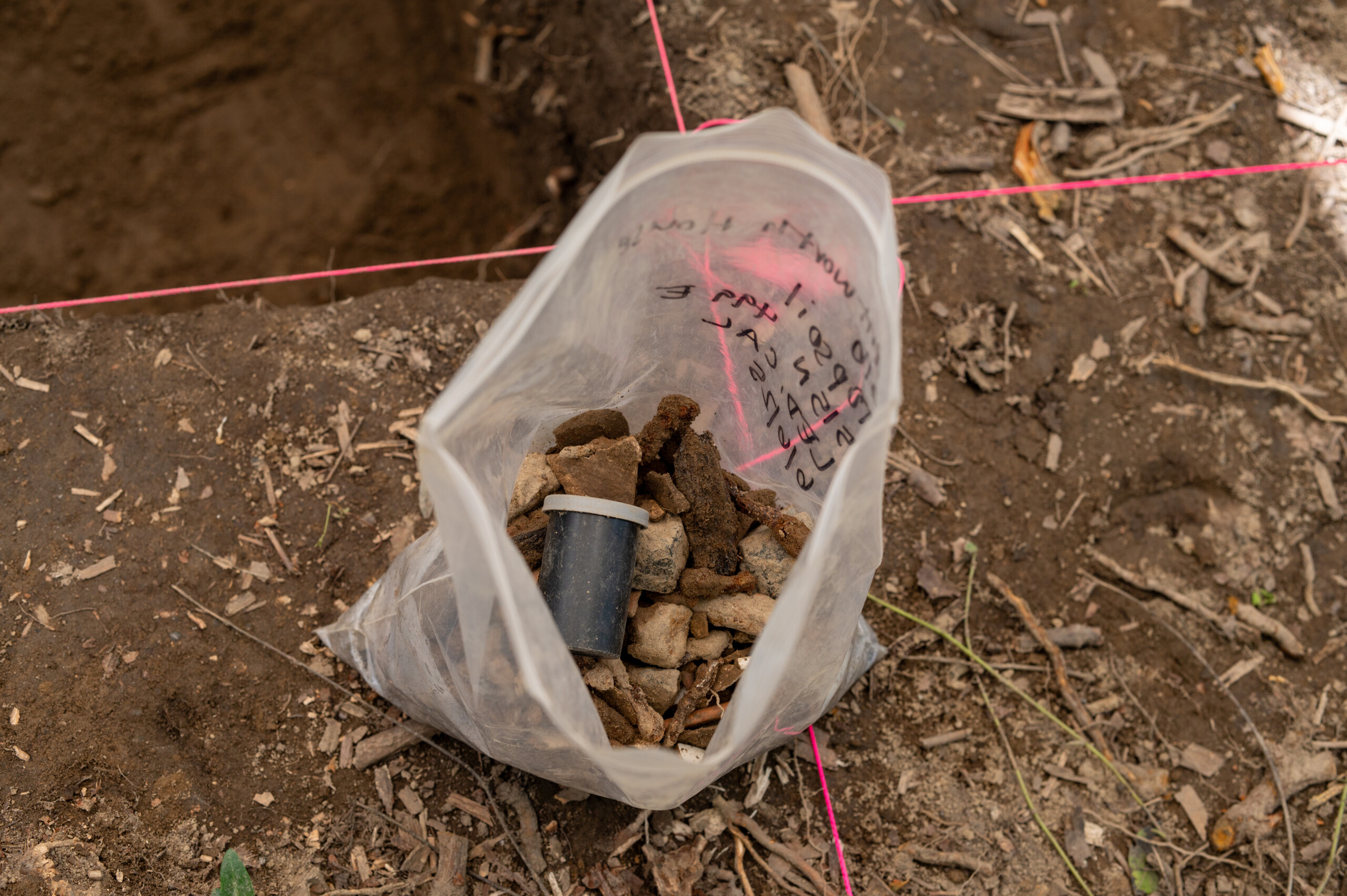
Bags from each sector are labeled so documentation is accurate from site to lab where the potential findings are sorted and studied. Old film canisters are used for smaller or more fragile pieces.
Baker isn’t dumpster-diving. He and a handful of SSU students are at an archeological dig site at the Colonel Paul Wentworth House in Rollinsford as part of a summer field school offered by Strawbery Banke. They are joined by archeology students and professors from the University of New Hampshire, one high-schooler, and archeological enthusiasts of all ages who want to spend two weeks participating in the field school.
Last year, the summer field school was held off Strawbery Banke’s campus for the first time in its history.
“One of the main principles of archeology is that you don’t dig just for the sake of digging,” says Strawbery Banke’s lead archeologist, Alix Martin. At first, finding a new location for the field school proved to be a daunting task. But when Martin and Baker received a request from the Association for Rollinsford Culture and History (ARCH) for an archeological dig at the original site of the historic Colonel Paul Wentworth House, they knew they had found the perfect dig site.
Built in 1701, the Wentworth House was originally owned by Paul Wentworth before ownership passed to his nephew John Wentworth. Don’t confuse Rollinsford’s John Wentworth with his cousin, John Wentworth, who served as New Hampshire’s last royal governor. This John Wentworth served as speaker of the Provincial House from 1771 until 1775 as president of the Revolutionary Congress in New Hampshire, along with other roles in the newly formed New Hampshire government.
When the house was deconstructed and moved to Dover, Mass., in 1936, Rollinsford didn’t just lose an old building — it lost its heart. That loss ultimately led to the founding of ARCH. Their goal? To bring the historic house back to Rollinsford.
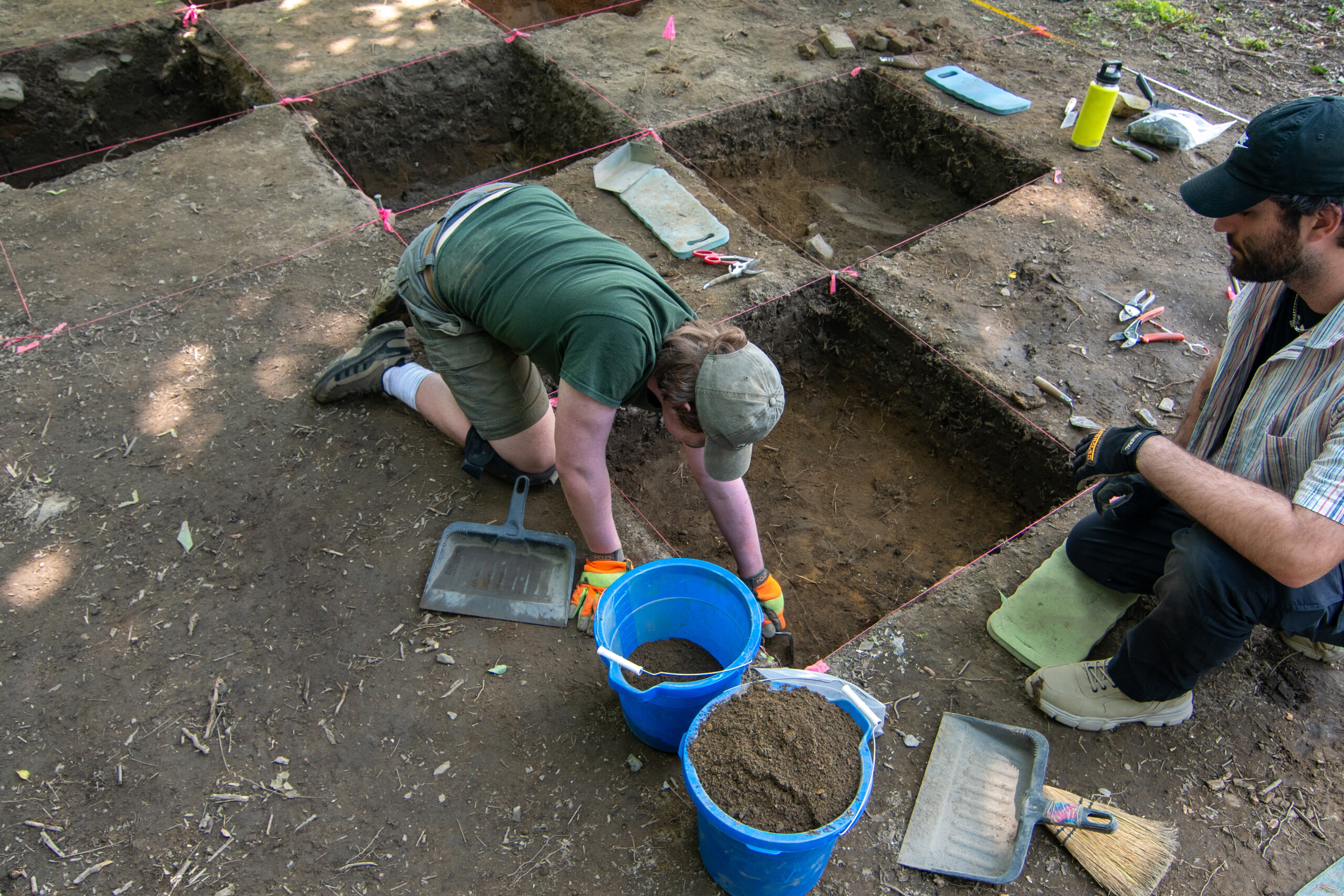
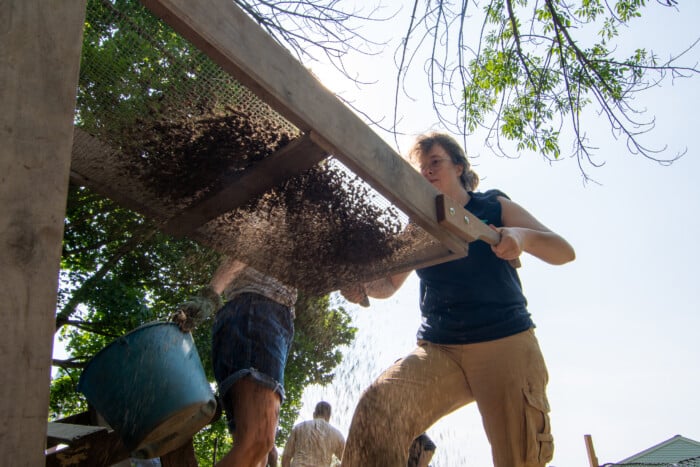
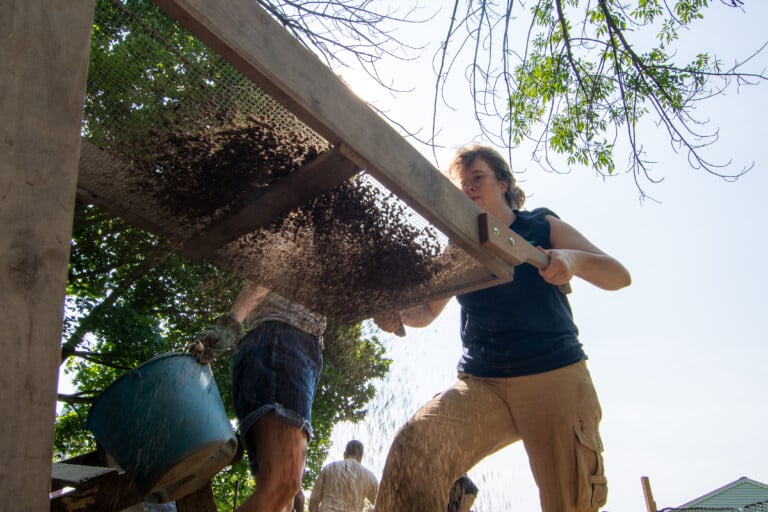
Students of Archaeology Field School with ARCH and the Strawbery Banke Museum carefully digs in marked areas to not damage potential artifacts, collecting soil in buckets to later sift and reveal artifacts they may have missed.
“The loss of historic houses, and cultural sites in general, leaves a deep and lasting scar on a community,” ARCH board member Jake Moody says. “We’re so lucky that this community banded together to bring the house back. It really is a case of a house that was repatriated back to its community.”
In 2002, Rollinsford residents voted in favor of buying the Wentworth House back, and by the end of the year, the house was disassembled in Dover and moved home to be rebuilt for a second time in the house’s history, a few yards behind its original location.
You read that right: This house was surveyed, mapped, taken apart piece by piece and rebuilt in Massachusetts to be surveyed, mapped, taken apart piece by piece and rebuilt again, decades later, in its original location’s backyard.
It had been a longtime dream of ARCH to have a full archeological dig at the Wentworth House’s original site, but while the house was gone, the lot become private property, and the owners weren’t interested in having their backyard torn up. That was until a new owner bought the property in 2024, and said “Why not?”
Armed with brushes, shovels and sifting screens, the field school began last June with the hopes of reuniting the household’s material history with the rebuilt house, along with locating two structures — the Wentworth House’s original foundation, and a carriage house that was left out of an inaccurate map drawn in the 1930s — but was noted as “slave housing” in early property maps. If the field school was able to find evidence of the carriage house, this would be the third excavation of slave quarters in New England.
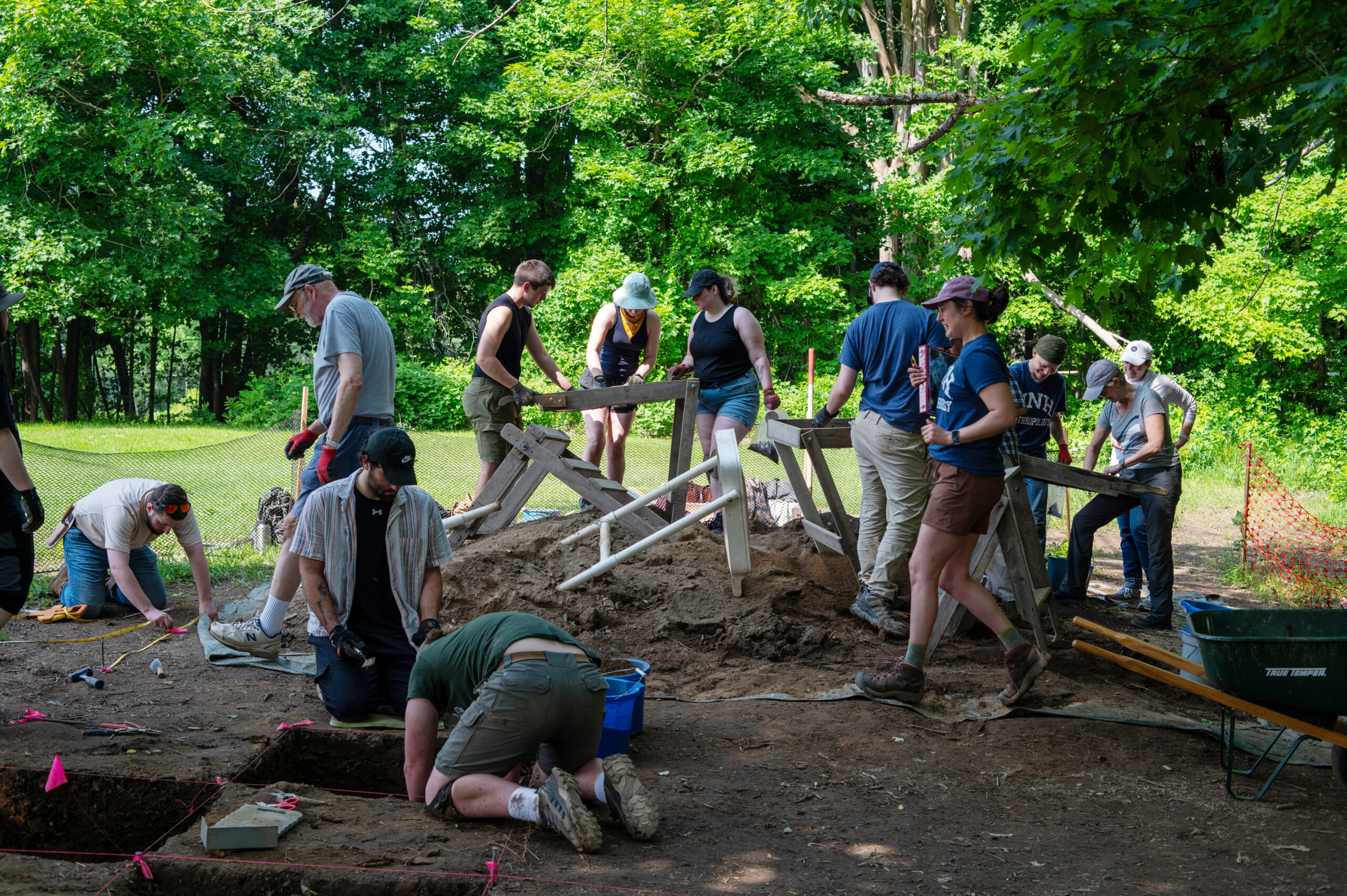
Students of Archaeology Field School with ARCH and the Strawbery Banke Museum spent the week long field session at the original location of the Wentworth home in Rollinsford, NH. On Thursday, June 12, 2025, they continue to carefully digging and collecting soil from marked areas (squares in foreground marked with pink), to sifting said soil to reveal potential artifacts from their lots.
Baker mentioned that it’s a common misconception in New England that everyone was free. In fact, he said, that by 1757, 10% to 15% of Boston residents were enslaved, with most people working in sawmills and with lumber because those jobs were undesirable. Along with unveiling a historical hypocrisy, a public project like this can bring attention to an overlooked piece of New England’s history.
“Archeology is good at telling the stories of those who didn’t leave written records,” Baker says. “(We) can put them back in the story where they belong.”
“Right now, we’re getting a snapshot — a redacted report,” Martin says. “(We’re) looking for evidence of people living there. Things like personal belongings in sub hole pits, some ceramics or evidence of West African culture.”
In the dig’s first season, the archeological team was able to locate the house’s original foundation, along with broken chamber pots, fragments of English ceramics and dinnerware, medicine bottles, a cat skull, thimbles and more. Each item found gives the team a glimpse into the day-to-day lives of the house’s former residents, and brings them a step closer into reconnecting the oral history of the carriage house with the physical.
Going into this season, Martin says that there’s a lot she and the team are looking forward to. In October, she and Baker returned to the dig site with a remote sensing team to narrow down the location of the carriage house, and see if they could locate a stone foundation, or evidence of it.
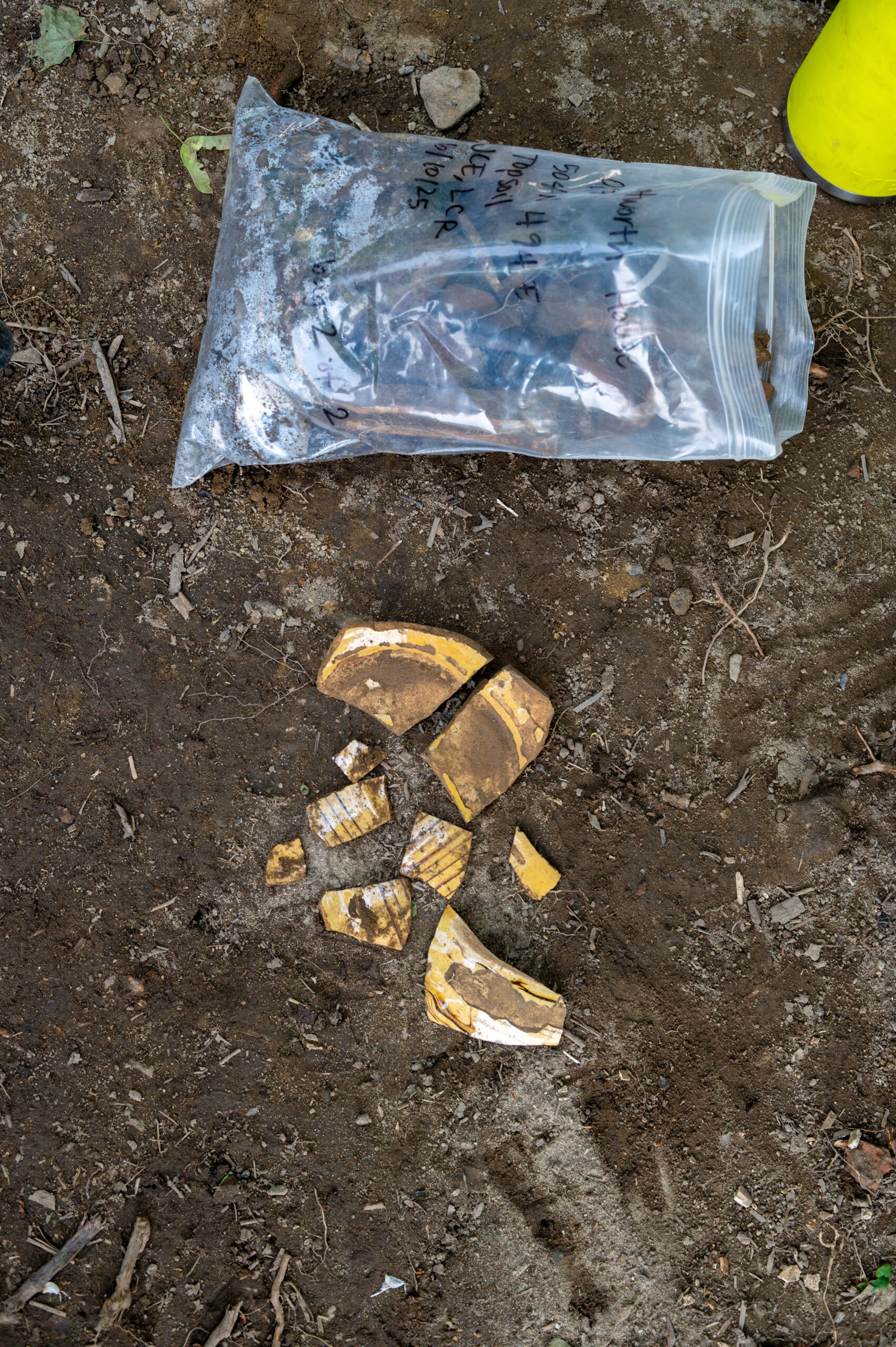
Shards of a yellow pot await its own carrier for easy recalling and to prevent further damage in transport to the lab.
“We didn’t find any promising results,” Martin says. “But in archeology, we like to say that ‘absence of evidence is not evidence of absence.’”
With a newfound understanding of how the carriage house wasn’t built, the team can go into this season looking for answers on how it was. With no stone foundation, they can focus on finding evidence of a wooden structure with posts or beams.
“We’re excited to start this season with the base of knowledge from last season, and focus on how (the carriage house) must have been constructed,” Martin says. “We’re starting with a better understanding of the site, and with a more specific question.”
While this year’s field school is currently full, interested participants can sign up to be added to their waitlist. Or, you can stop by and see the site firsthand and see what it’s all about.
“We’re also hopeful that we get more visitation from people who are interested,” Martin says.
This season, Strawbery Banke’s field school will be back at the Colonel Paul Wentworth House in Rollinsford from June 1-12 and June 15-26. For registration and more information visit strawberybanke.org.