Find Your Adventure: Hike in NH
From surfing to zip-lining, from climbing to biking, local pros show you where to start for some of the Granite State’s most thrilling pursuits
Looking for an opportunity to get out and try a new sport or hobby this season, but don’t know where to start? Don’t worry, we’ve got you. Each of our local adventure experts will guide you through how to approach ziplining, ATVing, biking, surfing, scuba diving, climbing and whitewater rafting, complete with tips and tricks for each quest and recommendations for where to go.
Find More Adventures:
Riding High: Zip-lining in NH
Wild On Wheels: ATV-in in NH
Cruising the Thin Blue Line: Surfing in NH
Find Your Froth: Whitewater Rafting in NH
Hot Wheels: Biking in NH
Take a Hike by Michael Wejchert
Hiking is as challenging as you choose to make it
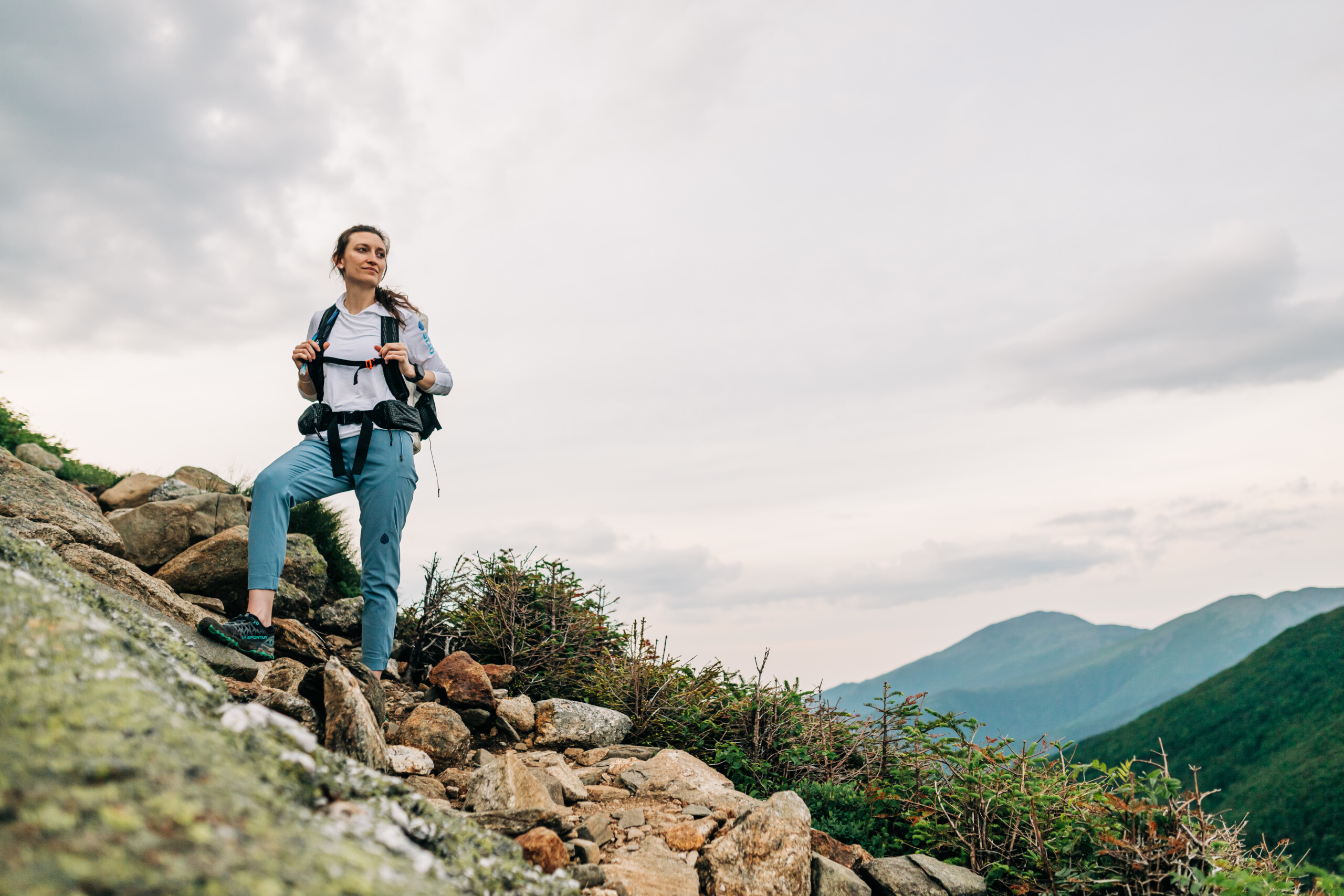
Vanesa Urango pauses in the rugged alpine Presidential Range near the summit of Mount Eisenhower. It may be considered one of the easiest 4,000-footers to hike, but reaching the peak requires a challenging and rocky 3.3-mile climb. Photo by Cory McMullen
Whipped by mist, the view obscured by an otherworldly fog, it’s like I’m hiking through a hurricane. My bare legs collect moisture that drips down to my running shoes. Mount Lafayette’s summit is a little way above me to the north. Somewhere.
Despite taking full advantage of the flexible schedule my job as a freelancer allows, despite clicking on weather forecast after weather forecast in my office over the past two weeks, I’ve gotten caught in a little squall on Franconia Ridge — par for the course when hiking in New Hampshire.
I duck and weave past startled hikers wearing full rain suits. As a team leader of Mountain Rescue Service, one of several volunteer groups responsible for search and rescue operations in the state, I’m fully aware I might be pushing it a little bit. If the weather stays bad, I’ll bail, I promise myself as I jog from cairn to cairn — the stone markers dotting the above-treeline paths across the state, hoping to make it back into the trees on Mount Garfield before too long.
All this should be taken in stride on the Pemi Loop, a grueling, 30-mile circle of peaks ringing the fabled Pemigewasset Wilderness, including Franconia Ridge, labeled one of the most beautiful hikes in the United States by Outside Magazine in 2025. Longer than a marathon, gaining over 9,000 feet in all, the loop is often done over three days with backpacking gear. I’m trying to complete it in a day, carrying little apart from water, lots of snacks, a light emergency kit, and a windbreaker the size and thickness of a plastic shopping bag.
About 15 miles in, after a two-minute lunch break at Galehead hut, my legs churn uphill to North and South Twin. I’m getting tired, longing to stop moving. The cloud ceiling has lifted now. I crest the thicket of vegetation and I’m above
the trees.
Go deep enough in the Pemigewasset Wilderness, and roads and towns aren’t visible even from the summits. Mountains undulate instead, unfolding to the horizon in infinite greens and greys. The air is crisp and the sky is blue now.
My shoes find traction on the newly dry trail, and my legs churn toward Lincoln Woods, a gradual descent up, over, and around the Bond mountains. I’ve been pushing my time all morning, checking my GPS watch, urging my feet to move faster. But I can’t help stopping to look at the view.
I realize I’m really up here for the same reason everyone else is: a reminder that it’s not so hard to get above the Northeast’s thick canopy in the Granite State, and that every time I do, the world seems a little more radiant.
A place to start
You don’t have to be an expert to enjoy the New Hampshire mountains — a half-mile hike to visit Pinkham Notch’s Lost Pond can be just as rewarding as a miles-long slog to the most remote part of the state.
New Hampshire’s White Mountains region remains the undisputed mountain capital of New England, with rugged Mount Washington the crown jewel. Check out the Appalachian Mountain Club’s hiking guide to the region, currently in its 31st iteration, for trails of all lengths, for any ability level.
Wild Weather: The state’s summits are notorious for high wind, summer snow squalls and pea-soup fog. The Mount Washington Observatory has been tracking it all since 1932. Each day, the Obs team provides an accurate forecast for Mount Washington’s 6,288-foot summit — an invaluable resource to check before heading out the door. mountwashington.org
Safety First: Everyone deserves to recreate in the mountains. Hiking requires gear, but most importantly, it requires knowledge. A few tips: Pick small objectives to start out. Weather can be unpredictable; check out Mount Washington’s website for up-to-date mountain forecasts. Buy a hike safe card — profits go to the New Hampshire Fish and Game Department, which coordinates most rescues in the state. Check out the nonprofit Hiking Buddies to join a friendly community built on safety and education. hikingbuddies.org
Hire a guide! Want to dip your toes in with an expert? Interested in tackling a winter ascent of Mount Washington, or even an ice or rock climb? It’s safest to do so with a guide. Local options for climbing include Cathedral Mountain Guides, Synnott Mountain Guides and International Mountain Climbing School.
Find your adventure!
Cathedral Mountain Guides: cathedralmountainguides.com
Synnott Mountain Guides: newhampshireclimbing.com
International Mountain Climbing School: climbimcs.com
Michael Wejchert, a writer and climber based in North Conway, has climbed in Alaska, Peru, Newfoundland, Argentina and the Canadian Rockies. His work has appeared in Yankee, Alpinist, Ascent, Rock & Ice, Appalachia and The New York Times.