Endangered Animals Living on the Brink
As the NH State Wildlife Action Plan enters its second decade, the need to protect local species from climate change, pollution and habitat destruction continues. These eight species and others facing ongoing threats represent a small slice of the state’s delicate ecosystem.
New Hampshire Fish and Game Department wildlife diversity biologist Heidi Holman has seen firsthand how environmental activism can shape the future of endangered species.
About 500 species — from fish and reptiles, to mosses and molds, tiny shoreline plants, mayflies, butterflies, mammals and more — live among the mountains, valleys, coastlines, lakes, ponds and bogs here. Some are plentiful, some are not.
Piping plover nests are legally protected at Hampton and Seabrook beaches. The moose, alewife, Canada lynx, Atlantic cod, purple martins and golden eagles are well-known threatened or endangered species. The American bumble bee, the Eastern wolf and certain bats have also made headlines for declining populations.
But conservationists say hundreds more are in danger, including a relatively unknown subspecies, the Mount Washington fritillary butterfly.
“A lot of species have been prevented from going extinct, but they’re often very dependent on our stewardship. They need humans to proactively manage them now. Extinction is permanent,” says Holman.
Since 2005, she and other Fish and Game conservationists have continuously refined the State Wildlife Action Plan (SWAP), a nationwide federal program that maps out the conditions of a state’s wildlife and habitats, identifies at-risk species, and creates a conservation action plan, or “blueprint,” to maintain and protect threatened and endangered species.
To be eligible to receive federal funds and access to state wildlife grants, agencies must update their SWAP every 10 years. New Hampshire’s 2025 version lists 138 wildlife species and 188 plant species, and covers 28 habitats, including salt marsh, ponds, rivers and lowland spruce-fir forest.
For all of New Hampshire’s federally endangered species, the state receives anywhere from $36,000 to $50,000 a year from the government. That’s not much, Holman says. And if more species become federally endangered, it doesn’t mean the state gets more funding.
“I just don’t think people understand the scale of the impact relative to the rest of the natural world we are really having. They think science will solve it somehow, and unfortunately, sometimes you just can’t overcome the threats and the challenges,” Holman says.
Holman has seen how crucial this funding can be when it comes to species survival. Competitive grants, sales from NH conservation license plates, fundraisers and donations can help fill in the gaps, but it’s still not enough.
While progress continues, many threatened species are not out of the woods yet.
“We have to make that decision to prevent species from going extinct and invest the money, or they do go away,” Holman says.
At this point, amid rapid global warming and habitat destruction, it’s not enough to just enact laws to protect certain species — it also takes ongoing vigilance and effort, she says.
And success stories aren’t as simple as receiving more funding, Holman says.
For example, installing a sign that says “keep on trails” around a White Mountain fritillary butterfly’s delicate alpine habitat won’t be effective, Holman says.
“People are very sensitive to too many signs. Everyone’s very protective of leaving no trace, (and) being very low-impact,” Holman says.
Fish and Game is working with the U.S. Forest Service, NH State Parks, Appalachian Mountain Club and the U.S. Fish and Wildlife Service to find a solution everyone can approve. But it takes time.
“You have to really justify (putting up a sign). How are we going to monitor what actually happens? You have to set up a plan,” Holman says.
The New England cottontail needs 10 or more acres of shrubby thicket for survival, but its habitat is fragmented here due to business development, and it faces fierce competition from the Eastern cottontail.
But through the New England Cottontail and Early Successional Habitat Project, Holman collaborates with other regional states and zoos to improve the New England cottontail’s diversity and populations. They’ve been trapping cottontails and releasing them into breeding colonies elsewhere to varied success.
Matt Carpenter, the fish conservation program project leader for NH Fish and Game, monitors all threatened and endangered Species of Greatest Conservation Need. He has been studying the federally endangered shortnose sturgeon for years.
Its population, once abundant in the Merrimack and Connecticut rivers and other waterways, was heavily depleted years ago. Dams constructed in the 1800s blocked migration, hastening their decline. These bottom-feeders are also difficult to find, tag and ultimately study, and it’s expensive to do so. Lack of funding and staffing issues further slows research.
“There’s a pretty limited number of people who have the expertise and ability to work on this. It’s not a simple story,” Carpenter says.
Now, 40 years after some dams were licensed, dam removal and relicensing offer a chance to lessen the damage.
“When it comes to fish restoration, a free-flowing river is the best option,” Carpenter says.
Conservationists are negotiating with hydropower companies, surrounding states, NOAA Fisheries and other agencies to improve fish passages by creating ladders, elevators and river channels that can direct fish around dams. Some dam removal is ongoing, but it’s not perfect.
“Sometimes the compromise works well, sometimes it doesn’t,” Carpenter says.
Still, the protected sturgeon population is on the rise.
“There’s been a number of good conservation projects that have had a really good effect on these populations. It’s not all bleak,” Carpenter says.
Natural Heritage Bureau researcher Peter Bowman has studied the federally and state-endangered Jesup’s milk-vetch, an ultra-rare pea plant, along the Connecticut River for about 15 years. There are only three natural populations here.
“It’d be amazing to find it somewhere else, but it seems pretty unlikely,” Bowman says.
Its delicate, fluid habitat has led to its precarious position. Its survival relies on flooding, but only at the right times. Spring flooding is ideal, but long droughts and summer flooding, when the flower produces seed, can sap the population of seeds. Connecticut River damming also inundated fledgling populations.
Bowman doubts Jesup’s milk-vetch will ever be abundant.
“It’s inherently rare. It’s going to be a continual management program,” Bowman says.
Regardless, endangered or threatened species with small populations or limited data doesn’t mean their role in the environment holds no value, Holman says.
“In some cases, it’s just integrity — its right to just exist, right? Sometimes people feel like it has to serve a purpose. It has to be a keystone species, or the primary food source for something,” Holman says.
One keystone species is the federally endangered Karner Blue butterfly. Its habitat is a small 300 acres of pine barrens in Concord.
Biologists have improved conditions through the Karner Blue Butterfly and Concord (NH) Pine Barrens Project. But the habitat may always need monitoring to prevent its evolution into a different habitat, such as an oak forest.
If that evolution happens, Holman says, “things start falling out of the landscape; then different species start to fall out.”
Another keystone species is the American beaver, North America’s largest rodent, which faced elimination in the late 1800s.
“They call them ecosystem engineers, because they create wetlands. They shape the habitat,” for other species. If the beaver disappears, then little by little, other species will follow, like spokes in a bicycle wheel.
“Turtles and frogs and snakes, all these other animals live there. If you don’t have certain bees, certain types of flowers aren’t getting pollinated, and so they stop — their population declines. And when that plant disappears, maybe there’s no food for caterpillars. So, then some butterflies that depend on it start to decline,” Holman says.
“Citizen science” can be a great asset in the fight to protect threatened species. There’s no right or wrong way for people to help, Holman says.
At the free nonprofit website and social network iNaturalist, anyone can record wildlife observations and share information with others. Individual reports are turned into scientific data that aids conservation efforts in New Hampshire and globally.
Volunteers have also created change at the NH Butterfly Monitoring Network, where data has been collected to better understand butterfly trends. The amount of data has snowballed.
“We’ve gone from 6,000 records of butterflies to 50,000 in a few years, just by having (that website),” Holman says.
There are yet more ways to help. People can grow a pollinator garden. Landowners can maintain their wetlands or vernal pools.
“People can steward their property. They can work with their conservation commissions to encourage them to work with us, or protect more land in that way,” Holman says.
Donating to a local land trust or specific agencies, being mindful of why trails exist in the first place, or simply buying a NH moose plate at mooseplate.com/ can make a difference.
The State Wildlife Action Plan is online for those who want to learn more. There are plenty of unique and bizarre creatures with specific needs.
“People can look there and be like, ‘What can I contribute?’ Maybe we’ll say (a species) needs research, and a student in a graduate program will decide to do that research,” Holman says.
Mink Frog
Odoriferous “frog of the north” and lily pad fanatic

Note: Species under the federal Endangered Species Act are either Endangered (in danger of extinction) or Threatened (likely to become endangered in the future). Since states have their own laws, federal and state designations of the same species can vary. For example, the ringed boghaunter is listed as “stable, of least concern” on the IUCN Red List, but it’s Threatened in NH, and Massachusetts designates it as a Species of Greatest Conservation Need. And while the White Mountain Fritillary butterfly isn’t listed on the IUCN Red List, in NH, it’s Endangered. Data for these info boxes was taken largely from NH Wildlife Action Plan profiles and research studies.
NH designation/status: NH Wildlife Action Plan Species in Greatest Need of Conservation; vulnerable to extirpation.
What does it look like? Often confused with the green frog, the mink frog can grow up to 3 inches and features irregular spots along its back legs. Listen for its deep “cut cut cut” sound.
Where is it in NH? “Restricted” to areas north of 43-degree latitude, the mink frog lives in northern Grafton County and north of the White Mountains in Coos County, at the tail end of its habitat. Its remaining range stretches up to Quebec and Ontario provinces, and west to northern Wisconsin and northern Minnesota. It can be found clinging to lily pads or pickerelweed in the cold, oxygenated water of lakes, ponds, stream edges and wetlands.
Fun facts: A 1986 study states the mink frog exists at the highest latitude of any North American frog. If you pick up a mink frog, you may get a whiff of rotted onion, similar to how a mink smells; hence its name.
Biggest threats: Water pollution and acid precipitation. Global warming has been linked to its decline. Because it also likes lily pads, which prefer warmer water, its habitat is limited. If a mink frog lays a clutch of eggs in too-warm water, eggs in the middle of the clutch will die from lack of oxygen, which may eventually kill the entire clutch.
What’s being done: Not enough is known about this shy frog because it spends much of its time in aquatic areas.
What you can do: Take a USGS frog quiz to identify different frog calls, or volunteer for a frog-call survey.
To report sightings / observations, contact Melissa Winters at melissa.winters@wildlife.nh.gov or wildlife.nh.gov
— Info from Melissa Winters, NH Fish and Game NH Wildlife Action Plan
New England Cottontail
Zig-zagging thicket-dweller who likes its space

NH designation/status: Endangered.
What does it look like? Much like the Eastern cottontail, but a bit smaller. The New England cottontail does not have a white spot on its forehead, like the Eastern cottontail, but instead has black lines along its ear.
Where is it in NH? This fluffy forager prefers thickets and early successional forests in southeastern New Hampshire. How to tell them apart: Eastern cottontails only eat in backyards and open landscapes; the NE cottontail does not.
Fun facts: The NE cottontail likes room to roam, and runs in a zig-zag pattern to confuse predators. It doesn’t interbreed with the Eastern cottontail. An expert at camouflage, the New England cottontail blends into thickets, shrubs and undergrowth for safety. It can emit a bloodcurdling scream to alert others.
Biggest threats: Besides competition with the Eastern cottontail, it faces habitat destruction like ongoing regional business development in large cities like Manchester. The more fragmented its habitat, the more risk it takes on, says Wildlife Diversity Biologist Heidi Holman with NH Fish and Game.
What’s being done: Fecal pellet collection and DNA testing helps identify the NE cottontail from its relative. Holman and others are coordinating regional breeding programs, working with zoos, landowners, state agencies, etc. to help manage its habitat.
What you can do: Be a citizen scientist! To put these furry friends on the map, visit nhrabbitreports.org to submit sightings and upload photos.
— Info from Heidi Holman / NH Wildlife Action Plan
White Mountain Fritillary Butterfly
Super-secretive, ancient alpine relict

NH designation/status: Endangered; currently proposed for evaluation for federal protection
What does it look like? A non-migrating subspecies of the Arctic, or purple fritillary, the upper sides of the White Mountain fritillary’s wings are in an orange and black pattern, with a black edge and white fringe. The host plant for its caterpillar stage is still unknown. Adults love to seek nectar, so on sunny days, you may see them visiting asters, goldenrod or violets.
Where does it live in NH? Its habitat is restricted to the “alpine garden,” an alpine zone in White Mountain National Forest. A small population exists on the leeward side of the mountain range, where snow collects and where they are sheltered from the wind.
This subspecies is only found in NH, and only in the Presidential Range, thanks to the ice age. When glacial activity receded, a rare alpine tundra habitat remained in the high elevations of the Presidential Mountain range. These butterflies were “left behind” and became isolated. It lays eggs in August, but the adult butterfly might not emerge until August —
two years later. During their first winter, tiny hatchlings will burrow into leaf litter, but don’t eat.
Fun facts: It was discovered in the late 1800s by insect biologist Samuel Scudder, founder of the Appalachian Mountain Club. During winter, it lives under snow-pack in a steady 32-degree climate, even if the air temperature above is warmer. This insect, like many others, can change its body chemistry to prevent freezing.
Biggest threats: Climate change affects mountain snow cover, and the White Mountain fritillary depends greatly upon existing snowbanks. Though their habitat is protected, if visitors stray from trails, their home can be trampled.
What’s being done: Members of NH Fish and Game are working with the Forest Service, US Fish and Wildlife Service, NH State Parks and other agencies to identify the butterfly’s host plant and set up a captive colony for research. Agencies are mapping out its habitat and conducting population surveys.
What you can do: Several things! Keep to trails in the Presidential Range; submit observations to iNaturalist at www.inaturalist.org/. At the NH Butterfly Monitoring Network, www.nhbutterflies.org, volunteers are collecting data to better understand butterfly trends in New Hampshire. You can also grow a pollinator garden to give common butterflies more food sources.
— Info from Melissa Winters, NH Fish and Game NH Wildlife Action Plan
Shortnose Sturgeon
Ancient coastal river-dweller; self-professed ‘living fossil’

NH designation/status: Both the shortnose and the Atlantic sturgeon are federally endangered; critically imperiled in NH, Mass., Vt., NY, and Conn.; and Vulnerable in Maine.
What does it look like? First arriving more than 100 million years ago in the time of the dinosaurs, the appearance of the shortnose sturgeon hasn’t changed much. Five “rows” of scutes — bony plates — along its body give it an armor-like appearance. It uses four “barbels” to help suck up their food. It can be more than 4 feet long and weigh up to 50 pounds. Some sturgeon can live up to 60 years, depending on how cold the water is.
Fun Facts: Some scientists studying low-vibration / low-frequency sounds from Atlantic sturgeon during spawning have dubbed the sound “sturgeon thunder.” Slow growth rates allow them to live for up to 30 years or more; they can migrate over 260 miles.
Where does it live in NH? They hatch in freshwater rivers, and live near estuaries, where rivers meet the sea. Shortnose sturgeon have been found in the Androscoggin, Merrimack and Connecticut rivers.
Biggest threats: Dredging, vessel strikes, habitat degradation, water pollution and the use of rivers used for nuclear power or hydropower. Dams block them from reaching other waterways to spawn. Overfishing for sturgeon meat and eggs, or roe, combined with dam-building and warmer water due to climate change, have also affected populations.
What’s being done: NOAA Fisheries Sturgeon Recovery Program and its partners are working with conservation groups and hydroelectric companies to remove dams that block fish passage. Though their numbers are improving, more research
is needed.
What you can do: In New England, the SCUTES program — Students Collaborating to Undertake Tracking Efforts for Sturgeon — offers educational kits for students to adopt a tagged sturgeon. Report any sturgeon you see to fisheries.noaa.gov.
— Info from NH Fish and Game biologist Matthew Carpenter; Research Fishery Biologist Micah Kieffer, U.S. Geological Survey; NOAA Fisheries
Little Brown Bat
Cave-dwelling insect-eater

NH designation/status: Endangered; a Northeast Regional Species of Greatest Conservation Need (SGCN)
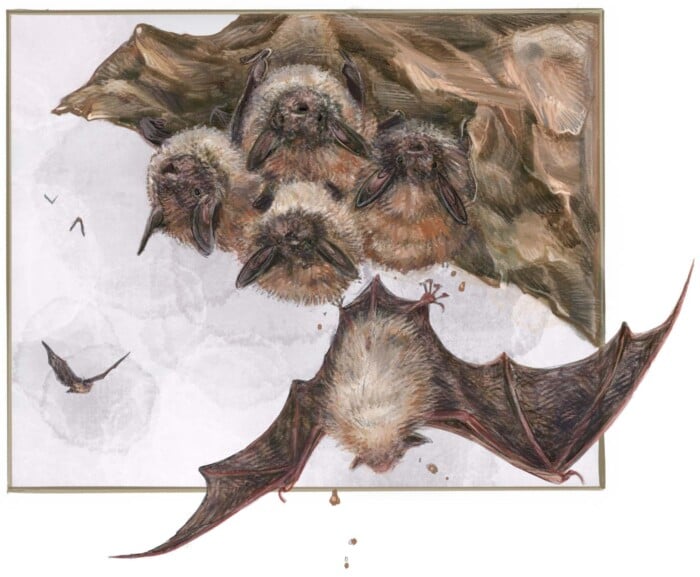
What does it look like? This 2.5-inch to 4-inch-long microbat weighs anywhere from 1/8 to ½ ounce. They look glossy brown from above and appear lighter gray below.
Where does it live in NH? They feed over wetlands and still water, navigating using streams and rivers. In the summer they roost in barns, attics and outbuildings, seeking hot spaces directly under roofs, while males might be found in tree cavities. During winter, they hibernate in clusters in caves and mines.
Fun facts: Bats use echolocation to find and eat insects like wasps, moths, mosquitoes, gnats and mayflies, keeping you more itch-free during the summer. They can live for 20-30 years.
Biggest threats: White-nose syndrome, discovered in New Hampshire in 2009, stems from a fungus that develops in the caves where bats hibernate at their preferred 40 degree temperature. During hibernation, the fungus attaches to their body and interferes with sleep This causes them to wake up more often than they should, burning up energy reserves. Some bats will then fly out of their cave to seek food and will die in the cold.
What’s being done: According to NH Fish and Game, there is currently no habitat management for the little brown bat other than educating landowners about how to manage nearby colonies.
What you can do: Consider installing a bat box, or simply leave them alone. Check out this UNH brochure on bats from Taking Action for Wildlife at extension.unh.edu/resource/bats-new-hampshire.
— Info from Sandra Houghton, wildlife diversity biologist with the Nongame and Endangered Wildlife Program, NH Fish and Game
Ringed Boghaunter
Rare, early-spring bog dragonfly

NH designation/status: Threatened; in Massachusetts, it’s a Species of Greatest Conservation Need and Threatened.
What does it look like? From the emeralds family of dragonflies, this glacial relict is about 1.2 to 1.4 inches long, with yellow-orange rings along its abdomen, transparent, colorless wings and blue-gray eyes.
Where does it live in NH? The ringed boghaunters’ range is restricted to the Northeast, from Maine to Connecticut, and southeastern New Hampshire. The dragonfly favors fens, wetlands, acidic environments and sphagnum bogs with open pools or standing water where few, if any, fish are present. They can mate and bask in the sun in the woods surrounding the bogs. It’s one of the earliest dragonflies to hatch here, appearing mainly in May, and has a short flight season.
Fun facts: The ringed boghaunter is one of the rarest dragonflies in North America, and the only dragonfly on
New Hampshire’s Threatened and Endangered Species list.
What are its biggest threats? Loss of forested uplands and wetland destruction. Other threats include insecticides and pollution; flooding from beaver activity; and water management programs that affect habitat.
What’s being done? Work continues to identify new sites the ringed boghaunter frequents. A NH Dragonfly Survey from 2007-2011 prompted its reclassification from endangered to threatened in 2017. More research is needed to narrow down its habitat needs.
What you can do: Monitor wetland and forested upland protection / preservation; send observations to NHFGreview@wildlife.nh.gov. It’s encouraged to send photographs and exact locations.
— Info from NH Audubon / Massachusetts State Wildlife Action Plan / Maine Department of Inland Fisheries and Wildlife
Saltmarsh Sparrow
Endangered saltmarsh resident facing dwindling habitat

NH designation/status: Species of Greatest Conservation Need. Not federally listed, but deemed globally endangered by the IUCN.
What does it look like? A small brown sparrow with streaks of color on its chest, orange eyebrows and mustache, rust-colored wings and a “spiky tipped tail,” it eats insects, spiders and small crustaceans inhabiting salt marshes.
What does it sound like? Gives series of tweets and little “clicks” followed by a static-y trill. “Some compare it to radio static. I like to call it alien communication,” says Grace McCulloch, community science project leader at New Hampshire Audubon.
Where does it live in NH? Saltmarsh sparrows are “habitat specialists”that only live in coastal / tidal salt marsh habitats from southern Maine to Chesapeake Bay. In NH, it’s found in the Hampton Seabrook Estuary and Great Bay salt marshes.
It lives nowhere else on earth.
Fun facts: This “flagship species,” whose success reflects the health of its habitat — coastal marsh ecosystems — weighs about eight pennies. It plans its nests around every full moon to avoid extreme high tides. According to McCulloch, saltmarsh sparrows are at risk of extinction by 2050.
Biggest threats: Loss of salt marshes where they nest; climate change; and accelerated sea-level rise. Coastal storms and extreme high tides can flood nests. Predators like crows, raccoons and deer also attack nests. Studies indicate an annual population decline in the U.S. of about 9 percent between 1998 and 2012 — about a 75 percent loss in that time period.
What’s being done: Ongoing salt marsh habitat conservation and restoration projects by various U.S. Fish and Wildlife Service agencies include ditch remediation, sediment placement and other interventions to expand high-marsh areas and build elevation to improve nesting conditions. Visit Atlantic Coast Joint Venture at www.acjv.org/ to learn more.
— Info from Grace McCulloch, NH Audubon / U.S. Fish and Wildlife Service / Atlantic Coast Joint Venture
Jesup’s Milk-vetch
Ultra-rare perennial pea plant

NH designation/status: Endangered; Federally endangered and state endangered in VT
What does it look like? It blooms in late May or early June with pale-purple to white pea-like flowers. Sometimes found competing for space with poison ivy, Japanese knotweed and black swallow-wort; springtime snowmelt and flooding can clear away these competitors and give the milk-vetch room to grow.
Where does it live in NH? It’s found in only three natural locations along the Connecticut River in NH and Vermont, growing on exposed ledges, including cracks in the rock where soil collects. One site has hundreds to thousands of plants; the others have far fewer. The U.S. Fish and Wildlife Service states that in 2018, there were about 736 natural plants.
Fun facts: The global occupied habitat of Jesup’s Milk-vetch is less than 1 acre. Only a couple other
milk-vetch species live in the eastern U.S. — this one is the rarest.
Biggest threats: It’s vulnerable to summertime flooding events. Other threats include global warming and encroachment
from invasive species like black swallow-wort.
What’s being done: NH Natural Heritage Bureau researchers are establishing new sites, collecting seeds and propagating seedlings to help the population and help prevent extinction.
What you can do: Leave it alone. It’s against the law to pick them or damage this federally protected plant.
— Info from Peter Bowman, Natural Heritage Bureau, Division of Forests and Lands in the NH Department of Natural and Cultural Resources.
To learn more and help out with these and any other species on the endangered list, visit New Hampshire’s Taking Action for Wildlife website at takingactionforwildlife.org