Live Free: Freedom on 2 Wheels
Bicycles are worth more than a revenue stream
As an avid cyclist, and a fan of New Hampshire’s backroads, I was delighted to see House Bill 1703 buried in committee, where it should die a well-deserved death. The measure would have required a $50 registration fee for all bicycles rolling along our roads, paths and trails —including out-of-state bikes.
The bill could actually discourage cycling, especially for the less affluent. And that could have terrible consequences.
The health benefits of riding a bike are well established. A study recently unveiled by the Journal of the American Medical Association, charting a half million adults over 13 years, found that those who biked regularly had a significantly lower risk of developing dementia, including Alzheimer’s disease, and an increased capacity for memory and learning.
I thought of the charity events I’ve ridden, including the Trans-NH Ride and the Mount Washington Auto Road Hillclimb, and the out-of-staters I’ve met. Should they all have to register their bikes, as this bill would require? Should we have troopers inspecting participants of the Tri-State Trek as they ride into New Hampshire from Massachusetts and Maine?
For me, cycling’s attraction runs much deeper. Bicycles have always been my wings. They represented freedom — I could travel as far as my legs could take me. I was one of six kids, and Mom had little time to play taxi driver. Growing up in New Jersey, my brothers and I rode our bikes to school, to parks, to friends’ houses. “Just be home for dinner,” was Mom’s standing orders.
When our clan arrived in Manchester in the summer of 1974, three years after cancer claimed Dad, my bike was my single most important tool in acclimating to a new reality. Mom, a Manchester native, came home to supportive parents. But her kids needed to get around. As a 16-year-old without a driver’s license, my escape was an emerald green Schwinn 10-speed.
That sturdy rig got me from my North End home to my grandparents’ place on Pickering Street. It got me to the Livingston Park, Derryfield Country Club (a bag of clubs draped on my shoulders), and soccer practices at Hillside Middle School. It got me to Charlie Mallett’s house, to Doug Zesiger’s house, to Rick Tracy’s house.
These were among my first Manchester friends, and they were undeniably a positive influence. Without my bike, my adjustment would have been far more difficult.
I also had bikes stolen, an affront that wounded me deeply because my bike was an extension of who I was. But those experiences also forced me to confront the real world.
As a student at the University of New Hampshire, I’d pedal to Manchester to see my girlfriend. (I’m not sure Mom approved of those trips.) During one early morning ride back to Durham, I got a flat. Luckily, an old Central High hockey teammate stopped to give me a lift. But I quickly learned how to patch, or replace, a punctured tube. Bikes teach self-sufficiency.
Today, my wife and I own two cars and 15 bicycles (excluding our stationary exercise bikes). We have road bikes, gravel bikes, cross-country hardtail bikes, full-suspension mountain bikes, commuter bikes and fat bikes. That would translate to a tidy $750 tab under HB 1703 (even though we can only ride one bike at a time).
Our two daughters also have bikes. A neighbor once quipped she saw our girls “riding everywhere.” I simply replied: “They don’t have a choice.” We want them to embrace their strength, and that same sense of self-assured adventure.
That’s the inherent danger of bills like HB 1703. Bikes aren’t the problem. More often, they’re the solution. Perhaps a nice spin on a bright spring day might clear things up for sponsors of this bill. It’s always worked for me.
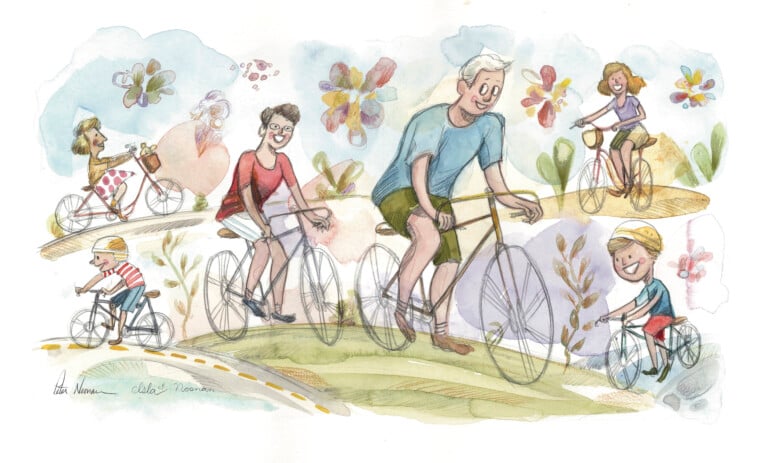
Editor’s note: The adults depicted in the illustration should be wearing helmets to practice bike safety, as one careful reader of the print edition reminded us.