WDYK: Gov. Barefoote’s Brawl
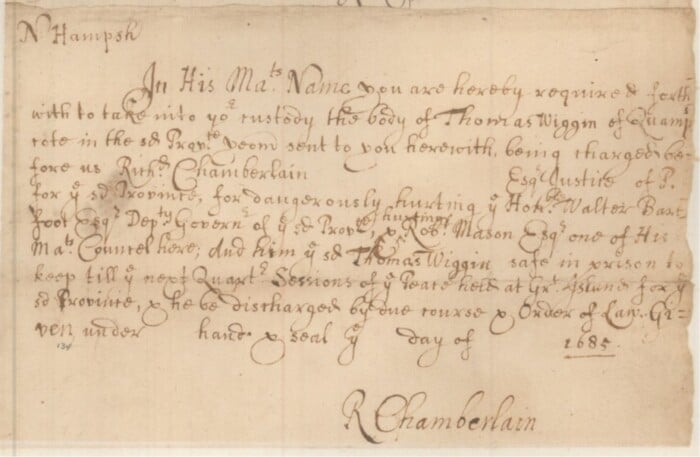
A 1685 document describes a knockdown fight between Walter Barefoote & Thomas Wiggin Jr.
I’m standing in lush, green, knee-high poison ivy and suspect I am going to regret it in a day or two. I’m at a small opening in the woods not far from the shore of New Hampshire’s Great Bay. In the center of this clearing is a large boulder engraved, “Gov. Thomas Wiggin 1633-1667.”
The dates presumably indicate the years he served as governor. But I suspect a “typo” in the inscription because Wiggin served as governor from 1633 to 1637, not “1667” as it reads on the rock. Historical records also reveal Gov. Wiggin was born about 1601 and died in 1666, so if the engraving on the rock is correct … then he continued to serve as governor for a year after he died.
Arguably, Wiggin was the first governor of New Hampshire, but there is room for debate depending on whether you count provincial governors who were chosen by the proprietors or the king of England.
Wiggin was the first governor of the Upper Plantation of Piscataway, an early settlement colony that today would include Dover, Durham, Stratham, Newmarket and parts of Greenland and Newington.
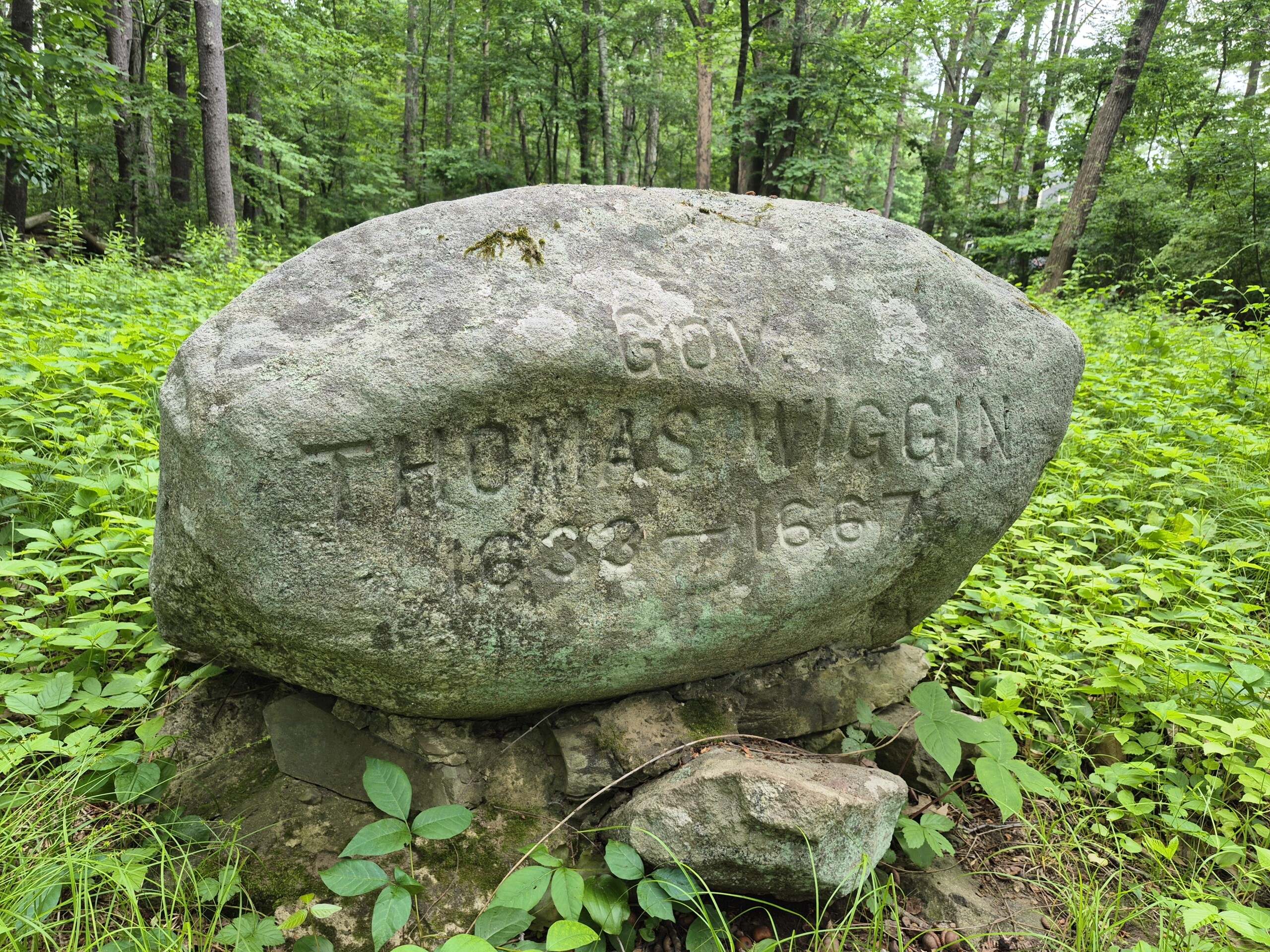
Gov. Thomas Wiggin served as governor from 1633 to 1637 — not 1667 as this marker suggests.
But I’m not here looking for the final resting place of Gov. Wiggin. I’m looking for the grave of Walter Barefoote, another provincial governor. Barefoote’s final resting place is rumored to also be here in this small clearing. But unlike Wiggin’s grand boulder, Barefoote’s headstone is said to be a small upright fieldstone with no inscription.
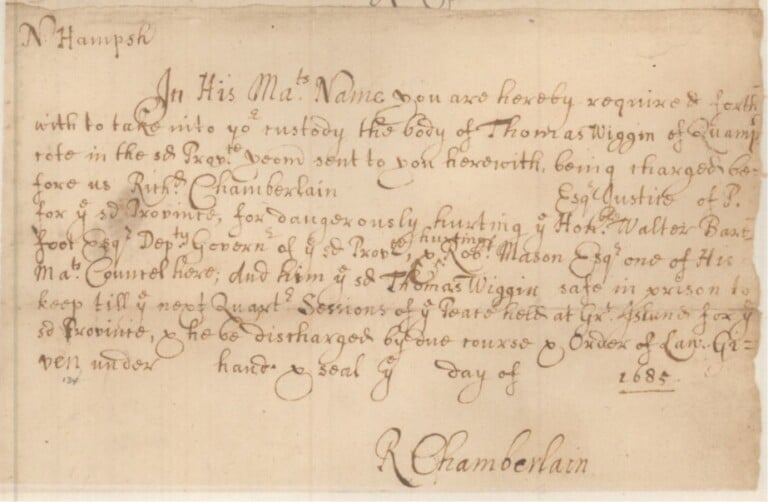
My interest in Barefoote was piqued when I discovered a 1685 document describing a knockdown bareknuckle brawl between Barefoote and Thomas Wiggin Jr., son of Gov. Wiggin, buried beneath this large boulder. The old document contains sworn affidavits and reads like a tag-team wrestling match. It also names the two other combatants. Aligning with Barefoote is Robert Mason, and backing up Thomas Wiggin Jr., is Anthony Nutter.
In December, 1685, Thomas Wiggin Jr., one of the richest men in the colony, along with Anthony Nutter, called on Barefoote and Mason to dispute debts owed and protest conflicting land claims.
The brawl that followed is described in an oath sworn by Barefoote:
≈I, Walter Barefoote, Esq., Deputy Governor of the Province of New-Hampshire, do make oath that upon the 30th of December last, Thomas Wiggin and Anthony Nutter, yeoman, being at my house, Wiggin did give Robert Mason, Esq., proprietor of the Province, very provoking language, so that Mr. Mason bid him several times to go out of the house, and I did also intreat the said
Wiggin to be gone, fearing some mischief might also ensue; telling him that Mr., Mason had the use of the house during his stay in the country, and the servants were his; but Wiggin would not go out, being encouraged to stay by the said Nutter, who did bid Wiggin not to go, but to stay. Then Mr. Mason opened the door, and took Thomas Wiggin by the arm, bidding him be gone, for that he should not stay there.
Thereupon Thomas Wiggin laid hands upon Mr. Mason, and threw him upon the fire, and by force kept him down, so that I had great difficulty to pluck him off; and I do verily believe Mr. Mason had been murdered had it not been for me. And Thomas Wiggin did also assault me, and threw me into the same fire, and fell upon me, so
that two of my ribs were broken, and one of my teeth came out.
Walter Barefoote.
Taken upon oath the 8th of March, 1686.≈
Additional details are provided by Prudence Gatch, a maid servant of Robert Mason, who was present at the time. Her testimony reveals Mason’s clothes, wig and foot were badly “scorched.” She testified that Barefoote intervened, attempting to rescue Mason, but Wiggin then threw Barefoote into the fireplace; Mason called out for her to “fetch his sword,” which she did.
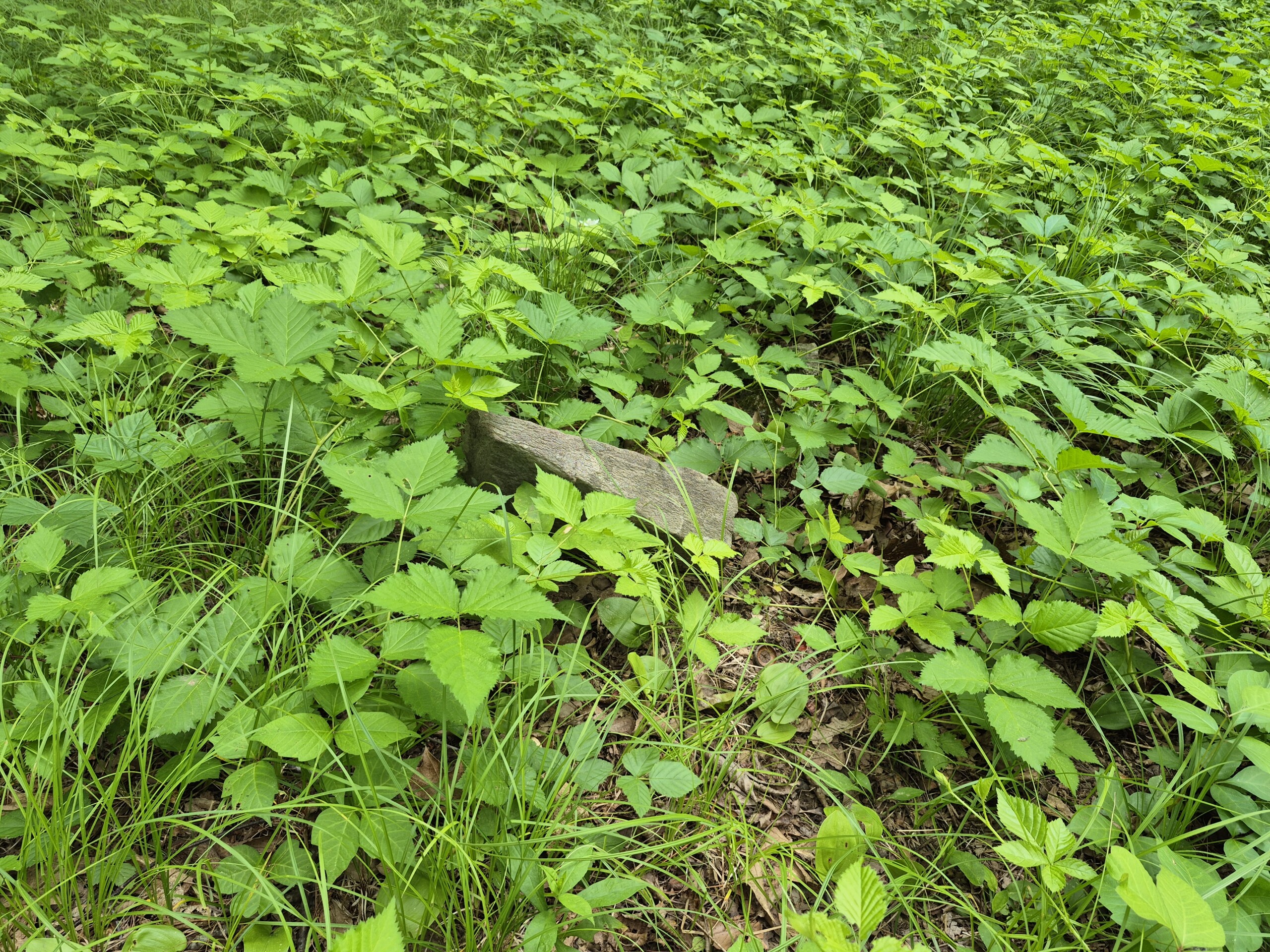
Could this small upright stone mark the grave of Walter Barefoote, the deputy governor and acting governor of the NH Province from 1685 to 1686?
But when she gave it to Mason, Nutter, the biggest man in the group, took it away from him and strode around the room laughing, apparently amused at seeing Barefoote and Mason being soundly thumped by Wiggin despite the 2-on-1 odds. The maid then ran from the house screaming of “the murder of her master” which brought neighbors running and ended the fight.
Both Thomas Wiggin Jr. and Anthony Nutter were prosecuted for assault in “high contempt” of royal authority. Wiggin was found guilty, and both he and Nutter were ordered to “behave as gentlemen” and put on probation, which included posting bonds of 500 pounds each. Although Barefoote and Mason prevailed in court, Wiggin and Nutter won the sentiment of the colony, which already disliked Gov. Barefoote and refuted the land claims alleged by Mason. The Barefoote administration became the laughingstock of the settlement and ended in May 1686.
Friction had previously existed between Mason and Wiggin over the competing land claims and debts from disputed tenant rents. Animosity also existed between Barefoote and the Wiggin family. In an earlier lawsuit alleging unpaid sawmill debts, Barefoote sued Andrew Wiggin, brother of combatant Thomas Wiggin Jr. During that lawsuit, in open court, Andrew Wiggin approached Barefoote under the pretense of reconciling with him … but instead bit him in the face.
Since Gov. Barefoote and the Wiggin family violently disliked each other, you might wonder how they came to be buried together in this family cemetery? The answer is that Gov. Barefoote’s sister, Sarah, was also the wife of Thomas Wiggin Jr. So, while the brothers-in-law hated each other to the point of physical altercations, Sarah (Barefoote) Wiggin is rumored to have been able to persuade her husband to allow her brother to be buried in the very back of the family cemetery, albeit in an almost unmarked grave.
Perhaps that rumor isn’t true, and the brawling Gov. Barefoote is buried somewhere else, in a grave unknown to historical record. We may never know for certain, but I am certain I’m now going home and shedding these poison-ivy-covered clothes.