Running Down a Dream
Derry duo each face cancer and complete their 25th Boston Marathon within the same year
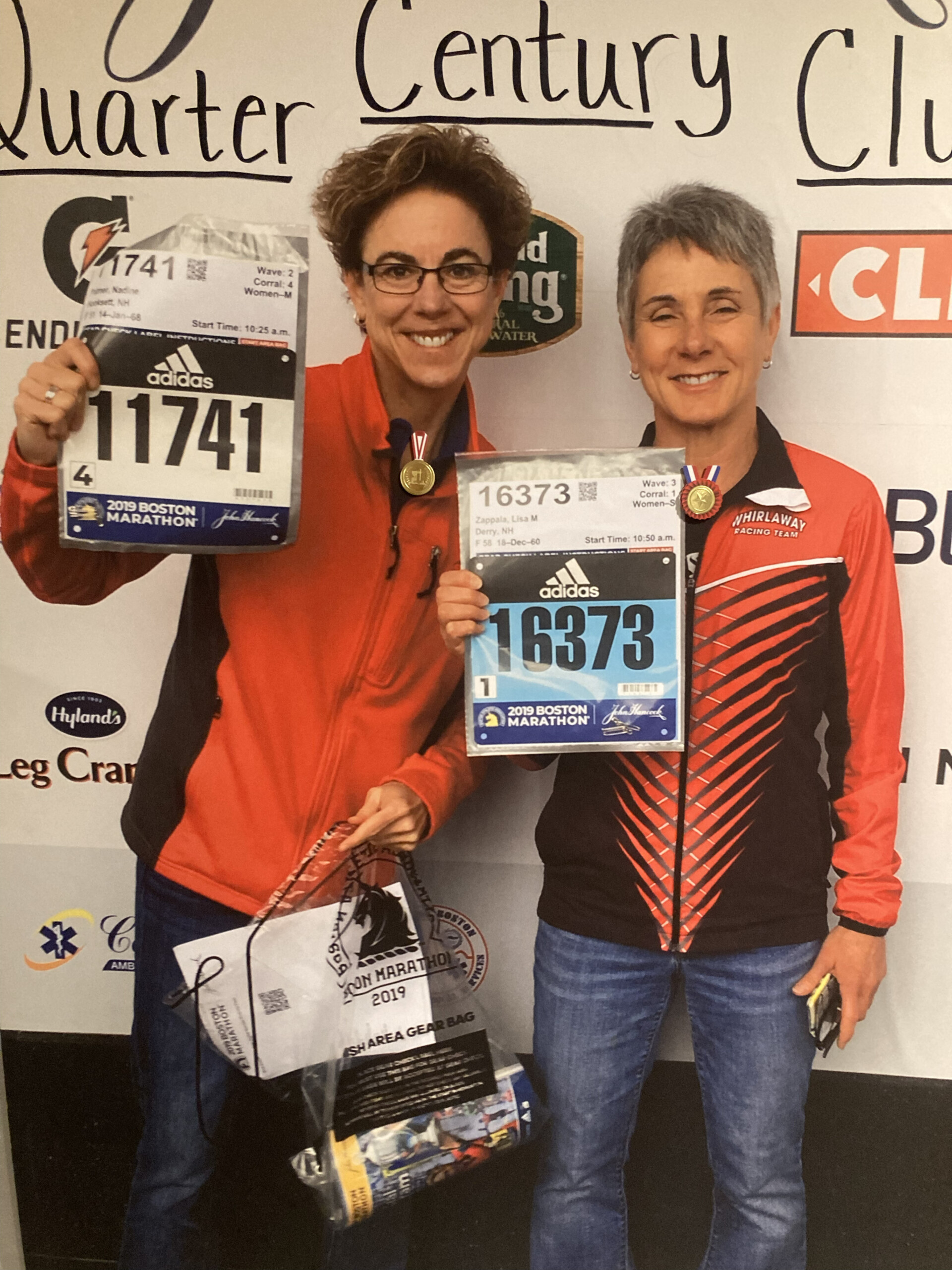
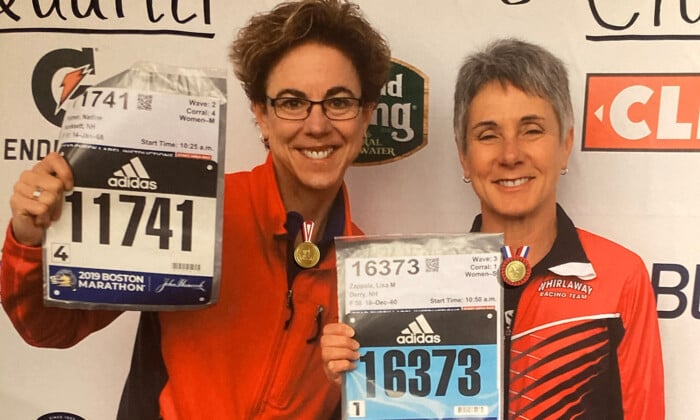
Nadine Palmer, left, and Lisa Zappala celebrate completing the Boston Marathon in 2019.
Even more impressive than running the Boston Marathon, the world’s oldest annual marathon and one of the most notoriously challenging 26.2-mile courses in the country, are the stories that bring these athletes to the starting line and carry them through to the end.
This past April, two Granite Staters, Lisa Zappala, 65, and Nadine Palmer, 58, of Derry, each ran their 25th consecutive Boston Marathon — ushering them into the exclusive and honorary Quarter Century Club, a small list with an even smaller percentage of female athletes.
And they both did it within the same year of receiving lung cancer diagnoses.
Roommates, running partners and teammates on the competitive Whirlaway Racing Team of Methuen, Mass., Zappala and Palmer have long since established themselves in the New England running scene. Not only have they both qualified for the race time and time again, but they have also been key players on championship teams that won Master’s titles, a division for athletes 40 and up.
“We’ve done it through thick and thin,” Palmer said. “I’ve been injured. I’ve been sick. But looking back 25 years, I’ve done the work.”
Palmer’s journey started in 2025. She’d been very ill since January of that year, but still ran her 24th Boston Marathon in the spring. When her condition wasn’t improving, she finally went in for a chest X-ray. After a few more tests, it was confirmed: lung cancer. Never a smoker or one who worked in a carcinogenic environment, both women were stunned about the outcome.
And so, Zappala took to the internet for answers. What she learned was high levels of radon, a naturally occurring radioactive gas, is the number one cause of lung cancer among non-smokers in the U.S., and that potential exposure to radon in New Hampshire is greater than the national average, as it emanates from granite bedrock and seeps into homes through cracks in old foundations.
With a workout room in the basement, where both women spent a substantial amount of time training, Zappala decided she had to test for radon. The results showed levels four times higher than the acceptable limit.
“My first reaction was that my house made her have cancer,” Zappala said. “I felt awful.”
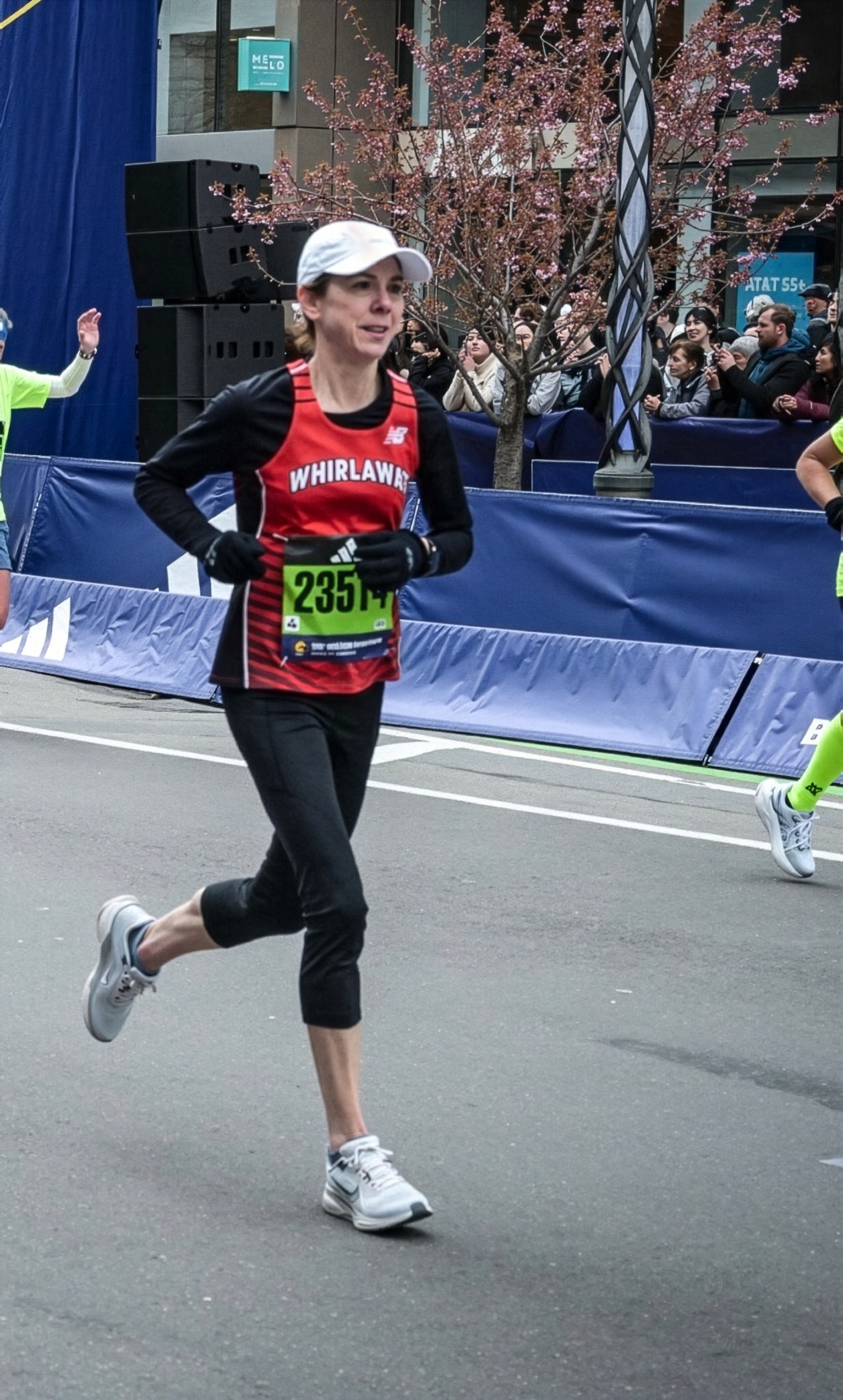
Nadine Palmer (above) and Lisa Zappala each ran their 25th consecutive Boston Marathon in April.
Shortly after, Palmer had her first surgery, and when Zappala went in for a physical later that year, sharing of her friend’s diagnosis and her discoveries of radon levels in her home of 28 years, her doctor ordered a chest X-ray right away.
“If Nadine hadn’t been diagnosed, I would have never known because I had no symptoms at all,” Zappala said.
After the diagnosis, Zappala installed a mitigation system (radon levels in her home now measure below the average limit) and informed others in her cul-de-sac neighborhood of this knowledge. Many reported similarly high levels, and most were totally unaware of the threat of radon poisoning.
“I just hope that if anything comes out of this, I really would like the state of New Hampshire to do a better job getting the message out about radon,” Zappala said. “There should be a public service announcement or social media posting every now and then. Because with a mitigation system, it is manageable.”
Within that year, Zappala and Palmer both had surgery (Palmer, her second), requiring the partial removal of a lung. Before, however, both women asked if they could postpone their surgeries until after the marathon. As one might expect,

Lisa Zappala
the doctors looked at them like they were crazy. Absolutely not, they said.
But they were determined.
Knowing that there wouldn’t be much time between her surgery and race day, Palmer started training early, completing her long runs months before in hopes she’d be able to recover within five weeks to reach the starting line for the 130th Boston Marathon.
“We were able to run; that was the good news,” Palmer said. “We were both able to run.”
Palmer continued her training during her stay at Dartmouth Hitchcock Medical Center. As soon as she could start walking again, she asked the staff how many laps around the nurses’ station would equal one mile – about 60. And so, through a fever, chest pain, withdrawal symptoms from pain medication, and other complications, Palmer kept up her training, completing 34 laps at the hospital every single day of her stay.
Five weeks after her release, she ran the Boston Marathon. In a qualifying time for her age, too, crossing the finish line in under four hours.
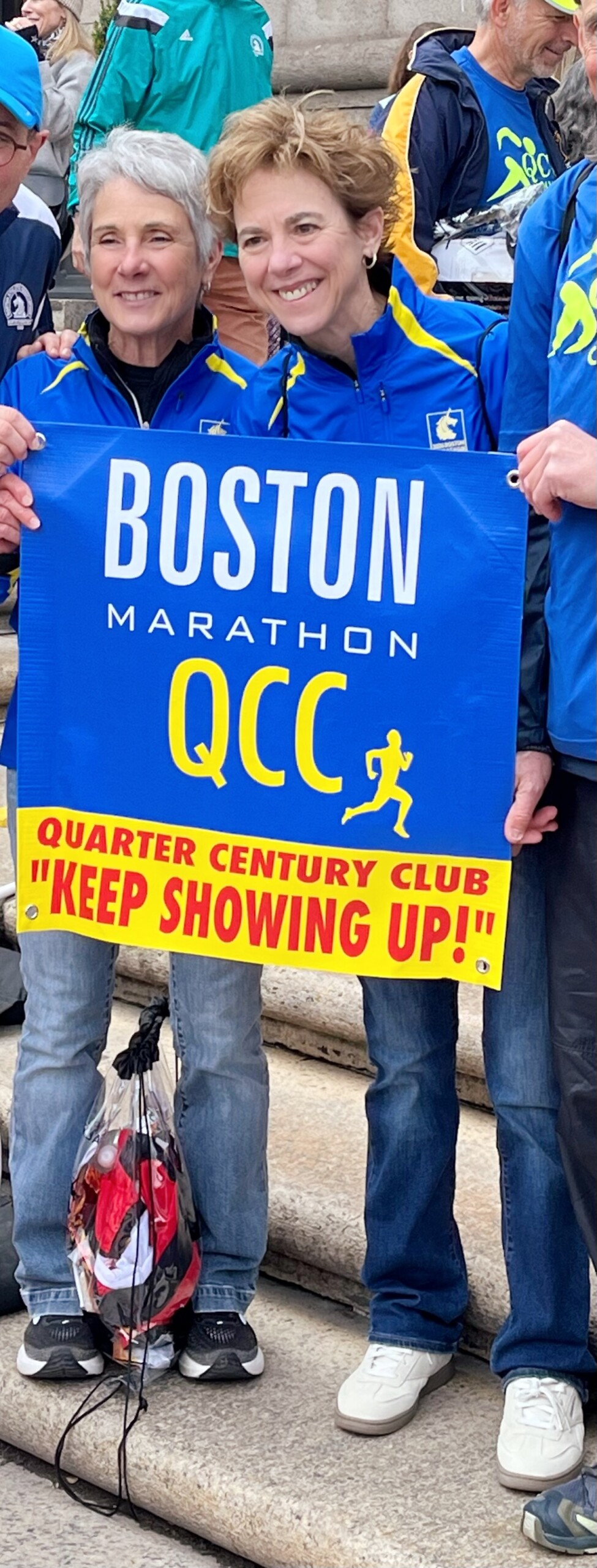
Zappala and Palmer celebrate joining the coveted Quarter-Century Club.
One of the perks of the Quarter Century Club is that, once a member, those runners no longer have to qualify for the race, and rightly so. With that in mind, Zappala knew she wanted to simply enjoy the experience. Instead of a heads-down type of race, she slapped hands with young kids on the sideline, stopped to say hello to bystanders who had come to support her, and read the humorous and inspirational signs as she passed by Wellesley College, known as the legendary “Scream Tunnel.”
“It was a very special one for me this year because I truly took it all in with all those people out there for me,” Zappala said.
Although she fears her competitive racing days may be behind her, Zappala’s grateful she can still get out there. “I love pushing my body. I love competing with myself to see how I can improve. I love the camaraderie of being part of a team,” she said. “And what I feel too about running is that anybody can run. I truly believe that.”
Zappala started running at the age of 33 after her father died. What started as a therapeutic walk/jog combination turned into an addictive passion for racing. A college athlete, Palmer needed a cheap way to stay in shape once she graduated, so she bought a pair of sneakers and hit the pavement. It wasn’t long before they recognized one another on the road, became friends, and left their mark on the scene in extraordinary ways.
Palmer and Zappala, however, were quick to note that their stories aren’t unique. Tens of thousands of runners line up each year with their own trials and tribulations, motivating them to cross that finish line. In fact, they added, two of their Whirlaway teammates, Christin Doneski and Cindy Scully, were also diagnosed with cancer that same year. All four of them ran the Boston Marathon.
Regardless, their tenacity, their resilience, their hope, is no less inspiring.
In the end, it was running, they said, that helped them through. “We’ve run all these marathons. We can certainly get through this cancer diagnosis,” Zappala said, crediting Doneski. “And beat it, too.”