Portsmouth remembers Ona Judge Staines
Mural installation celebrates a woman who escaped enslavement by George Washington

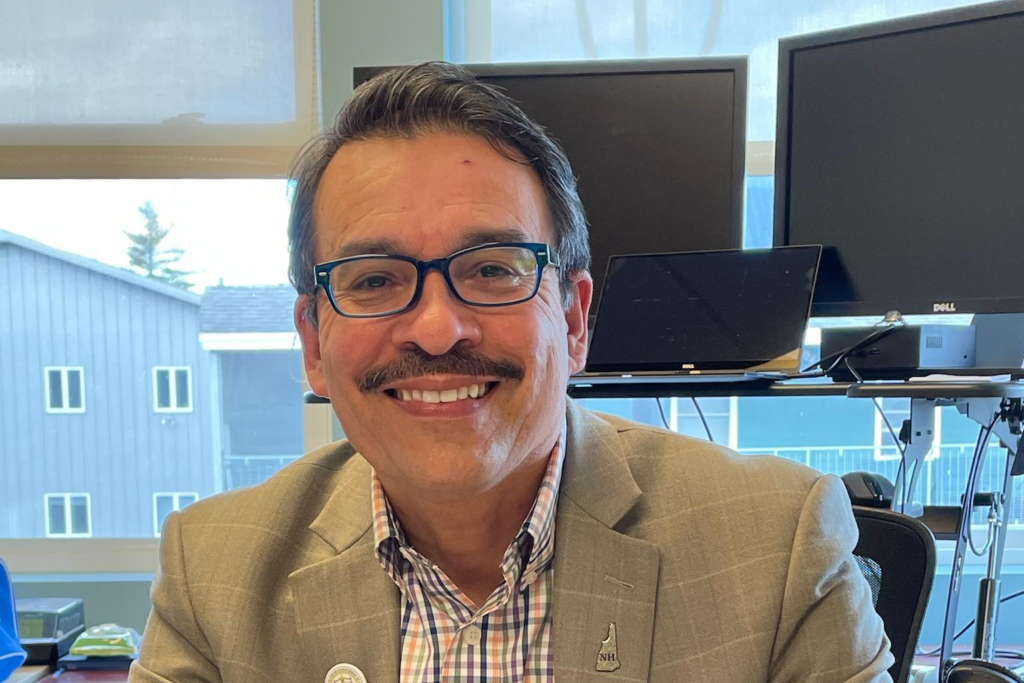
Manuel Ramirez, artist behind the Ona Judge mural, speaks at the unveiling ceremony.
While many were celebrating the ideals the country was founded on this summer, others were offering more context of the ways those ideals fell short of reality.
The Black Heritage Trail of New Hampshire drew an estimated crowd of 500 for the unveiling of a mural of Ona Judge Staines on the side of its Court Street headquarters.
On May 21, 1796, George Washington and his family sat down for dinner at the President’s House in Philadelphia, enjoying one of their last meals in the city before returning to Mount Vernon for the summer. As the Washingtons dined, an enslaved woman named Ona Judge made her escape, slipping out of the mansion to freedom.
After Judge fled, she made her way north, securing passage on a ship bound for Portsmouth, New Hampshire.
“Ona walked these streets over 200 years ago,” said mural creator Manuel Ramirez of Positive Street Art, based in Nashua.
“I am thankful to honor a person like her,” he said. “It was very emotional for me trying to get into her footsteps and to imagine how she would like to be portrayed.”
He depicted the woman who escaped to Portsmouth against the backdrop of the city’s waterfront as it would have looked in 1796 when she arrived.
“As we unveil this mural, we unveil memory, we unveil history, we unveil the truth,” JerriAnne Boggis, the executive director of the nonprofit, said at the unveiling ceremony. “We unveil the courage of a young woman who chose freedom despite all the odds. This mural ensures that Ona’s story will no longer remain hidden.”
Jazlynn (Jazzy) Mota, a spoken-word artist, led the hourlong ceremony by reading a poem she wrote titled, “We Gotta Learn.”
“My poem was inspired by Adrienne Rich’s poem ‘From an Old House in America,’” Mota said. “Rich’s poem explores the long history of struggle and survival in America, focusing on how the past is connected to stories of pain and courage. It shows how the experiences of women, including their trauma and resilience, are often overlooked or misunderstood. Inspired by this, my poem, ‘We Gotta Learn,’ honors that history and the strength it represents.”
Mota said another huge inspiration for her poem was the story of Ona Judge.
“Ona Judge’s story reminds us how important it is to truly understand the hardships Black Americans — especially Black American women — faced in their fight for liberty and freedom,” she said.
Gene Martin, board president of the BHTNH, gave some background on the history of Judge, who lived in Portsmouth and in the neighboring town of Greenland, where she married a free Black sailor named Jack Staines, raised children and lived the rest of her life as a free person.
“Today we erase that silence,” Martin said. “This moment belongs to Portsmouth, to the USA, to the nation.”
The ceremony included remarks by representatives of the city and elected officials. Brendan Narcia, a descendant of another Black person enslaved at Mount Vernon, also spoke.

Black Heritage Trail of NH representatives JerriAnne Boggis (left), executive director, and Irja Cilluffo, co-founder, unveil the mural of Ona Judge Staines in Portsmouth
Portsmouth Mayor Deaglan McEachern said that, although he grew up in the city, he had never heard of Ona Judge until he went to college.
“Someone, somewhere far away, told me of her courage and about this city’s place in her story. This is why this mural matters,” McEachern said. “This place and this mural make hidden history visible. They tell everyone who passes that Black history is not separate from Portsmouth history or from American history. It is central to both.”
Michael Coard, founder of the Avenging the Ancestors Coalition and a Philadelphia civil rights attorney, asked for nine seconds of silence to honor Ona’s legacy.
In Western cultures, listeners typically feel the urge to fill conversational gaps after just three to four seconds. When a pause stretches to nine seconds, it often signals an “awkward silence,” a sudden shift to a heavy atmosphere, or an indication that a delicate topic requires processing.
 “Everything was great until it wasn’t,” Coard said. “The guy in the White House shut down a site that had 34 panels (depicting slavery). But the guy in the White House did one good thing: He brought us all together here today.”
The mural unveiling comes as the Trump administration has made aggressive attempts to strip discussions of slavery, race and systemic oppression from federal sites and institutions, including exhibits connected to Ona Judge at the Philadelphia President’s House site.
In Portsmouth, Judge found lodging and employment as a domestic laborer. Compared with her duties as a lady’s maid, this work would have been much more demanding.
Following the unveiling, a reception was held at Strawbery Banke Museum, where Erica Armstrong Dunbar, a nationally recognized historian and author of “Never Caught: The Washingtons’ Relentless Pursuit of Their Runaway Slave, Ona Judge,” was the keynote speaker.
As Dunbar writes in “Never Caught,” “that Judge elected to become a domestic, that she chose to endure physically punishing work in New Hampshire, rather than remain a slave, says everything we need to know about how much she valued freedom.”
“The unveiling of the Ona Judge mural was nothing short of extraordinary,” Boggis said. “It was powerful, emotional and simply beautiful. More importantly was the overwhelming sense of community and purpose that filled Portsmouth. I mean, did you hear that extended applause?”