Accessing health care for all
Mobile health care an option for more communities

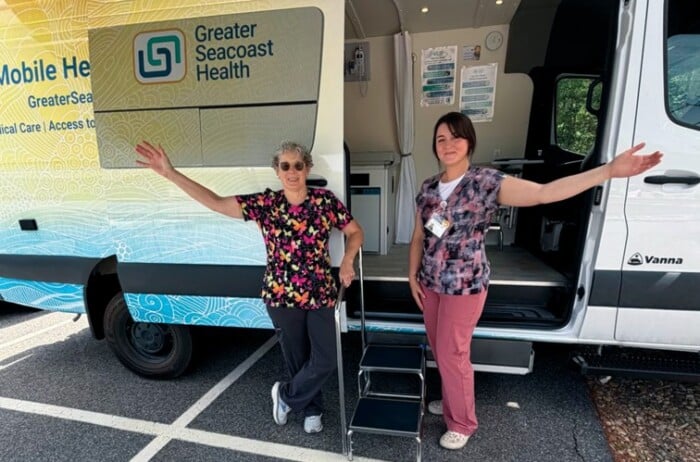
Nurse practitioner Dayle Sharp, left, and medical assistant Lauren Bernier welcome patients to Greater Seacoast Health’s new mobile health van. (Courtesy of GSH)
Imagine moving to a new city or town, maybe not having reliable transportation, needing non-urgent health services and you don’t know where to begin. Health care can also be especially hard to obtain if you are experiencing homelessness, don’t have stable housing or don’t have money.
Mobile health care in New Hampshire includes mobile medical vans that bring primary and urgent care directly to specified locations or communities.
Greater Seacoast Health’s Mobile Health Clinic
Families First, based in Portsmouth, was a pioneering organization for mobile health care in the Seacoast region. Using federal grants secured to help the local homeless population, the organization launched its innovative Mobile Health Services in 2002, offering easy-to-access medical and social work services at convenient places like shelters, soup kitchens and community organizations in the Seacoast region.
Families First operated two vans, and in 2018 it merged with Goodwin Community Health, based in Somersworth, expanding its outreach. The merger is now named Greater Seacoast Health with locations in Portsmouth and Somersworth.
“When the two organizations merged, there were two vans that serviced the Seacoast community, not one designated per site though,” said Luke Mason, BSN, RN, the Mobile Health program director.
“These vans have provided us with so much opportunity, but it was time to retire them and purchase a new van. The two now-retired vans required drivers with a Commercial Driver’s License to drive. The new smaller van does not require a CDL, is driven by staff members, and by removing the license requirement, increased our availability within our communities.”
Last year, the mobile health clinic provided services to nearly 600 patients.
“In most instances, our van sees and establishes patients, and is their first access point into our clinics,” Mason said. “As we meet these patients’ immediate needs, we develop a care plan that often connects them with our health centers so they can meet with social workers, insurance specialists and more. It’s a bridge between our direct community and providing them access to the tools our organization offers to meet their optimal health goals.”
With the new van, communities from Seabrook to Wakefield will be able to access health care.
“Increasing access to our community is offering a chance for all people to partake in holistic health care regardless of who they are, where they come from, their circumstances, etc. Our goal is to provide an opportunity to help address anyone and everyone’s individual social determinants of health care needs.”
Reasons for using the van can range from having a temporary or transitional living situation, being unsheltered, to being a seasonal worker or to being anxious in traditional medical settings.
Appointments aren’t required, and those needing health services can check out the van’s schedule online at greaterseacoasthealth.org.
“Many think health only pertains to their physical health, but we humans are so much more than that,” Mason said. “We are like a windchime. When one piece of the chime rings, it often makes another chime. In short, our health needs are all interdependent, and here at Greater Seacoast Health, we provide care for all care needs for all people, with this belief —what better way to offer this type of care where people need it most, where they currently are.”
The services offered by the mobile health clinic include preventive health screenings, sick visits, chronic disease management, access to medications, help in applying for housing and food assistance, disability benefits, Medicare, Medicaid, other health insurance, veterans benefits and more.
It also helps with referrals to dental care, substance abuse and mental health counseling at its health centers, referrals to family support and parent education at its Family Center, and referrals to specialty care, labs and diagnostic testing.
Mason said there is a high demographic of patients seeking help to quit smoking or needing some rehabilitation help.
The van drivers are medical assistants with a per diem nurse practitioner or, at some sites, a medical doctor to see patients. The van is handicap accessible, and the restroom situation is assessed when establishing partnerships with a site such as a fire station, food pantry or library. The van is available at each location in three-to-four-hour blocks.
Mason recalled a woman who came to the mobile health van in Portsmouth.
“She was living in a homeless shelter with her husband and one child,” he said. “She had an addiction problem, and we established primary care for her. She became pregnant and had access to the clinic’s prenatal care program.”
The woman anonymously made a statement about the mobile health van:
“The mobile health van was there when I needed it most. It opened a door I didn’t think existed for me. I was offered so many different kinds of support — not just medical care but help creating a plan that actually worked for me, my life and my situation. What I liked most was that there was no judgment. They treated me like a human being, not just a set of problems. That one visit made me feel seen and respected, and it gave me the ability and direction I needed to keep going. It’s the reason I’m where I am today.”
St. Joseph Hospital’s Mobile Health Clinic

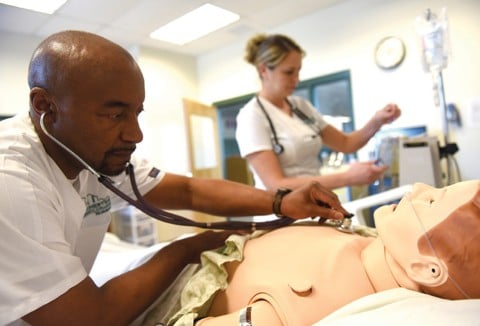
St. Joseph Hospital’s Mobile Health Clinic provides services in Nashua and surrounding communities. (Courtesy photo)
Health care is most effective when it meets people where they are.
Every week, the St. Joseph Hospital Mobile Health Clinic brings medical care directly into neighborhoods across Greater Nashua, serving individuals and families who might otherwise face barriers to accessing health care. Since launching in 2021, the clinic has become a trusted health care resource, providing compassionate, high-quality care where it is needed most.
The Mobile Health Clinic serves Nashua and the surrounding communities of Amherst, Brookline, Hollis, Hudson, Litchfield, Mason, Merrimack, Milford and Mont Vernon. Through regularly scheduled community stops and partnerships with local organizations, the clinic delivers care in locations that are convenient and accessible for patients.
“Consistency is key,” said Rosemary Ford, system director of interpreter services and the mobile health clinic.
“Many individuals rely on knowing exactly where and when the clinic will be available, making it easier to seek care without the transportation, scheduling or logistical challenges that often prevent people from visiting a traditional medical office.”
The clinic posts its schedule at stjosephhospital.com/mobile-health-clinic.
The clinic also works closely with community partners to respond to emerging needs. During the winter months, for example, the team partners with Nashua Public Health to provide health care services at the Nashua Warming Station, ensuring vulnerable community members have access to care during the coldest time of the year.
One of the Mobile Health Clinic’s greatest strengths is its accessibility. No appointment is necessary, and walk-in, non-urgent care is available to anyone who needs it. The clinic is fully ADA-accessible and equipped with a wheelchair lift, ensuring individuals with mobility challenges can comfort-ably access services.
The mobile clinic is fully integrated into St. Joseph Hospital’s electronic medical record system. Every patient is registered and receives a medical record that allows for coordinated care, continuity of treatment and seamless follow-up throughout the health system.
“Most importantly, everyone is welcome,” Ford said. “Patients are cared for regardless of insurance status or ability to pay. For individuals who are uninsured or underinsured, staff members assist with free-care applications and help connect patients with available resources. No one is turned away because of financial circumstances.”
The impact of the Mobile Health Clinic continues to grow. In 2025 alone, the clinic provided care to more than 1,500 patients and experienced an 81% increase in registered patient visits. Those numbers reflect more than growing demand; they reflect the trust that has been built within the community.

On the Greater Seacoast Health’s first day in its new van at Gather in Portsmouth, medical assistant Lauren Bernier, right, chats with WIC Program Manager Camie Wade.
Not every interaction begins with a medical concern. Sometimes health care starts with a simple conversation, a blood pressure screening, or an opportunity to step inside the clinic and meet the team. The Mobile Health Clinic places a strong emphasis on outreach, relationship-building and education. For individuals who may have experienced barriers to care in the past, building trust is often the first and most important step.
The team also distributes essential items such as water, snacks, hygiene products, seasonal clothing and socks to individuals in need. These small acts of kindness often open the door to larger conversations about health, wellness and available community resources.
“The clinic truly functions as a doctor’s office on wheels, featuring two examination rooms and a patient registration area,” Ford said. “Patients commonly visit for sick visits, wound care, chronic disease monitoring, preventive screenings and point-of-care testing.”
Services include blood glucose testing, respiratory illness testing, pregnancy testing, HIV screening, vaccinations, medication management and health education. Providers can also prescribe medications and coordinate follow-up care when needed.
While the ultimate goal is to connect patients with a primary care provider, the Mobile Health Clinic often serves as a vital health care lifeline for individuals facing transportation challenges, housing instability, financial hardship or other socioeconomic barriers. By bringing care directly into neighborhoods, the clinic helps ensure that health care remains within reach for everyone.
A key component of the clinic’s mission is ensuring meaningful access to care for individuals from diverse back-grounds. Through on-demand audio and video interpreter services available in more than 240 languages, patients can communicate with qualified medical interpreters in real time. This allows individuals and families with limited English proficiency to actively participate in health care decisions and better understand their treatment options.
“The Mobile Health Clinic is equally committed to providing culturally responsive care,” Ford said. “Team members recognize that effective health care extends beyond language alone. By understanding and respecting the cultural backgrounds, health beliefs and lived experiences of the people they serve, providers can deliver care that is more personalized, effective and meaningful. This approach is especially important when working with underserved populations, including immigrant, refugee, Black, Latino and other diverse communities throughout the region.”
The clinic does not currently provide dental services but works closely with community partners to connect patients with organizations that can provide dental care and related support. Donor contributions, grant funding and collaborative relationships help sustain and expand the clinic’s services, allowing the team to bring health care where it is needed most.
“Every day, the Mobile Health Clinic demonstrates what health care can look like when it is accessible, compassionate and community-centered,” Ford said.