Born from Fire, Built to Play
Bretwood Golf Course in Keene, a family-owned business spread across nearly 300 acres, is the state’s only 36-hole facility
It was 5:05 a.m.
Matt Barrett, then 16, was awakened by a loud cry of “Fire!” The ceiling above his bed glowed orange.
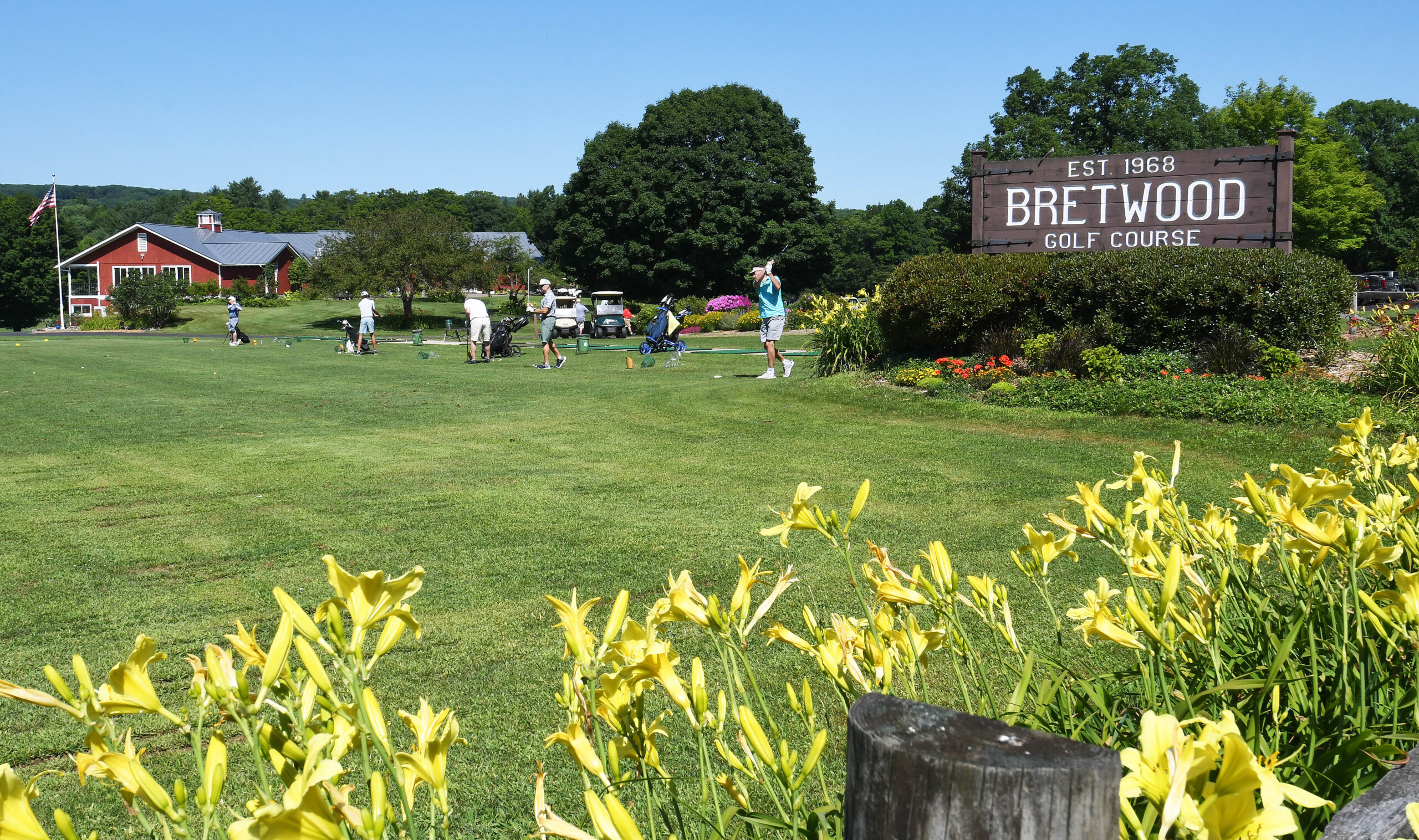
Golfers practice at the driving range.
Barrett sprang, grabbed a pair of dungarees from a wall hook in his room on the second floor of a large two-story, two-family brick colonial. Shirtless and shoeless, Barrett dashed through one of his sister’s bedrooms, past the room where his parents slept, down a staircase and outside.
The home was not burning, but the family dairy farm just yards away on the other side of East Surry Road was intensely ablaze.
The loud cry came from Matt’s father, Ellis Barrett.
“I remember peeling out of the house, my brother Billy and I running together,” Matt says. “Fire was shooting from the front of the barn’s main entrance. We jumped off a stone wall and ran into the barnyard where we normally let the cows out.”
Matt is the lone surviving member of four Barrett family members who went into the fire that Monday morning, June 22, 1967. It was, otherwise, a routine summer day in Keene, the Elm City; the weather was cool with a gentle southerly breeze.
In a brief but tense, adrenaline-fueled burst, Matt and Bill Barrett, their uncle, Tobey Barrett, and their father saved all of the farm’s more than 90 heads of cattle — milking cows, young stock and a handful of steers — marshaling them to safety in a pasture across the street beside the large family home.
Matt’s reflections are evocative, still vivid, sometimes emotional, down to each lost tree, maybe a butternut or a meaningful maple; to the community that came to the aid of the Barrett families that fateful day; to just “how hot” his bare feet got, which he didn’t realize in the midst of the frenetic rescue.
Yes, this is a story about a farm fire 59 years ago, a fire that gave rise to a showcase public golf course that bears the same name as the farm, Bretwood, that is run by members of the same two Barrett families.
The course features 36 pristine holes, or two championship-caliber layouts; hosts roughly 50,000 rounds each year; and touts more than 400 members.
Bretwood the golf course has hosted the prestigious NH Open 19 times, eight more than any other course, and the State Amateur twice.
This is also a story about rural traditions, remarkable patriarchs and matriarchs, passionate families, land and community stewardship and Yankee ideals that still ripple across this idyllic and historic 299-acre property.
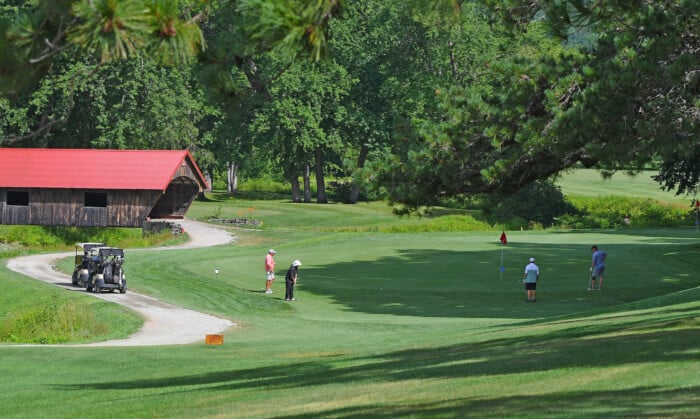
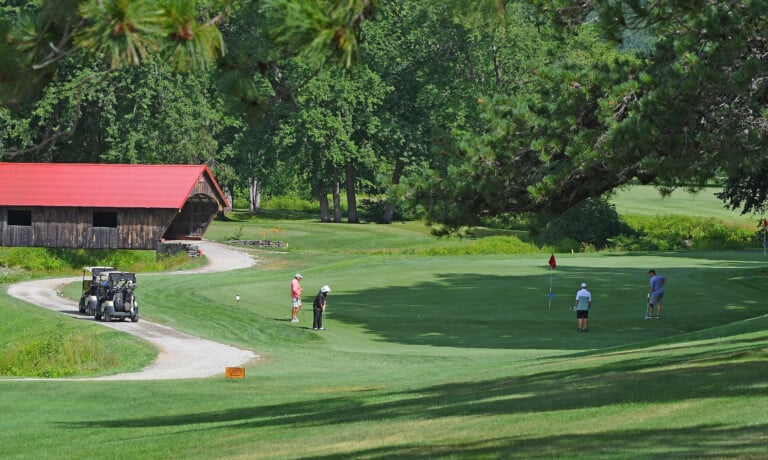
Golfers play on one the 36 holes at the Bretwood Golf Course in Keene.
It was later determined that spontaneous combustion in a hay mound in the main barn caused the Bretwood fire.
Setting the cows free was anything but routine. Matt raced to the north side of the main barn, where embers from burning hay, grain and sawdust were falling. Bill raced to the opposite end, a newer section of the barn.
The cows were secured by stanchions, spring-loaded headgates that secure the animals for milking. The stanchions didn’t always unlock easily, but the “energy was running,” Matt says, “and we went down the row as fast as we could and didn’t miss a beat. Everyone, first try … boom, boom, boom.”
Used to being let out for feeding, most of the milking cows, once freed, moved quickly to escape, Matt says. More frightened ones pulled against him, he says. “They knew the place was in trouble.”
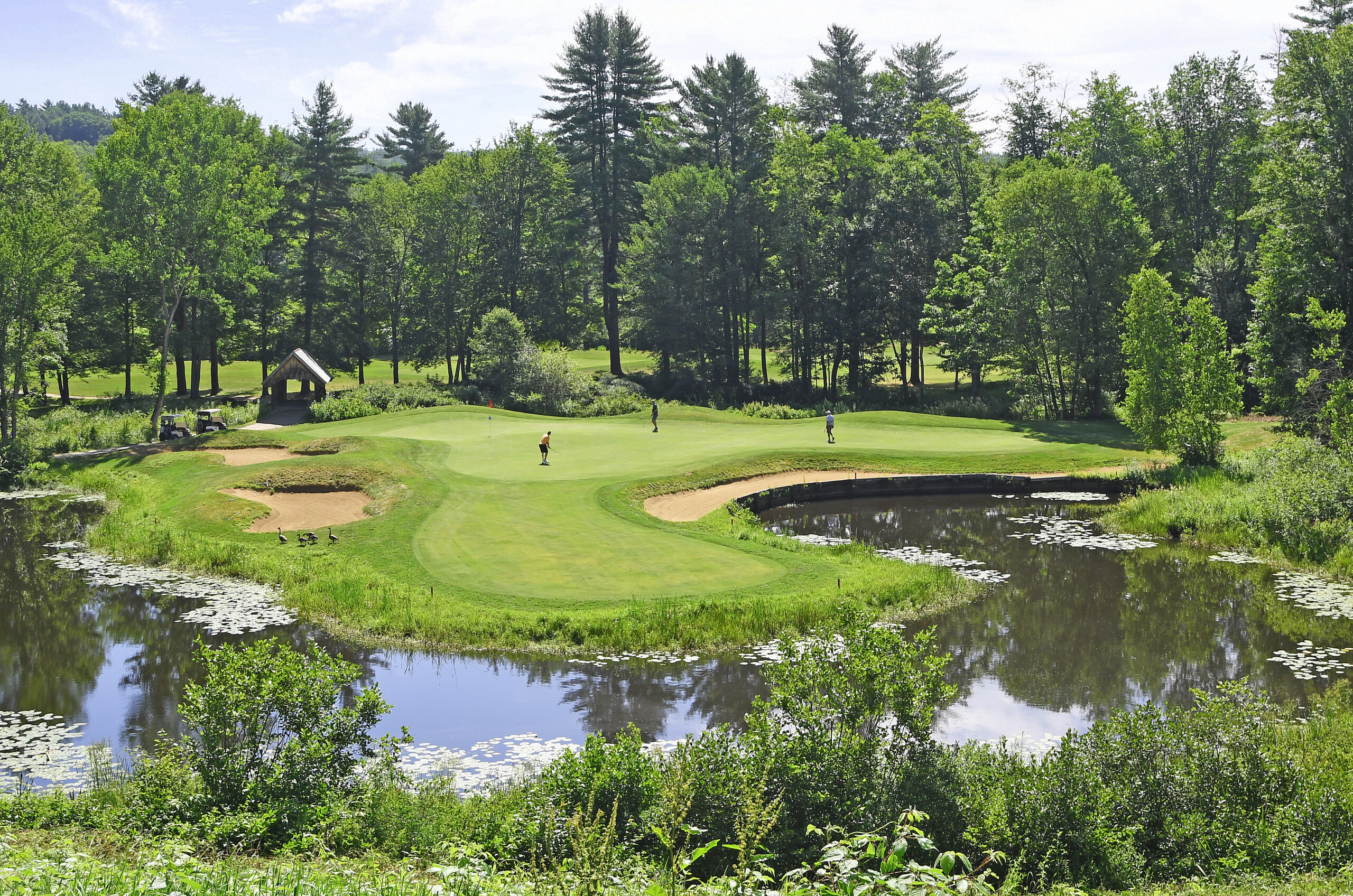
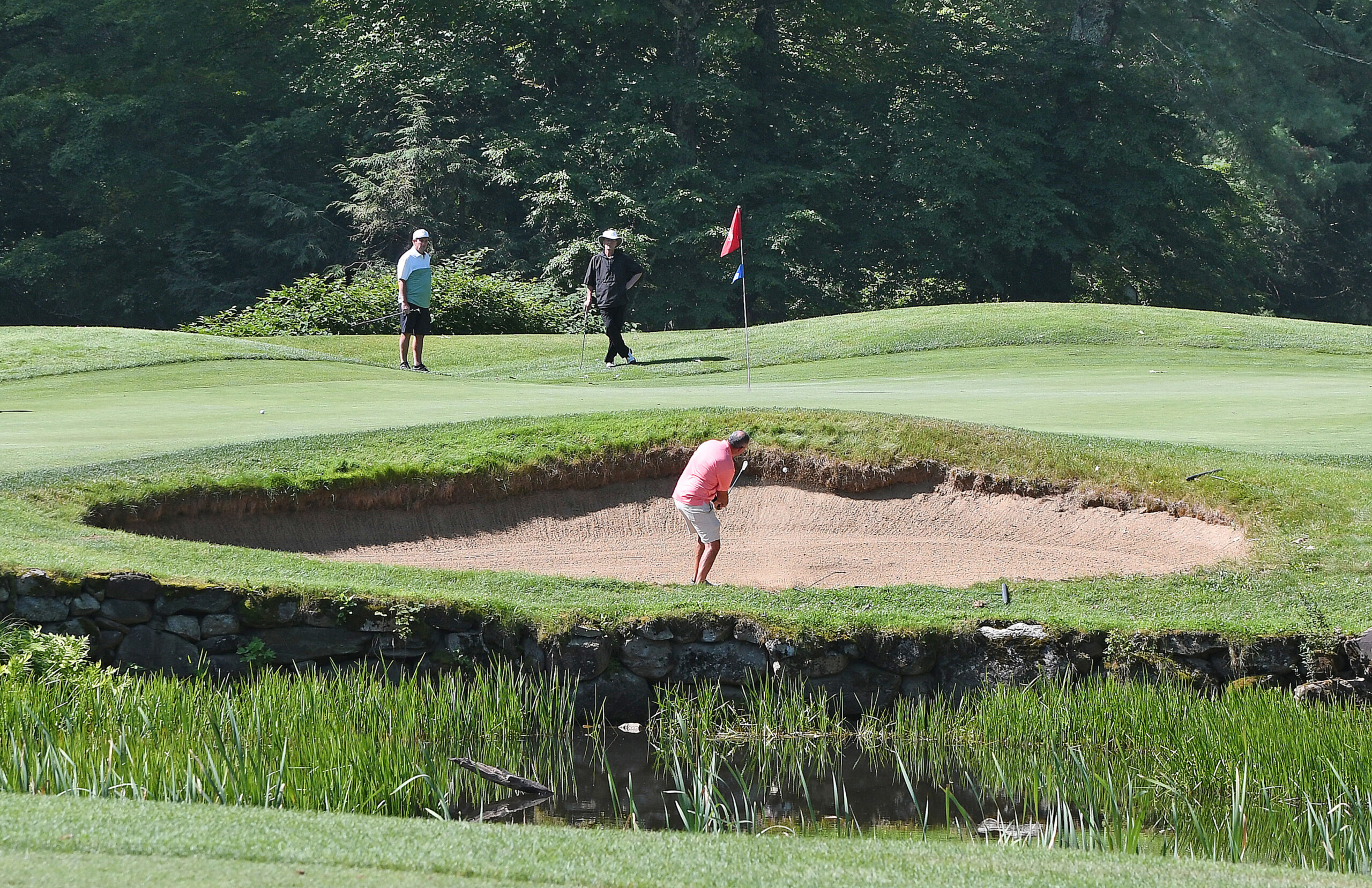
Golfers on the green on hole 16 of South Course at Bretwood Golf Course in Keene.
Matt says he and his brother would often race to see who could open their stanchions faster. “There was always a sticky one or two,” he says, “but not this time.”
Smaller calves were hand-carried from the barn, Matt recalls.
After the first 25 stanchions were unlocked, and with fire now falling more heavily, “My dad yelled, ‘Matty, get out of there!’ ” Matt says. Instead, Matt ran to the next section and let out 25 or so more heifers.
By the time fire crews arrived — two from Keene and one from Surry — most of the damage had already been done. A sugar house and a bunkhouse, where one of Matt’s uncles lived, were spared. Ellis’ Piper Cub aircraft, anchored as usual in a pasture near the barn, sustained damage to its tail section.
The heat from the flames was tremendous, Matt says. “Our house was fully covered in ivy then. It was all scarred, cooked and eventually died. Windows were broken, too.”
Matt’s sister, Kathryn Barrett Blair, recalls firefighters hosing down th
e house to cool it.
The fire drew an immediate and overwhelming community response, as area farmers, neighbors and citizens flocked to the scene to provide help, bearing hammers, saws and other tools. Without electricity right away, wood was hand-cut.
Materials were brought in and RN Johnson, a contracting firm, delivered a bulk tank for milk storage. A local homebuilder and family friend, Jim Mugford, coordinated an effort to erect a temporary structure, complete with trusses and plywood, so cows could be milked.
“By 3 o’clock that day, we were milking cows again,” Matt says, still sounding amazed.
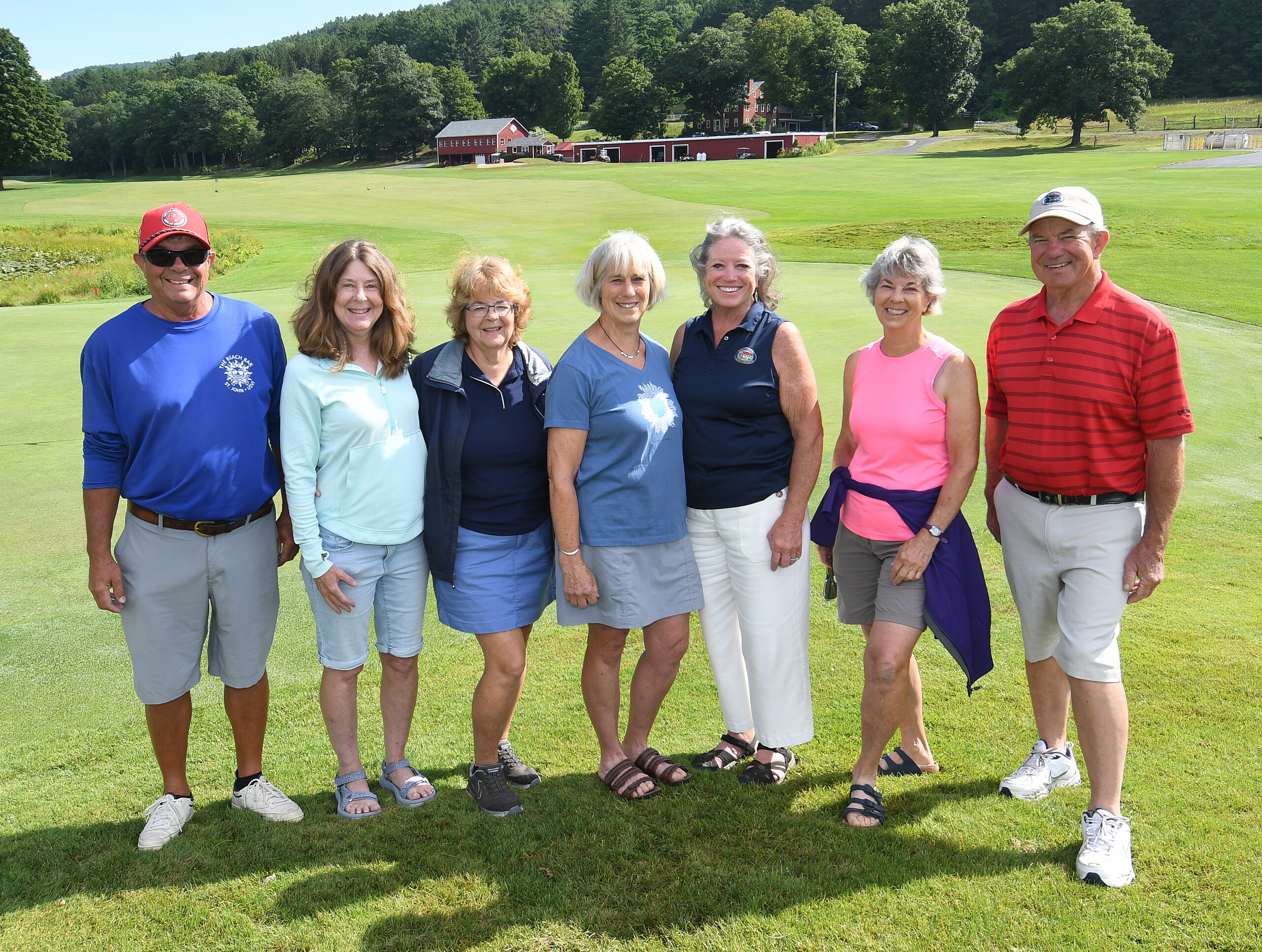
Family owners of the Bretwood Golf Course in Keene gater for a photo. From left are: Hugh Barrett, Caren Barrett, Bonnie Shortsleeve, Julie Barrett, Kathy Blair, Becky Barrett, and Matt Barrett. In the background where the buildings are was the original location of the dairy barn.
Lemonade, ham sandwiches and coffee arrived from nowhere, Joye Barrett, Ellis’ wife, told the Keene Sentinel the day after the fire. “This is all pretty amazing to me,” she said. “I had no idea people would turn out like this.”
Bonnie Barrett Shortsleeve, one of Tobey and Janis Barrett’s five children, recalls the commotion that morning and looking out from the basement window, where she shared a room with a younger sister, Caren, and seeing flames. Just 10 years old, she retreated to two maple trees adjacent to the home, where the children were taught to gather in the event of a fire.
“It saddens me a little still that neither of those trees are still standing,” she recalls. “I remember so many people bringing food to feed all of those folks that were helping us. You could also hear the sawing of lumber and the pounding of nails as the temporary structure to milk the cows went up. I especially remember the cows mooing at the gate in the field across the street in the early evening, as if to say, ‘Could you tell Toby and Ellis that it is time for us to be milked?’ ”
Bretwood Farm did business for a short while after the ruinous fire, which claimed structures, including a large silo and equipment. But it was only a few weeks before the decision was made to repurpose the land as a golf course.
From farms to fairways
Who knew that the rhythms of rural dairy farming and tending to livestock, and the rhythms of golf-course management and tending to fairways and greens were absolutely compatible?
But history shows that farmland can make excellent golf land: The topography is often favorable, the pastures largely undisturbed and the soil rich in nutrients.
In New Hampshire, Baker Hill in Newbury, Campbell’s Scottish Highlands in Salem, Blackmount Country Club in North Haverhill and Hooper Golf Course in Walpole are other examples of courses developed on farmland. In the case of Blackmount, the hilltop pasture of the Blackmount Dairy Farm became its golf footprint; in the case of Hooper, it was created on Meeting House Farm and then the highly rated nine-hole track was gifted to the town.
Bretwood’s history is distinguished by the blaze.
“The fire was devastating; it changed our lives,” Shortsleeve says, “but how we evolved is a great family story of dedication and perseverance.”
She credits her father and uncle for instilling in all the children and extended family a strong farming ethos built on Yankee values, especially hard work and humility.
Patriarchal figures, Ellis and Tobey were frugal men with distinct talents. They were also shaped by their idiosyncrasies: different from one another, but complementary. They built bridges and baseball fields, served in the military, flew and assembled planes, were competitive outdoorsmen, held elected offices and volunteered in their communities.
They were not throw-prudence-to-the-wind types; rather, family members say, they were pragmatic and nonsense.
Jack of all trades, they could build just about anything.
A strong, creative spouse supported each. Janis’s parents owned and operated Darling Farm before selling it to Tobey and Ellis in 1950. It then became Bretwood Farm. Tobey and Janis were married for 67 years; Ellis and Joye for 65.
Ultimately, the four family guardians and providers found in golf the same connection they found in farming. At the same time, it was new and peculiarly familiar.
The Barretts’ attachment to golf were small strands. As a young teen, Tobie caddied at Winding Brook Lodge Golf Course. After caddying, he was allowed to play or use the lighted driving range. He and Ellis also had a mutual friend, Towar (Tige) Arnold, who lived nearby and who had recently developed and opened a golf course of his own, Edgewood Country Club in Southwick, Mass.
Arnold would come over to the Barretts’ home and often talk to Ellis and Tobey about how ideal the farm property was for a golf course, Matt says.
At the time, the property was farm buildings and pasture — cow fields, alfalfa fields and Timothy fields, which provided foraging for livestock. “There was virtually not a tree out there,” Matt says.
“I remember the family meeting around the table when it was decided that we’d stop farming and try golf,” Blair says.
All of the animals, named and graded as they were, and some equipment were sold at an auction that September. “The barn having been completely destroyed by fire, the herd must be dispersed before cold weather,” read the first line of the Dispersal Catalog.
The course opened a week shy of one year after the fire, on June 17, 1968, as nine holes. It was “a kinda rainy day,” Matt says, as if he could picture it.
“The parking lot was grass and it had five or six cars, and one was Mom’s,” Kathryn chuckles.
A Harley Davidson three-wheeler with tiller steering was the golf cart of choice then; Bretwood had a starting fleet of six.
The course featured 18 holes, named the North Course, when the facility opened for play in 1969. Bretwood expanded to include a second 18-hole layout, the South Course, in 1991. Over time, the Barretts strategically acquired abutting properties, including another one-time dairy farm, to make the expansion possible.
The original 18 holes were designed by prominent golf architect Geoffrey Cornish, whose stamp is on hundreds of New England layouts. Where Cornish stopped, Hugh Barrett took over, making the entire complex a co-creation and vision of the two.
Barrett is the son of Aubrey and a prolific player in his prime. He captured the N.H. Amateur title in 1980 and was the event runner-up the following year. He also touts a state high school individual championship.
Hugh, who still helps maintain the course, is regarded as a natural at the creative and technical demands of golf course design. While contours can be shaped, he said, Bretwood’s landscape already offers abundant natural beauty and features to work with.
“It’s a unique place; just look at that,” he says, gazing out over the 18th and 17th holes of the North Course from the clubhouse deck. “These views are what I enjoy the most about Bretwood.”
Lucas Barrett, Matt’s son, says the beauty of Bretwood, as a course and a business, is consistency of approach.
“When Bretwood was a farm, it was just that, a dairy farm,” he says. “They fed cows, bred cows, milked cows. Then they sold the milk on the wholesale market. It was about providing milk for the community and providing stability for the family.
“When it became a golf course, it was just that, too: Support the community, provide recreation at reasonable prices and draw people from outside to patronize local shops and restaurants and hotels. Very old-fashioned.
“When the farm burned down, and the community rallied around the family, I almost feel like Bretwood has been paying that back forever, continuing an unwritten relationship of supporting people and a place that supports them.”
Spread across 299 acres, the two golf courses, depending on setup, serve up perils and pleasures. The Ashuelot River makes its presence felt on 18 of the 36 holes; water hazards, including ponds and brooks, are in play on 27 holes.
Three par-3s have carries over water, including the signature island hole on the South Course, No. 13. A par-4 on the
same track, No. 15, is short but menacing. It requires two impeccable shots, including an approach over water that is all carry to a long, but shallow green.
“The land itself has so much going for it as a template for a course layout,” says Jonas Maynard, course superintendent. “There are some reasonable elevation changes and movement to the terrain while still maintaining a connection to the river on nearly the whole of both courses.”
Eight prominent, red-roofed covered bridges, longstanding stonewalls and a variety of trees — oaks, maples, ash, walnuts, hickories, basswood and a small scattering of sycamores, the last trees on the course to grow leaves in the springtime — are other distinguishing characteristics of the lush acreage. The tree list is actually too long to mention in full, Maynard says, noting that apple and cherry trees steal the show in spring blossom.
Wildlife is abundant, including foxes, great blue herons, egrets, hawks, minks, turtles, geese and owls.
Silty sand deposits are prevalent and drain well, Maynard says, making them ideal for firm golf conditions.
He and his “small but mighty” grounds team tend to approximately 9 acres of greens and collars, 9 acres of tee boxes and 65 acres of fairways.
What truly sets Bretwood apart is its immutable focus on being what it is, a golf course and a golf course only, head professional John Pawlak says.
“We have no homes, condominiums, or town homes on the property. We have tees, fairways, greens, bunkers and trees! Pure golf.
“So many people and groups return each year and the common reaction is, ‘We love this place!’ Consistent faces in the snack bar and pro shop over the years adds up to a homey atmosphere.”
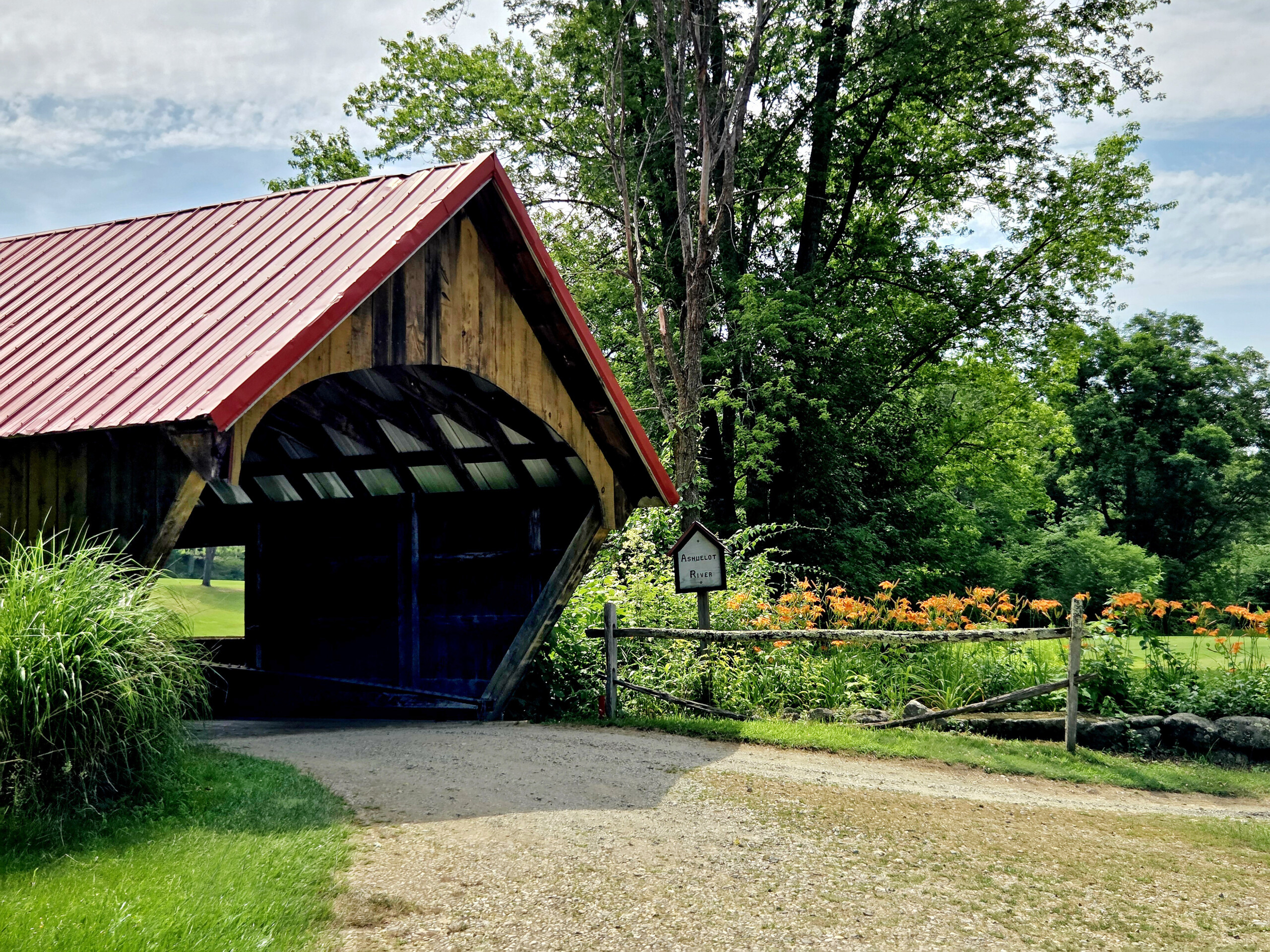
Day lilies are in bloom behind the fourth tee and near the only covered bridge on Bretwood’s North Course. Photo by Paul Miller
Mike Foresteire is part of a large group of friends from Massachusetts, New Hampshire and Connecticut that has made a four-day trip to Bretwood for each of the past 20 years. “I think everyone in our group would agree that Bretwood offers 36 of the best golf holes in New England.”
The group rents several cottages on nearby Spofford Lake, and everyone contributes food. Says Foresteire, “Evenings have become just as important as the golf: campfires, card games, plenty of laughs and enough food to feed an army.”
There are 97 golf facilities in the state, 75 of which are public. When Green Meadow closed in 2023, Bretwood was the state’s only remaining 36-hole facility.
“Bretwood is invaluable to us,” says Matthew Schmidt, executive director for NH Golf. “When we host an event there, you can feel what it means to them, and just to think of all the great golfers that have won championships there. It’s a special place.”
The course layouts have endured as challenging competition venues for professionals and amateurs, Schmidt says. Keegan Bradley (eight PGA Tour wins, Ryder Cup captain) and Dana Quigley (11 PGA Senior Tour victories) are notable golfers who have competed at Bretwood.
“We love coming there … it’s like a time capsule,” Schmidt explains. “It is still very much like golf was in the ’70s. Some of the golf carts are a little older, range balls are picked from the ponds and creeks and partly painted, and the porch and deck are perfect to relax on and watch players come in. Then, you can end your day with a milkshake … a great milkshake.”
Where uncomplicated trumps sophisticated as an aspiration, perhaps the milkshake — simple and satisfying — symbolizes all that is unique and quaint about this history-filled and beautifully-manicured golfing playground.
Over its nearly six-decade history, after all, Bretwood has shunned familiar upscale trappings of many of today’s modern golf venues — lavish dinning, pools, mahogany-trimmed locker rooms and gaudy initiation fees — and stayed resolutely true to its simple charge: to provide a memorable golf experience for all players.
At its core, it is a farming mentality, one might say. There can be no doubt that here, it is a family thing.