A Champion for Whales
The Blue Ocean Society continues to fight for our oceans in its 25th year
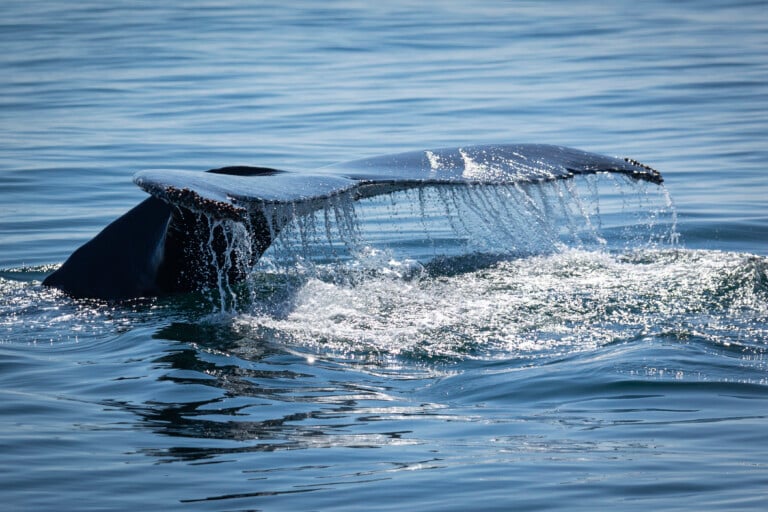
Only half an hour has gone by on the trip to Jeffreys Ledge before the boat starts to slow down and the roaring of the engine is replaced by the gentle rocking of waves. The Granite State Whale Watch tour hasn’t even made it past the Isles of Shoals before a spout is spotted nearby.
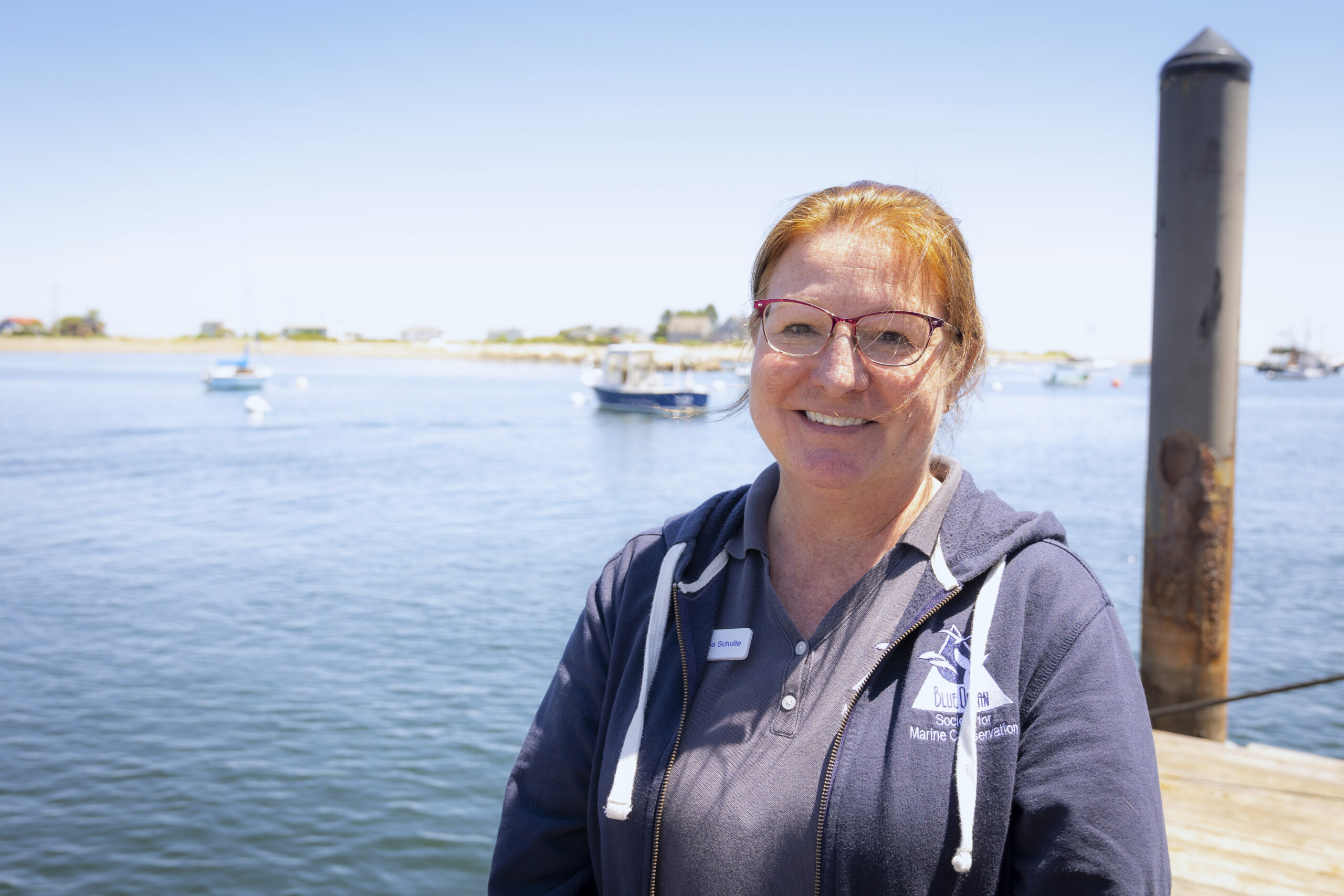
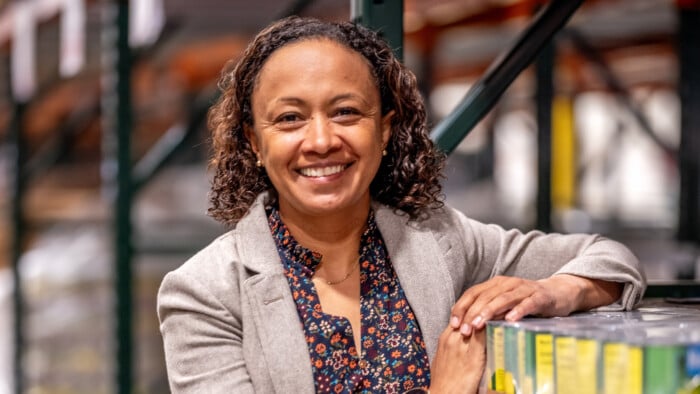
Dianna Schulte pauses on the pier at Rye Harbor after one of the whale-watching tour
The captain turns the engines off as the radar shows a blip swimming closer to the boat. Suddenly, a burst of water erupts from the waves as something nearby exhales, and everyone on board rushes to the ship’s port side to see a humpback whale come up for air.
It’s Dianna Schulte’s time to shine. As one of the Blue Ocean Society’s co-founders, she’s onboard the whale watch today as a naturalist, educating passengers about the Gulf of Maine and what lives in its waters. Also onboard are two Blue Ocean Society interns, who are spending the day collecting and logging data after every whale and animal sighting.
This isn’t Schulte’s first whale watching rodeo.
“Myself and our co-founder, Jennifer Kennedy, have been working on whale watching boats as deckhands since the mid-’90s,” Schulte says. “We met doing an internship for whale research in Gloucester, and we learned how nonprofits run and how they were collecting data on their whale watching boats, and we were like ‘We can start doing this ourselves in New Hampshire,’ and so we did.”
The duo started by collecting handwritten data and taking film pictures of whales to send to other established whale research groups. After a while, they realized that these other nonprofit research groups didn’t have the time or bandwidth to incorporate the data being sent in to their study areas.

Guests film and enjoy a whale coming up for a breath alongside the tour boat.
“We figured if we wanted to learn anything about all the whales that we were looking into on Jeffreys Ledge, we’d have to do it ourselves,” Schulte says.
The ledge sits roughly 20 miles off the coast of Rye and is a major hub of marine activity. Bird watchers, cod fishers and whale watching tours alike all gather at this 33-mile-long underwater ridge to enjoy all it has to offer. For local whale researchers, like those at the Blue Ocean Society, the ledge is a prime spot to encounter whales of all species, because it’s a vital feeding ground on the East Coast.
Schulte and Kennedy also wanted to do more than just publish research and write papers.
“We wanted to bring what we were learning about the whales back to the public, and inspire them to take action to create a safer marine environment for these whales that we care so much about,” Schulte says.
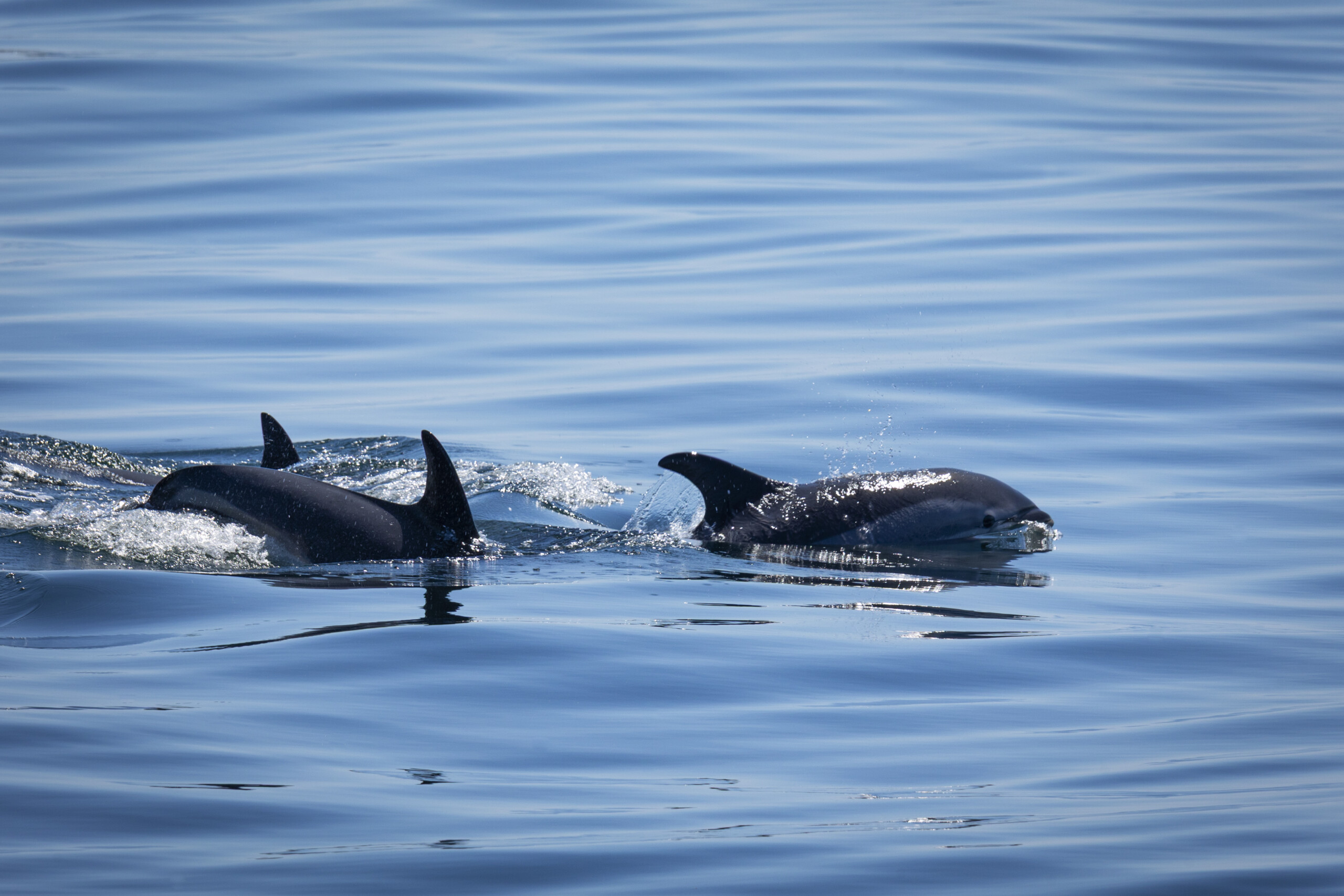
A pod of Atlantic white-sided dolphins swims among the whales and baitfish.
For the past 25 years, they’ve done just that. The Blue Ocean Society has grown from humble beginnings into a major nonprofit that provides marine education and outreach to schools across the New England, hosts hundreds of beach cleanups annually, has a bustling intern program, greets thousands of visitors at their Ocean Discovery Center at Hampton Beach, has helped create marine protections and regulations for whales off the coast, and partners with Granite State Whale Watch as naturalists while conducting whale research on the tours. There’s no question the impact that the nonprofit has had on our coast and our ocean.
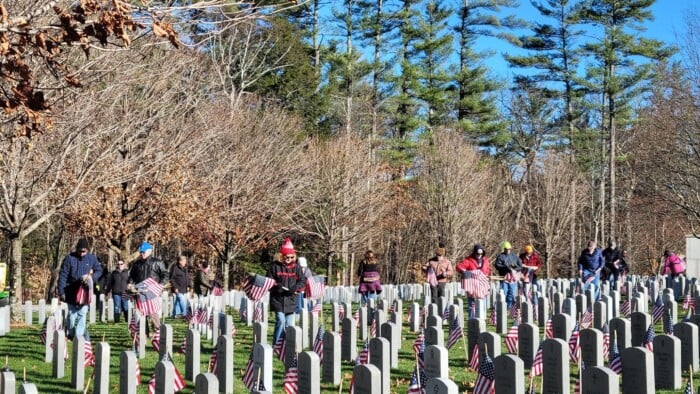
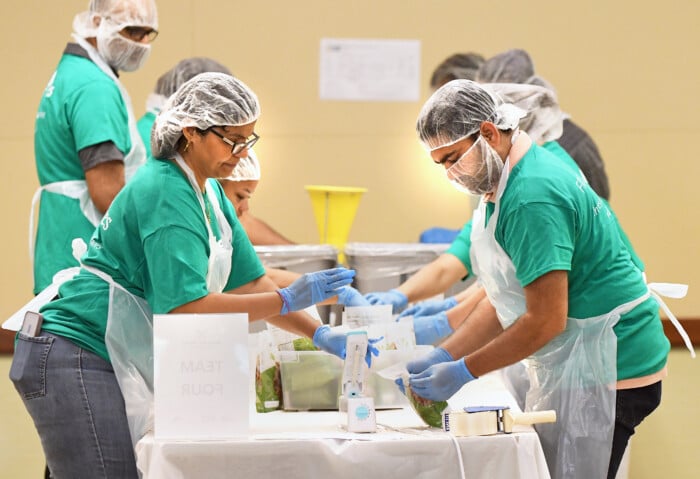
Last year, with the help of 4,000 volunteers, the Blue Ocean Society conducted 336 beach cleanups and picked up roughly 3½ tons of trash. Off the beach, they can be found traveling to schools around New England with the help of their life-sized inflatable blue whale.
“We had an inflatable whale — it was a homemade thing that one of our friends donated to us and we had it for many years. Then, we decided (to upgrade to) a professionally crafted inflatable fin whale,” Schulte says. “Our fin whale is 65 feet long, and it’s modeled after an actual whale that used to live in the Gulf of Maine, named Ladder. You can actually go inside the whale and check out an inflatable heart and backbones and jaw bones.”
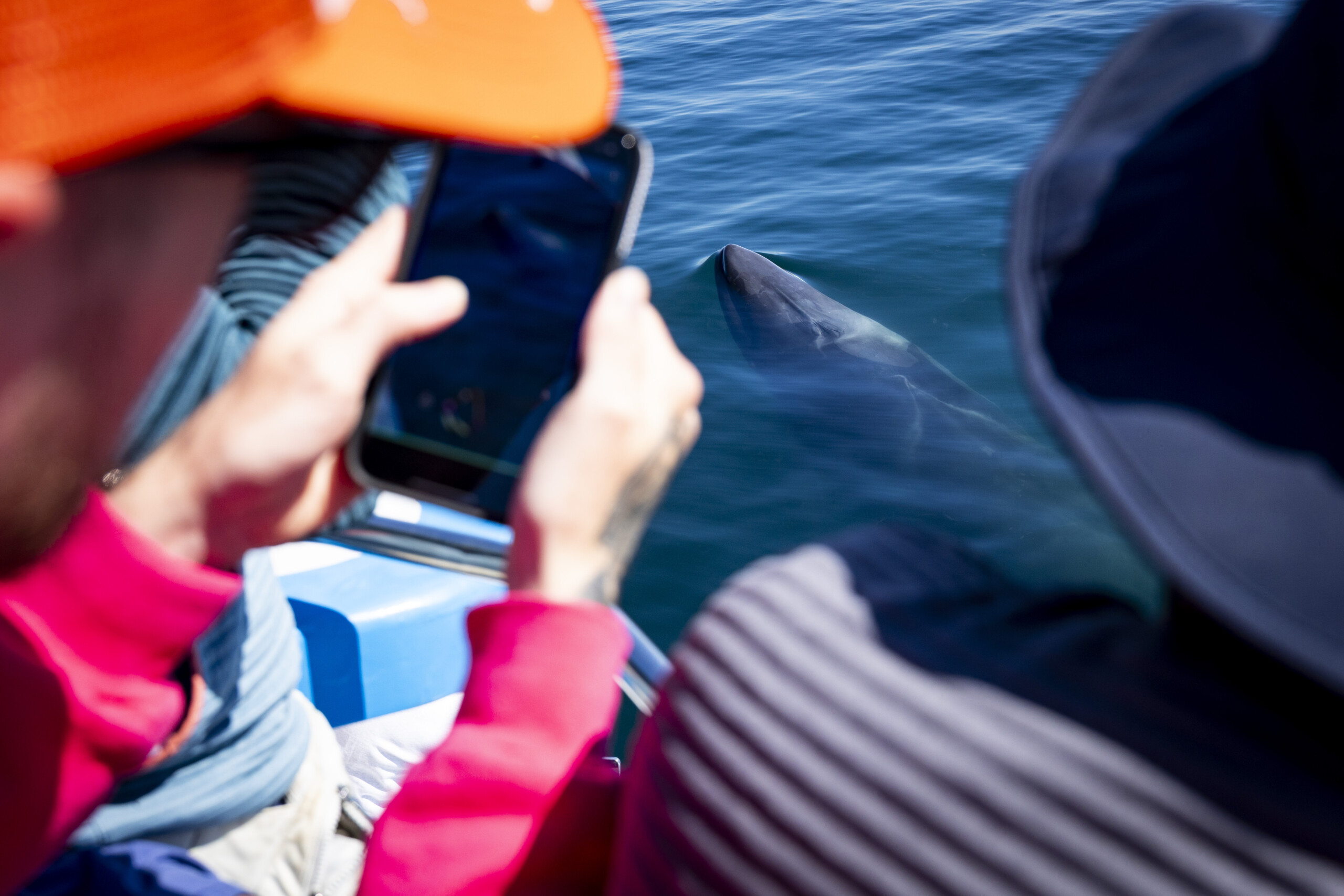
A guest captures a photograph of a baby fin whale as it nears the surface.
“Even if (the students) don’t go on a whale watch, we can go throughout New England with our inflatable whale and teach kids that don’t have the opportunity to go to these coastal locations what a real whale looks like, how big it really is and then learn more about that,” Schulte says.
The inflatable whale is just one of their teaching tools. One program they have allows students to sift through sand samples for microplastics to teach about marine debris.
“We do a lot of work with the Marine Debris Program, talking about problems with marine debris and bringing in more reusable options for debris items,” Schulte says. “I think something like 23% of the debris items that we find on the beach are things that have a reusable alternative. We teach the kids about that, and talk more about microplastics and trash in general, and what the problems are with trash and microplastics, and how that impacts not just us, but also the marine environment and how it goes down the food chain.”
None of this would be possible without their whale research that dates back to 1996.
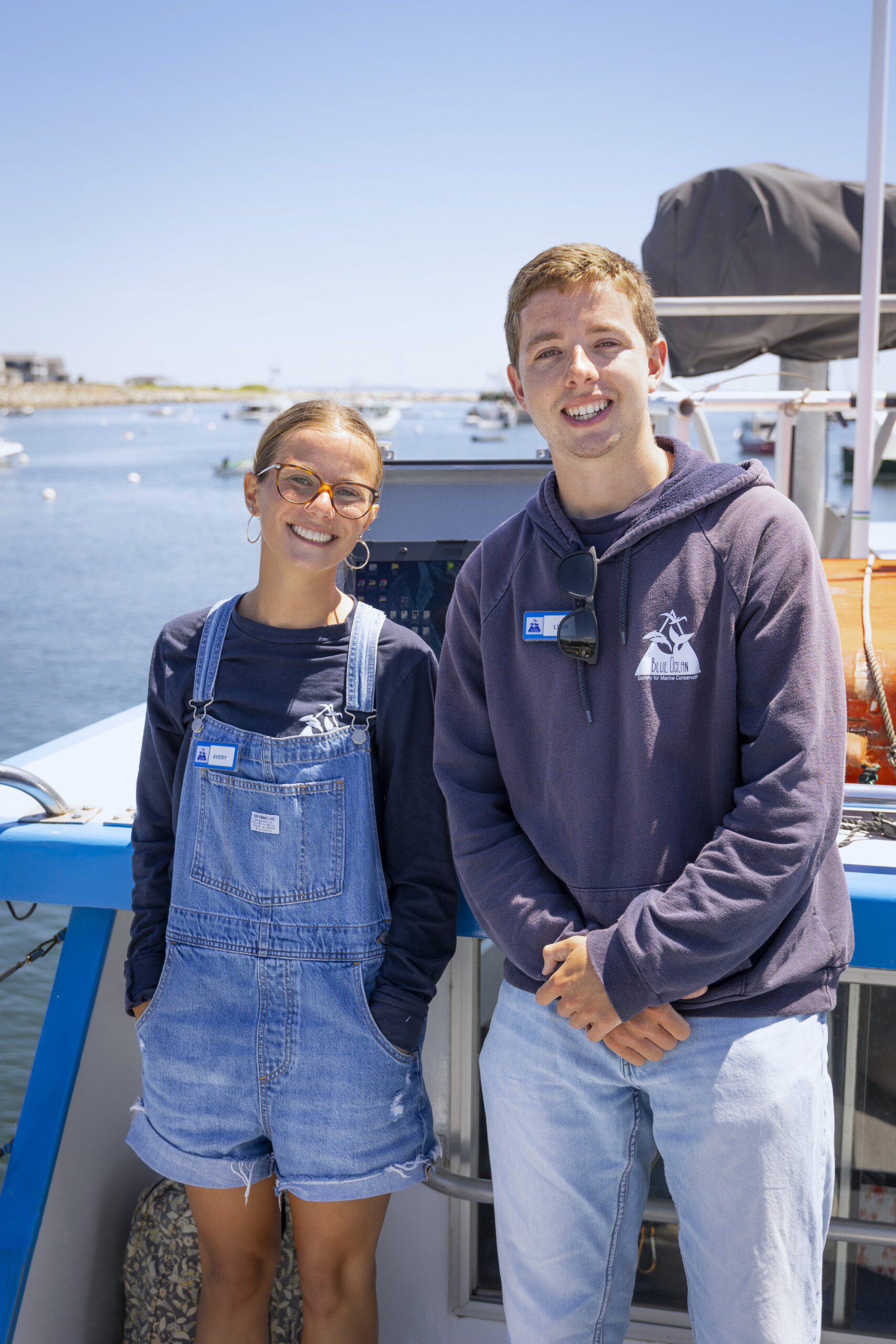
Interns are a crucial part of the work within the Blue Ocean Society.
“It’s interesting to see changes over time like, what species we’re seeing, how many of each species we’re seeing, habitat preferences and how that’s shifting a little bit over time. It’s also really exciting for us to see whales that might’ve been born back in the early 2000s coming back today,” Schulte says.
While changes are interesting to see, they are concerning to researchers. As the Gulf of Maine warms faster than any other body of water on Earth, whales are moving out of their historic protected areas and are moving into colder waters in areas where they’re unprotected and at risk.
Schulte said that when the right whale’s food source in the Bay of Fundy dried up, they moved up north to the Gulf of St.
Lawrence, where at least 20 (out of a remaining 370 animals) died due to the lack of speed and fishing restrictions. While the Canadian government was able to act quickly and put those protections in place in the Gulf of St. Lawrence, the damage had already been done.
“Whales are important to our environment. The (ocean’s) phytoplankton produces half of all the oxygen on the planet. … (Whales are) great at nutrient-cycling,” Schulte says, adding, “Basically pooping and fertilizing the ocean; without that fertilizer, we don’t have plankton and without plankton we don’t have air. If we’re screwing up the oceans, we’re screwing up our own habitat.”
“If we don’t have a healthy ocean, we don’t have a healthy planet,” Schulte says. “The oceans are hugely important for the vitality of the population.”
Schulte doesn’t feel like the future of the planet is all doom and gloom. She’s cautiously optimistic we can turn things around for ourselves and our oceans.
“The general public is getting a lot more involved,” Schulte says. “There’s a lot more push from nonprofits reaching out to their supporters and asking them call their Congress, but I feel like there’s a lot more work also being done to try to get opposing groups to find solutions that are going to work for everyone.”
Schulte is proud of the work the Blue Ocean Society has done in the last 2½ decades, and while they will be hosting a celebration this fall, she’s already looking ahead toward the work to be done over the next 25 years.
“Come on out and see a whale and support these nonprofits! We do a lot of hard work, and have lots of volunteer opportunities as well,” Schulte says. “Be engaged!”
Schulte and Spoon
In high school, Dianna Schulte adopted a whale named “Spoon” from an adopt-a-whale program. After reading the description for each adoptable whale, she chose Spoon because she was described as a “mature female.”
“Of course, I’m like, ‘Well, yeah, of course, because there’s no mature males out there really,’ ” says Schulte, laughing. “Even back in high school I was a feminist.”
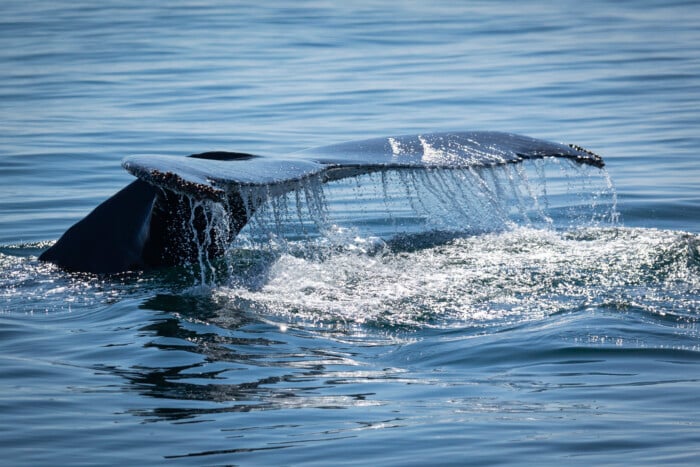
After adopting her, Schulte received a packet with photos of Spoon, and her tail, which she hung up in her room. In her first year working on a whale watching tour, Schulte didn’t see Spoon, but in her second summer, the two finally met.
“It was the most amazing thing in the world,” Schulte says, recalling how she recognized Spoon immediately. “She was known for being one of the largest humpback whales in the Gulf of Maine population, and she’s well known for being extremely lazy. She likes to sleep a lot. I’m like, ‘That is just perfect.’ ”
Schulte and Spoon see each other frequently on the Granite State Whale Watch tours, and Spoon’s laziness makes her a fan favorite among anyone who meets her.
“It’s still amazing that she’s still around, and everyone knows this particular whale and what she’s known for throughout the Gulf,” Schulte says. “Everyone’s got their favorite for whatever reason, but (mine) goes back to high school. I adopted an individual, and there she was.”