Champions at overcoming challenges
Jiu-jitsu builds skills for neurodivergent competitors on and off the mat

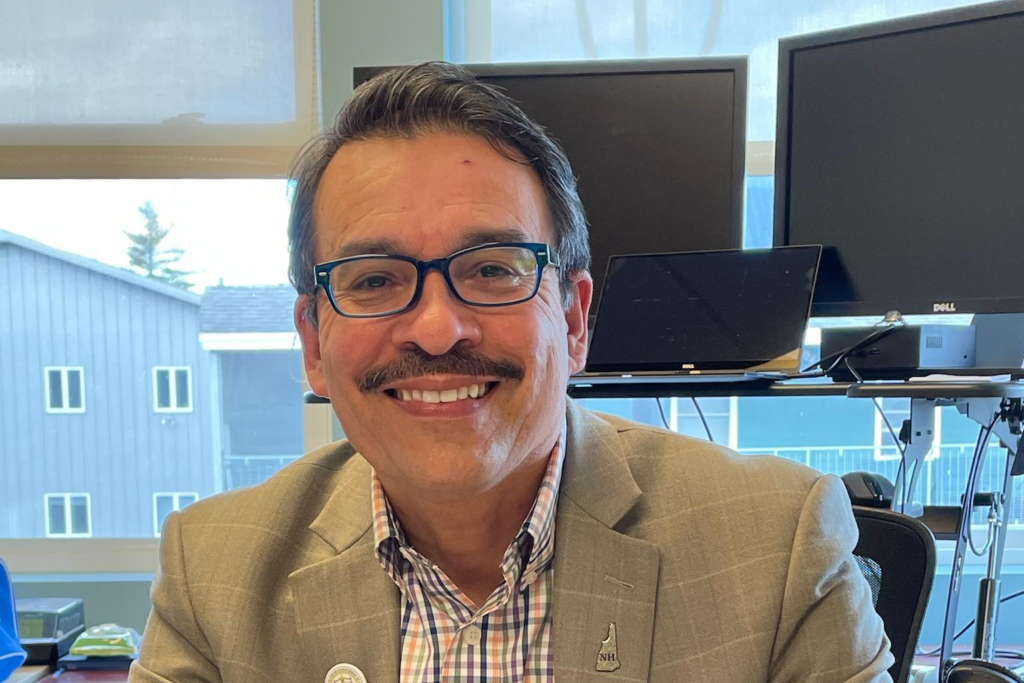
David Lisboa
In the heart of the city, Manchester Police Department employee David Lisboa is breaking barriers across the spectrum of ability by teaching grappling and combat sports.
Lisboa trained for most of his life in Brazilian jiu-jitsu (BJJ), a martial art known for its primarily ground-based fighting style. It emphasizes the power held in all competitors regardless of size and strength through tactics like leverage.
He immigrated to the United States in 2005 from Brazil and gained citizenship in 2013. The next year, Lisboa found a position among the Manchester Police Department, a decision which ultimately shaped the course of his life into a trajectory steeped in community.
Even before his tenure with the department, Lisboa was involved volunteering with the youth-serving nonprofit Manchester Police Athletic League (MPAL), which offers after-school programming across the city free of charge. It aims to spark positive interactions between police or detectives and children, in an effort to facilitate safe, positive environments for students and officers to interact.
 After learning about an acquaintance in Brazil who ran BJJ classes for children with disabilities, Lisboa saw an opportunity to execute a similar vision within the MPAL programming and community.
“I thought, ‘we have the wrestling mats here, we have the space, we have the Ikiro gis, we can use those for now; let’s start training on Saturdays.’”
Since August 2023, this dynamic BJJ group called Real Champions has held down a steady and dedicated training team, proven by the participants’ willingness to sacrifice their weekend time to attend.
“I have kids from all different ages,” Lisboa said. “I have some kids who have started here from as young as 7 who have autism. My oldest right now is 28, also autistic. In that spectrum, between 8 years old and 28 years old, we have kids with autism, Down syndrome, even one kid with Cerebral Palsy.”
Class is coached by Lisboa, and assisted by parents, paraprofessionals and MPAL volunteers including Lisboa’s wife. While he has no formal educational background working with students who have special needs or disabilities, his wife, Melissa Lisboa, is a special ed coordinator in a local district, and her extensive experience is certainly a reason for the Real Champions program’s success.
“It’s been great being able to work with her, and learning from her,” he said.
A gateway to regimen and routine, Lisboa guides students weekly through a series of warmups and drills as they navigate personal challenges such as sensory struggles, physical touch boundaries and more.
 “Holding each other’s uniform (a key skill for a takedown in BJJ), that was something we had to overcome,” Lisboa said. “In jiu jitsu, there’s a handshake we do before a match — that was how I worked around that. ‘When we do the handshake, it’s OK for you to hold onto your partner’s uniform.’”
Over the years, Lisboa has had to challenge himself just as much as he challenges students to see the world through a new lens, considering accommodations and ability differences that many neurotypical individuals walk through life without confronting: how even before the match starts, there are barriers to entry for some with sensory-processing differences.
“OK, now there’s a step,” he coaches. “Now, we can maybe be okay with touching each other, the feeling of the uniform.”
Lisboa cites a shift in mindset and challenge that faces neurodivergent individuals and their preconceived notions of disability and how disabled people move through the world and wish to be perceived.
“In the beginning sometimes, I found myself treating them with a little more leniency than I might have given a neurotypical person,’ he said. “After a while, I was like ‘What am I doing? I gotta treat them the same way I would treat any other student, right?’”

Youth from ages 8 to 28, who have disabilities like autism, Down syndrome or cerebral palsy participate in jiu jitsu training through the MPAL program.
He has since grown to understand how the Real Champions are able to achieve real power and inclusivity just by treating everyone with the same capability and respect.
Lisboa, as well as students’ families, note a distinct growth in students’ physical and mental character through the program. One student with cerebral palsy has made significant progress not only in his BJJ form but also in his ability to walk, with the strength provided by training aiding muscle function.
“They are learning a lot of different things here … I see some of them working through anxiety sometimes, ADHD, physical and sensory touch, personal space, vocabulary,” he said. “My goal is, hopefully someday, we get more people involved in BJJ, more people embracing the disabled population to participate; maybe see some of our players go to the Special Olympics.”
These impactful and important classes, among a number of other offerings, are free and open to all in the Manchester Police Athletic League at 409 Beech St., Manchester. Manchester Police Athletic League and their programs, including Real Champions, is funded by donations, which are accepted online.