WDYK: Maxfield’s Monument
A poor farmer who scrimped on his own needs left a surprise in his will to his beneficiaries
I’m poking around in an old cellar hole on a forgotten farm in the corner of the world where the towns of Canterbury, Loudon and Concord all come together. The cellar hole is atop a rocky knoll, and somewhat like a castle moat, is surrounded by wide, stagnant marsh.
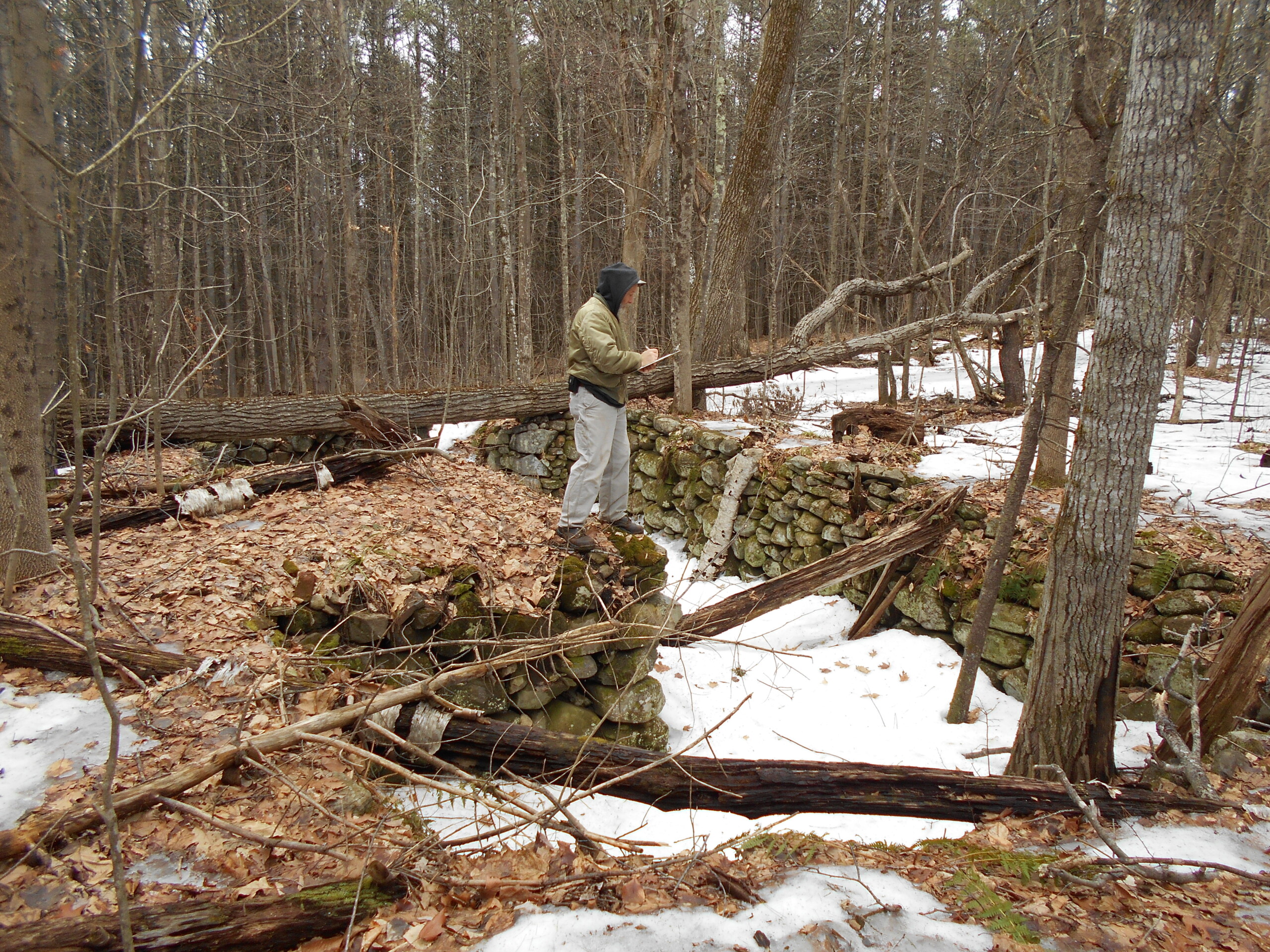
Marshall Hudson explores the cellar hole where the William Maxfield house once stood.
Old maps indicate that a road once provided access to this house, but historical records reveal the house was dismantled about 100 years ago, and maintenance of the road ceased. Encroaching forests and zealous beavers have plugged the swamp outlets and flooded the access road. I hoofed it in here following abandoned roads and crossing the frozen marsh on the ice.
Maps of this area are contradictory, with some showing the entire area being a part of the town of Loudon, but the town line corner markers indicate the old farm straddled the town line. While the house was in Canterbury, the adjacent barn was in Loudon. Both structures are now long gone. The remaining cellar holes, stone walls and outbuilding foundations suggest this farm was once an active place.
The family burying ground, across the dooryard from the barn, is small and contains a handful of headstones. Probably not intentionally, but some of the graves are in Canterbury and some in Loudon.
An important-looking monument in the center of the cemetery announces the name, “Maxfield.” Collectively, the dates on the headstones suggest the family resided here for generations, up until the early 1900s. Puzzled by why such a prominent monument would exist at this remote hardscrabble farm, I found the answer in an old newspaper clipping.
The last Maxfield to own the property was William Maxfield, a farmer who grew apples on this hill in the late 1800s and then sold them door-to-door from a broken-down horse-drawn wagon. The road into his farm from Canterbury Center was rough and unpassable at times, so Maxfield preferred to travel the longer route into Loudon Village, where he sold his apples and other produce. Village residents described him as frugal and poor: “He was short and chubby and had a full beard and wore a rusty looking coat. He looked like he didn’t have the things he needed.” Maxfield appeared to be teetering on poverty, and housewives sometimes took pity and purchased his produce whether they needed it or not.
Maxfield lived all 76 years of his life as a bachelor on the farm, and died alone in 1905 of what is described as “cardiac dropsy and valvular disease of the heart.” His handwritten last will and testament left a small amount of cash to be shared by nieces and nephews, along with a donation to the Canterbury Free Will Baptist Church. He also left money for his burial expenses, requesting to be laid to rest beside his parents, in the family graveyard.
The will further stated that the remainder of his property and assets were to be left to the town of Loudon. His farm consisted of 119 acres, which included the rundown house
on 10 acres in Canterbury, 2 acres in Concord and the remainder in Loudon. Except for some small orchards, most of the land was rocky, steep or wetland.
Maxfield’s will stipulated that Loudon could never sell the farm, and that the town must maintain the family cemetery located on it. Because the farm couldn’t be sold, it had little cash value. It was presumed that other than the farm, there were few additional assets in his estate. To everyone’s surprise, Maxfield had cash and savings worth some $16,692. He also had a life insurance policy valued at $20,000, a significant amount of money in 1905. An inventory of his estate also discovered Maxfield owned rental properties in Penacook and Loudon.
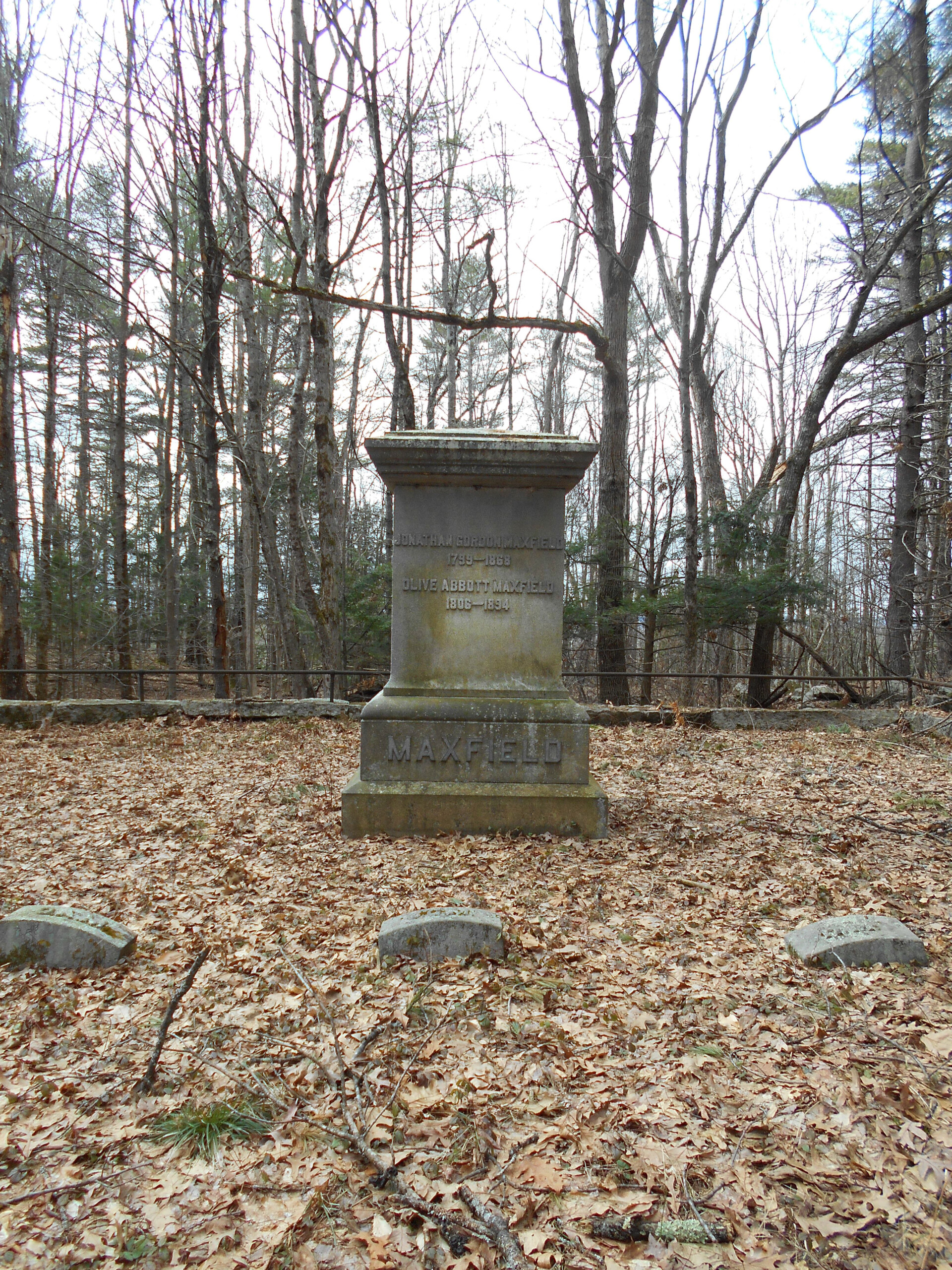
An impressive monument for, what was believed to be at the time, an impoverished farmer.
Maxfield’s will bequeathed nine relatives a combined gift totaling $1,800. When the will and inventory of his estate were placed on public record at probate court, the nine relatives, along with five other relatives, protested and filed a lawsuit contesting the legality of the handwritten will, charging that the deceased Maxfield was not of sound mind, and that the will hadn’t been properly witnessed. The NH Superior Court upheld the terms of the will and dismissed the charges brought by the disgruntled relatives.
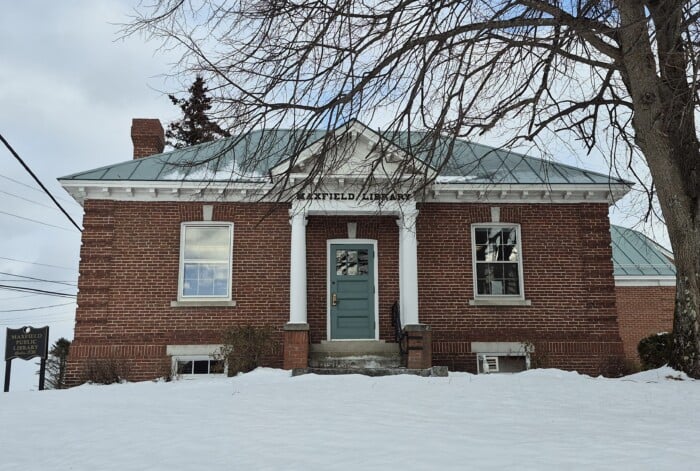
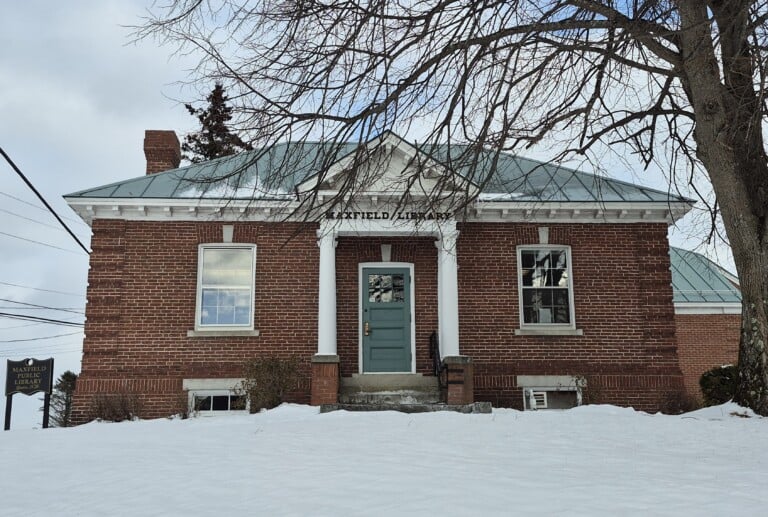
Residents of Loudon must have been surprised to discover that the frugal and poor Maxfield had generously left his farm, worldly possessions and bulk of his estate to the town. Loudon residents voted to accept the donations, along with the stipulations specified in Maxfield’s will. Further, they voted to use this money to construct a Maxfield Public Library named in his honor. The new library would be built at the crossroads in the village where he had once sold apples door-to-door. Construction of the new library was completed in 1909 and remains in operation today, although expansion projects have increased its size.
Maxfield’s farmhouse, a deteriorating, dark, center chimney cape on an open hilltop in Canterbury, was leased out for a few years by the town of Loudon. But about 30 years after his death, Loudon voters lacking funds for the continual maintenance and repairs had it torn down. Workmen dismantling the building found books and old magazines stuffed beneath the floorboards acting as crude insulation to keep the winter wind and cold out. The barn lasted a few more years and then it, too, was taken down.
This story explains the cellar holes I’m now exploring, and also the unusual Maxfield monument in the woods at this remote site. Perhaps it also explains why maps of this area sometimes indicate Loudon bulging across the town line into Canterbury.
What it doesn’t explain is why an apple farmer went without the things he needed, only to leave significant funds to the town. But I think Maxfield would be pleased to know his lifetime of scrimping and saving resulted in a public library, monument and curious tale.
You never know what you’ll find poking around in old cellar holes.