Small Footprint, Big Ideas
Modest-sized homes can offer an unexpectedly expansive way of life
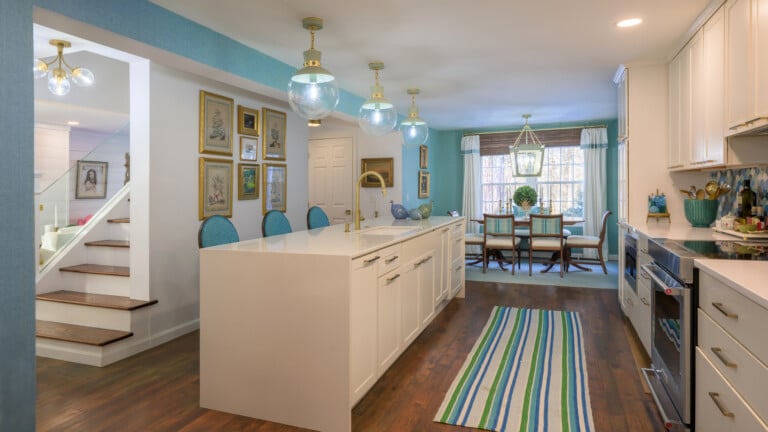
As an architect, Tracy Kozak has the training and expertise to maximize every inch in a house with a modest footprint. But when it comes to living large in a small space, she has another advantage: She has lived it.
For 27 years, Kozak raised a family of four in a 200-year-old former fisherman’s house in Portsmouth with less than 900 square feet of living space.

In Jeff Feuer and Leslie Feldman’s 340-square-foot cottage, a La Cantina folding door opens up the back wall to ocean views and the expanded deck area. Key pieces such as the Murphy bed/sofa and dining/coffee table create multi-purpose rooms. A loft provides extra sleeping space.
Photos by Rob Karosis
“We had a view across Portsmouth Harbor all the way to Kittery, Maine, and that was more important to us than a large living area. It was all about location, location, location,” says Kozak, of ARCove Architects in Portsmouth.
The location was ideal, but the footprint wasn’t, and that required plenty of flexibility and ingenuity. Kozak created space by cleverly turning a dining room into what she calls “our everything room.” Convertible furniture choices included a table that expanded for dining and folded into a desk-sized box, a piano that was used as a sideboard when the top was closed, kitchen countertops that folded up when cooking and down when not needed, ceiling racks over the sink to hang glasses, and sliding drawers under all the living room furniture for storage.
“We had cubbies under the stairs and little nooks and crannies everywhere,” she says. “There is a ton of wasted space in a typical house. Closets, cabinets, stairs, plumbing fixtures — none of them are designed to maximize space. Built-in storage is essential.”
There are many such ways to create the illusion of space. The use of vertical space, with floor-to-ceiling shelves, frees up floor space. Closet organizers and over-the-door storage capitalize on every inch. Hidden spots, such as under the bed, behind doors and in awkward corners, can house storage bins or shelves. Beds with drawers, ottomans with storage and tables that fold down are also wise choices, as is furniture with simple lines and exposed legs that make a room feel less crowded. But when it comes to that plush, oversized sofa? Forget it. 
“That takes up a lot of space,” says Shannon Alther, principal architect at TMS Architects & Interiors of Portsmouth. “Maybe go for something a little more modern or chic, in terms of its bulkiness, and that might allow you to put a cabinet behind the sofa, which could store books, or even dining ware, so that it becomes like a pantry that will consolidate space.”
One of the first things Kozak advises homeowners is to declutter. “Get rid of the things you don’t use,” she says. “It takes a lot of self-discipline, and it’s hard, because we’re all frugal Yankees, and it’s not easy to let go of things that are still useful or sentimental, but you have to do it to live in a small space.”
A useful design trick she recommends is strategically placing frameless mirrors high on a wall. “The mirror will reflect off the ceiling and make it look like it’s pulling you into another room,” she says.
Jeff Feuer and his wife, Leslie Feldman, who purchased a 340-square-foot seaside cottage eight years ago, turned to Alther to design a welcoming home that never feels claustrophobic, “even though we have 1,500 square feet of stuff crammed into 300 square feet of space,” Feldman says.
 One reason is a 12-foot-long La Cantina folding door that replaced nearly the entire back wall of the cottage and provides unobstructed ocean views, while turning the wraparound porch into an extension of the living space. Another is the removal of the attic, which was replaced by a cathedral ceiling, with two skylights that now flood the interior with natural light.
Now, Feuer says, “The feel of the place is like you’re staying in a really, really nice hotel room that’s overlooking the water, so whenever we go there, we feel like we’re on vacation.”
Among Alther’s tips when working with a modest footprint is to avoid full-size kitchen appliances. “Maybe you look at a 2-foot-wide refrigerator instead of 2.6, which is standard,” he says. “Six inches doesn’t sound like a lot, but with that space you could have tray storage and a couple of shelves for silverware. Every 6 inches in a kitchen is important.”
He also suggests installing a convection oven that also serves as a microwave and downsizing to a two-burner stove. As for that desired dream dining room that will host family dinners on Thanksgiving and Christmas, Alther says bluntly, “Don’t design your house for two days of the year.”
 Instead, he offers, design a slightly larger living room that is open to the kitchen, and bring in a table that expands and contracts. In the Feuer-Feldman house, the dining room table expands to seat 12 but also converts to a small coffee table.
“We’ve rolled that table onto the deck, turned it horizontally and had parties,” Feuer says.
Rooms should adapt and do double duty. For example, a mudroom or entryway could have a bench seat where the top lifts up for storage and there are cubbies below to place shoes. “Think about using spaces twice, not only vertically, but horizontally,” Alther says. “That minimizes the amount of floor space you are using, while balancing the open feeling of space.”
For Pier Pennoyer and his wife, Emily, the use of glass was a major factor when designing their 1,000-square-foot home. Two rows of 6-foot-high windows, stacked on top of each other, provide endless views from
the main living areas.
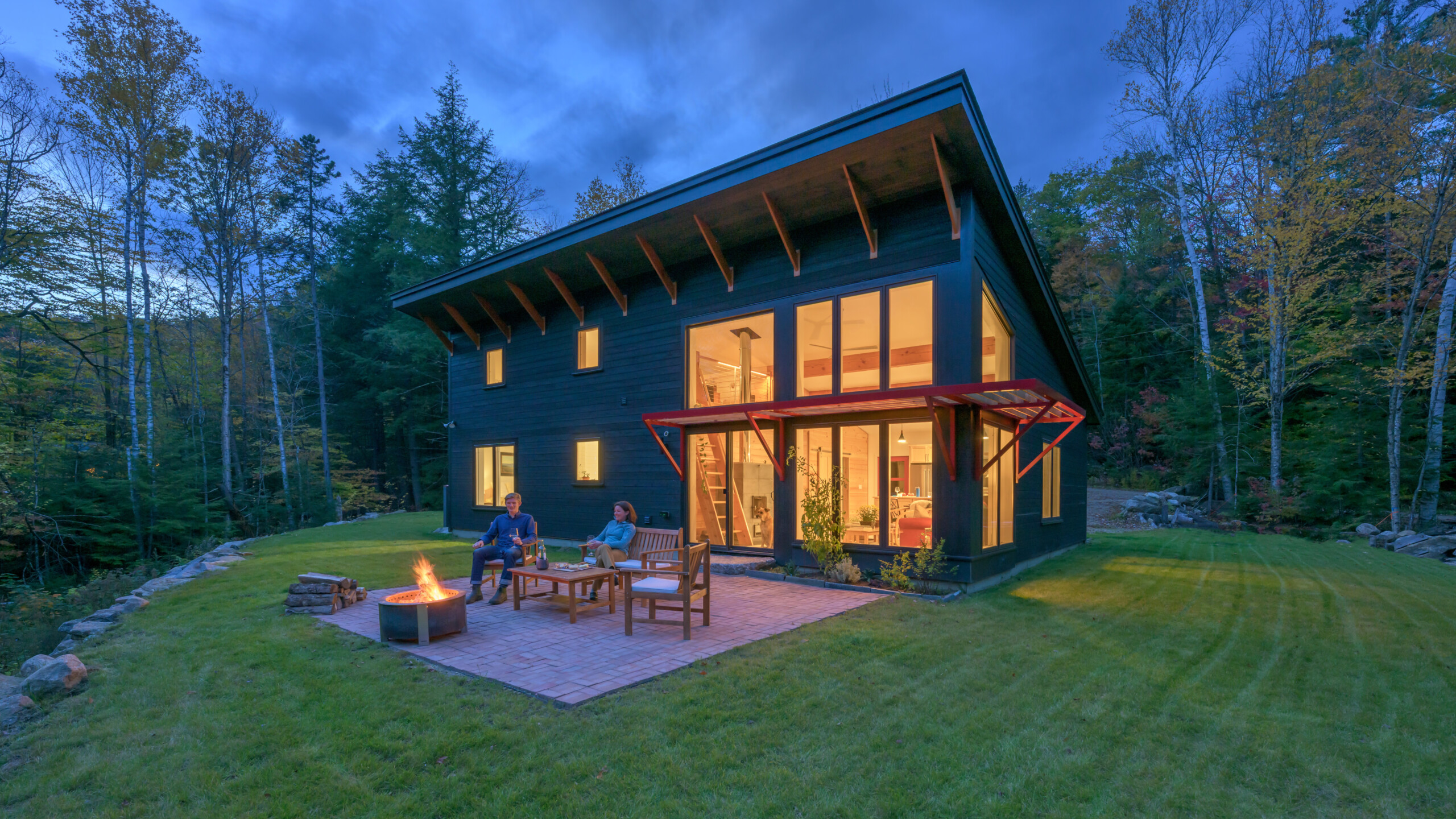
Pier and Emily Pennoyer’s 1,000-square-foot home is
clean and modern, with a pop of red in the steel beam and supports. Stacked, oversized windows bring in light and make the interiors of the home feel more spacious.
“The windows let in so much daylight that you feel like you have this wide, expansive space,” Emily says. “When you’re sitting at the kitchen table, your eyes are drawn past the walls of the house outside to the trees and beyond.”
Pier’s dad, Sheldon Pennoyer, an architect, made some creative design choices. For example, a hallway that runs along the east-west access of the house is wider than usual, and kitchen countertops are more than 4 feet wide. “We could have added an extra square foot or two in each bedroom instead, but we made the decision to put that into what would traditionally be smaller spaces, and I think that contributes to the feeling of having more room,” Emily says.
A loft tucked along the pitched roof’s highest side serves as both an office and a guest bedroom, and off the kitchen is a laundry room, which includes shelves and a ski locker for cleaning supplies and winter gear.
“Between the laundry room, the crawl space up in the loft, and with the pitched shed roof and the lower angle of the ceiling that’s not usable space for walking around, there’s plenty of room for storing things that we don’t need access to every day,” Emily says.
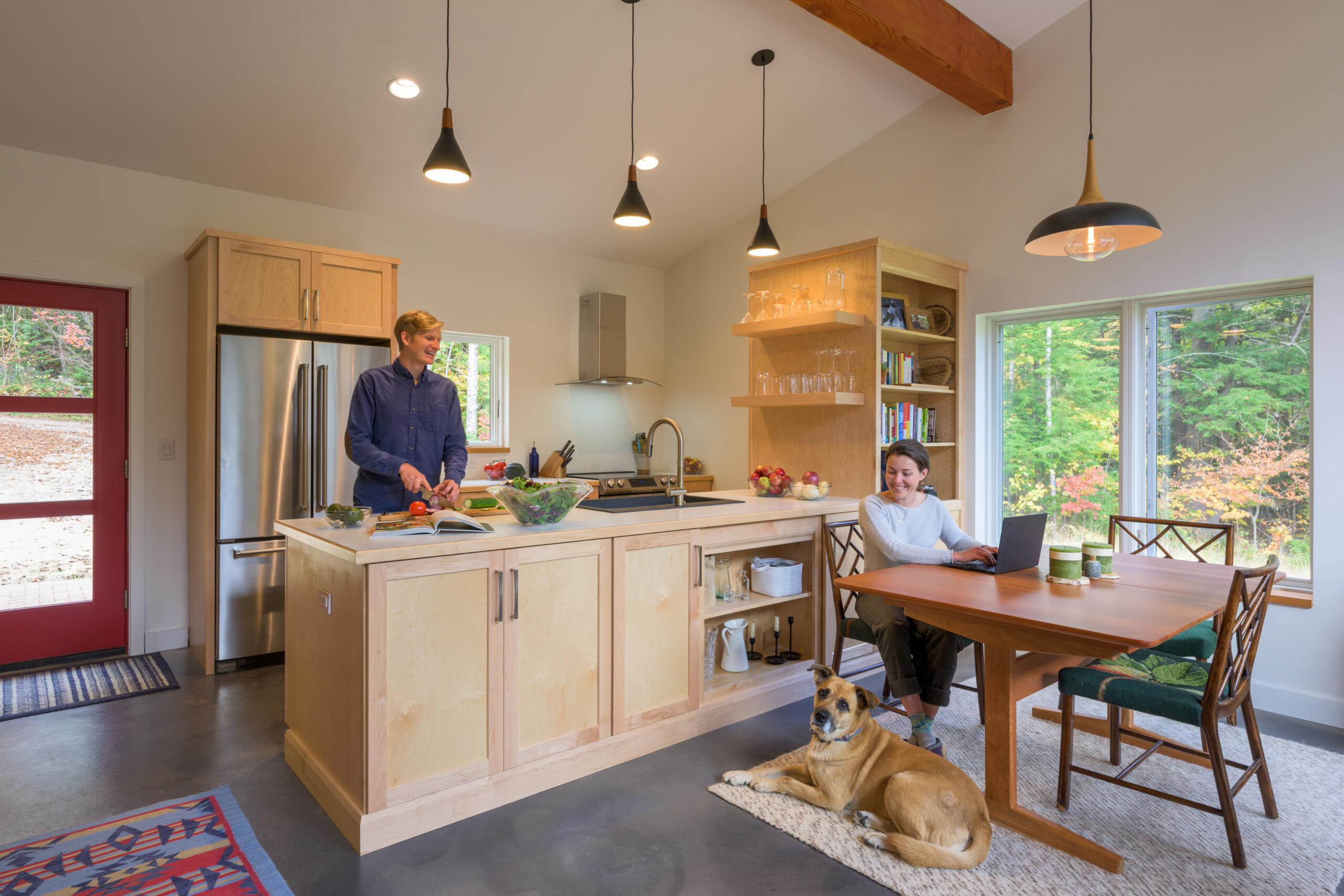
Pier and Emily love the openness of their new kitchen, and their dog, Nellie, likes being wherever the sunshine lands. One-half of the house is devoted to an efficient lineup of kitchen, dining and living spaces.
Photo/ John W. Hession
Finally, a sliding glass door provides access to a patio, which in summer becomes an extension of the house, where the couple host dinners around a firepit. “That gives us another 200 square feet of living space,” Pier says.
With resourcefulness, a few wise choices and a design trick or two, the goal of living large in a small space is not unrealistic.
“Just think high ceilings, lots of windows, flexible-use spaces and rooms that can adapt,” Kozak says.