Our Town: The Republic of Indian Stream
Pittsburg’s frontier days included a battle for independence
With its miles of trails, waterways, campsites, cozy lakeside cabins and peaceful vistas, the town of Pittsburg really does have it all — including an origin tale rooted in New Hampshire’s independent spirit.
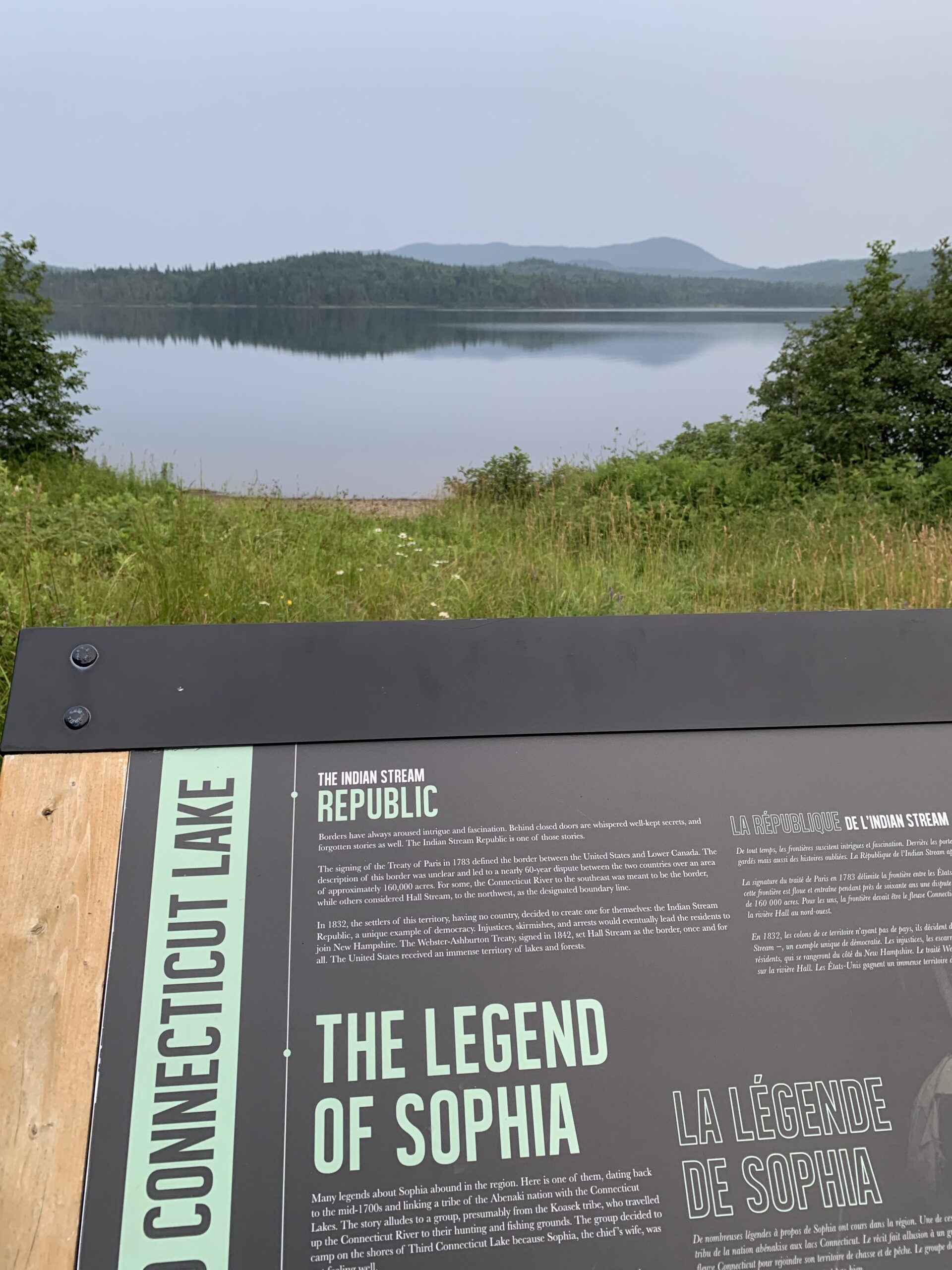
A plaque looks out onto the Third Connecticut Lake in Pittsburg, part of a historical circuit of panels describing the once-free Republic of Indian Stream. Photo / Emily Reily
At roughly 281 square miles, it’s also the largest New Hampshire town by area, with a population hovering around 730. It’s the only New Hampshire town that borders Quebec, Canada, and the only New Hampshire town fully north of the 45th parallel.
Here, in the Great North Woods, you’re halfway between the equator and the North Pole. And if you keep driving north through Pittsburg on U.S. Route 3, you’ll reach the U.S./Canada border.
The Connecticut River, its northern tributaries of Hall Stream, Indian Stream
and Perry Stream; the First, Second and Third Connecticut lakes; and Lake Francis provide ample opportunities for recreation and international tourism.
Fishing, boating, hunting and snowmobiling are part of Pittsburg’s identity as a northern New England outpost with a small-town feel — New Hampshire’s own vacationland.
Pittsburg’s origin story, a slice of American history, is a symbol of frontierism, bravery and the ongoing search for freedom from taxation.
From July 9, 1832, to Aug. 5, 1835, settlers had their own country called the Republic of Indian Stream, a population of about 300 in an unrecognized state with an elected government and constitution. They celebrated independence until international diplomacy stepped in.
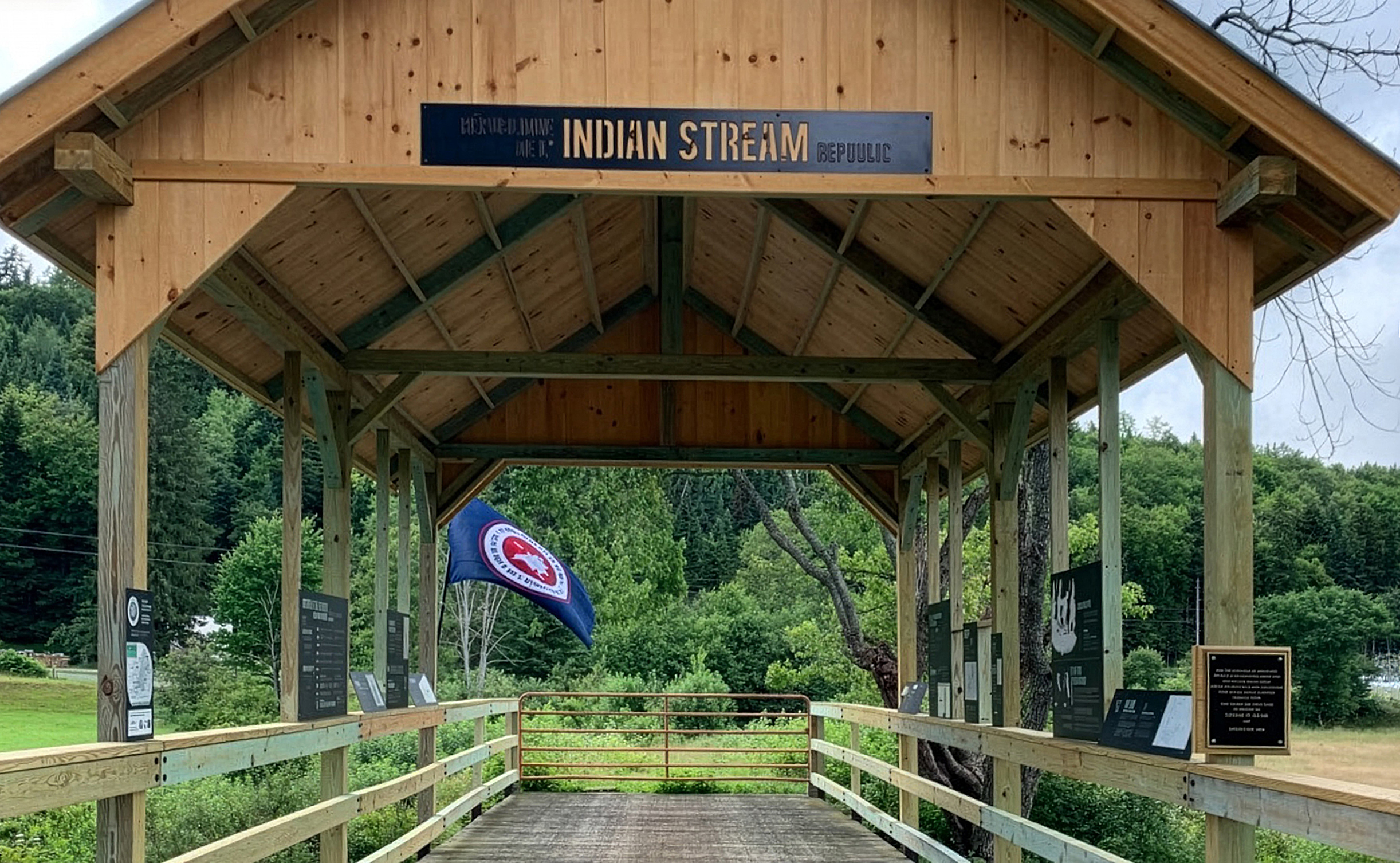
This bridge in Pittsburg, which opened in 2019, signals the beginning of the historical trail. Each panel on the trail is in English and French. Photo Courtesy David Covill / Pittsburg Historical Society
But the tiny settlement still links the two countries. Several years ago, a small group of Pittsburg residents, including some Indian Stream Republic descendants, collaborated with a group from Quebec to enrich their countries’ cultural histories through education and awareness.
It’s a complicated story.
Before Pittsburg was incorporated in 1840, an area called the Territory of Indian Stream originally belonged to the Abenaki indigenous people. The 1783 Treaty of Paris, which ended the Revolutionary War, failed to specify the U.S. and Lower Canada boundaries, only indicating it would be at the “northwesternmost head of the Connecticut River.” The river’s tributaries of Hall Stream, Indian Stream and Perry Stream were also eyed as possible international boundaries.
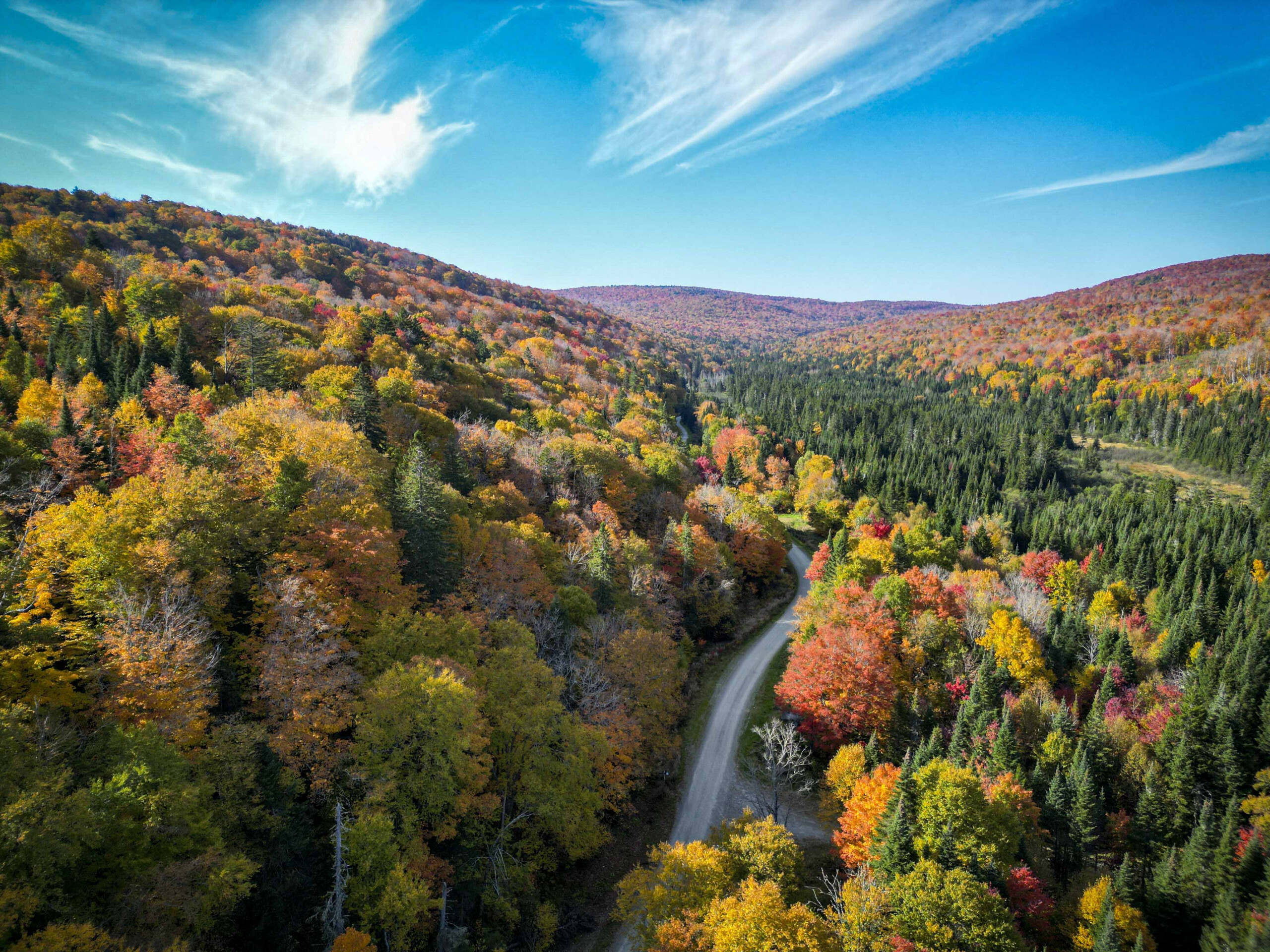
Here, in the Great North Woods, if you keep driving north through Pittsburg on scenic U.S. Route 3, you’ll reach the U.S./Canada border. Photo Courtesy Visitnh.com
Despite the ambiguity, both British Canada and the U.S. claimed the territory. By the late 18th century, land agents on both sides illegally sold parcels along Indian Stream, including Drayton Township in Lower Canada.
Loggers, hunters and trappers started settling here, but boundary disputes continued, and settlers were taxed by both countries.
Fed up with indecision, on July 9, 1831, settlers created the Republic of Indian Stream, drafting their own government and constitution, tapping Luther Parker as their representative.
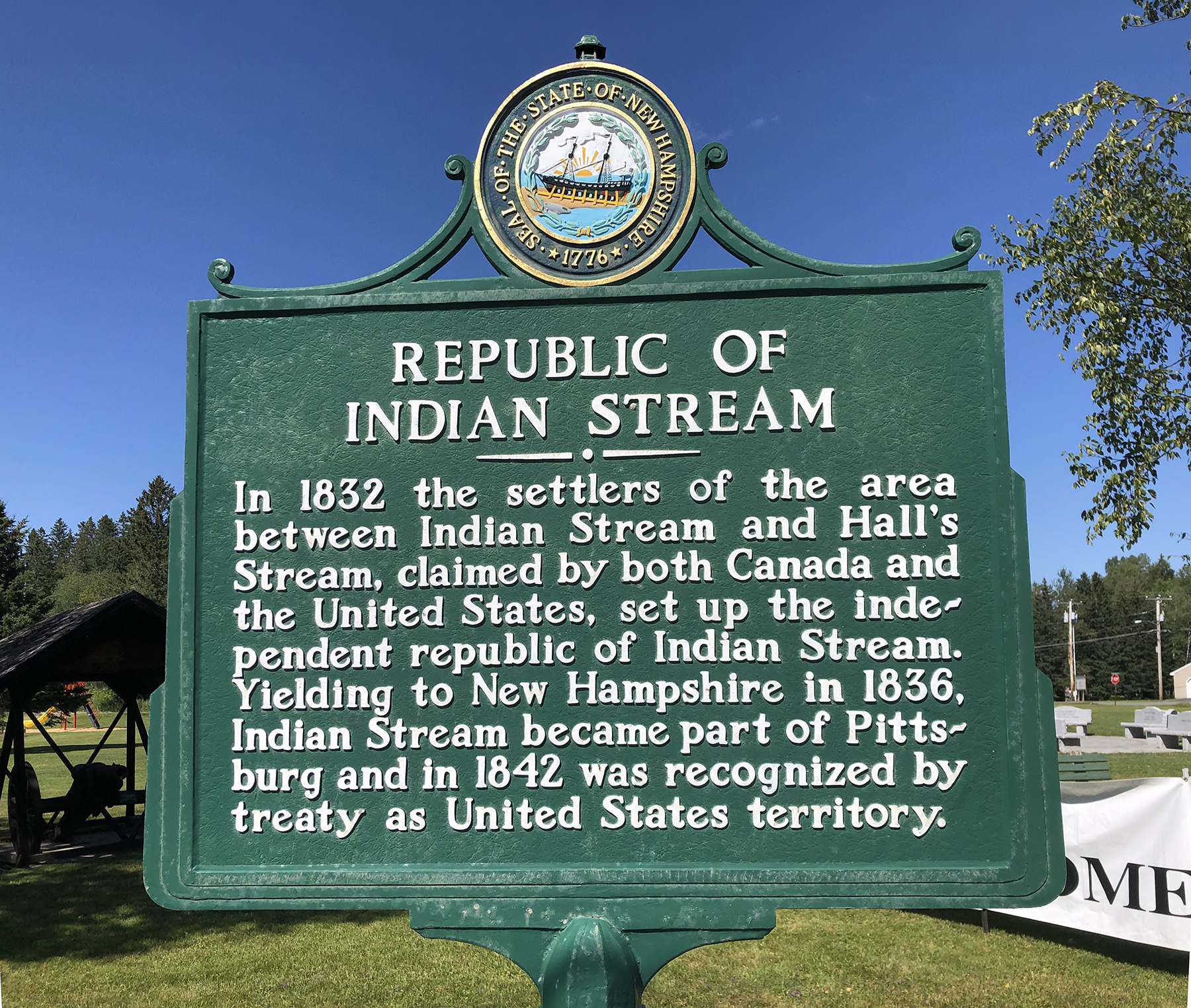
This marker in town briefly summarizes the events of the Republic of Indian Stream. Photo Courtesy Ann Gray
Somewhat similar to the U.S. Constitution, the 13 articles in the bill of rights included “the right to life, liberty, prosperity and the pursuit of happiness,” and the right to religious freedom.
Armed skirmishes between settlers and both U.S. and Lower Canadian authorities
continued to push the matter. From November 1835 to February 1836, the New Hampshire militia occupied the Republic, and in 1840 the state replaced Indian Stream Republic with the town of Pittsburg. As for the boundary dispute, the Webster-Ashburton Treaty of Aug. 9, 1842 officially designated Hall Stream as the international boundary.
A Walk to Canada
Descendants of the Republic of Indian Stream have lived here for generations, including Lindsey Gray of Pittsburg. Gray lives on Indian Stream, close to the Canada border. He says he can walk there from his house, which is just a few miles “over the hill from me.”
Now retired, Gray worked for the Pittsburg Fire Department. He still works, cutting wood and driving a truck in the summer. A member of the Pittsburg Historical Society, Gray has extensively researched Indian Stream Republic.
Gray’s grandmother, a U.S. citizen, taught school in Hereford, Quebec. Gray’s great-grandfather, a cheesemaker, worked at factories in Clarksville, Pittsburg and Hereford, Quebec.
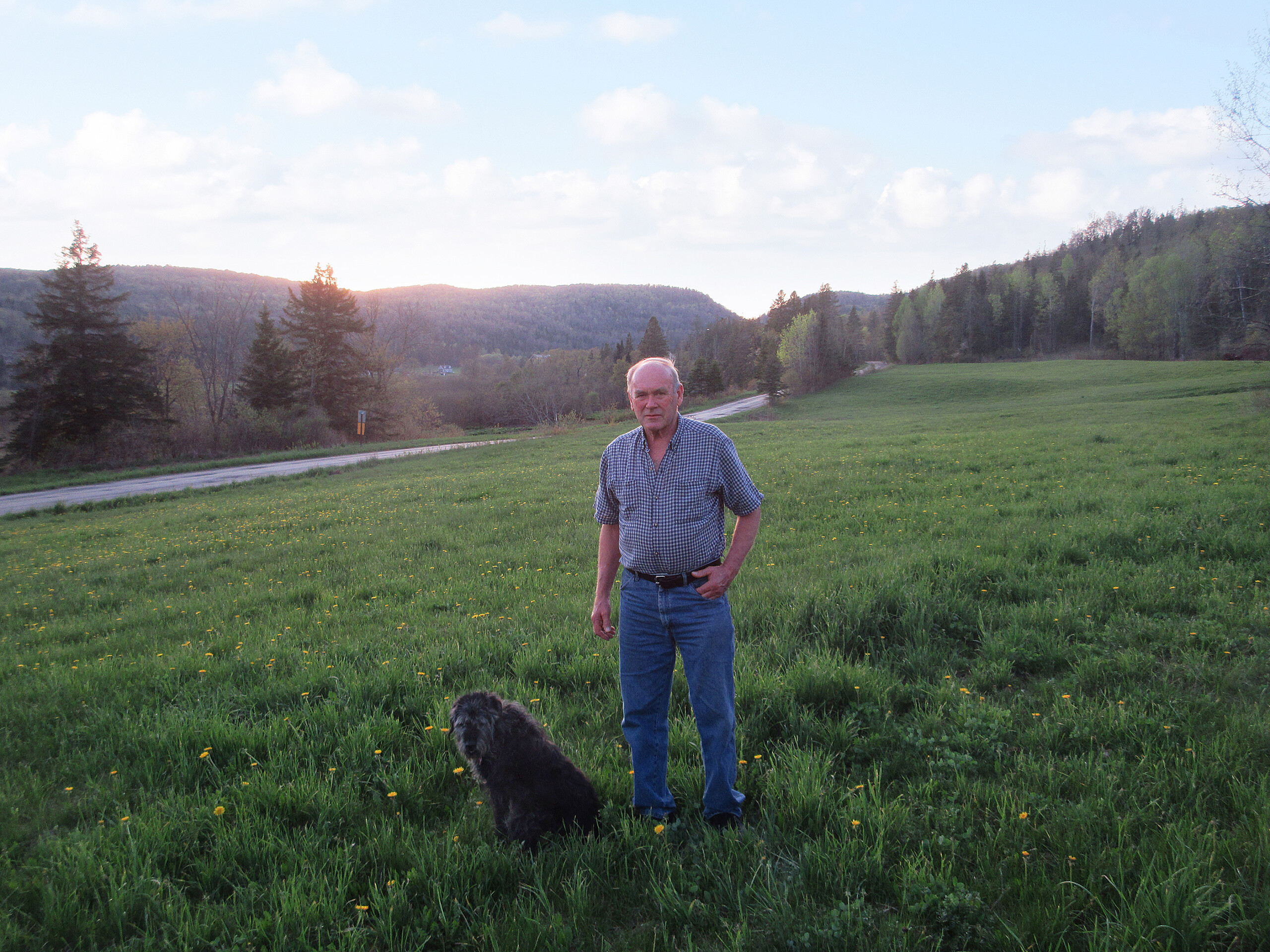
Lindsey Gray and his dog, Piper, stand on his property near Indian Stream in Pittsburg. Tabor Notch is in the background. Gray says some of his ancestors, who were Republic of Indian Stream settlers, are buried nearby. Photo Courtesy Ann Gray
Gray says back then, people crossed the border regularly.
“People didn’t think anything of it,” Gray says.
Avoiding taxation was a big factor for settlers, “just like it is today,” Gray says. “They didn’t want to be double-taxed. That’s what it amounted to.”
Retiree Bobby Ormsbee worked for the Pittsburg post office for 28 years.
He says his great-great-grandfather, John Langdon Haynes, helped found the Republic.
“It’s in my family. My great-grandmother’s father was John Langdon Haynes, and her grandfather was John Haynes, one of the land agents for the Bedel Company that got the land from the Indians,” Ormsbee says.
The Connecticut River was a major source of revenue and transportation of goods for the area, he says.
“Early settlers came from Lisbon, Bradford, Vermont, down around Charleston (Vermont), because these towns were along the river, and that’s what they use for their transportation. There was no roads, so they came via the river,” says Ormsbee, who is writing a book about the Republic of Indian Stream with the president of the Pittsburg Historical Society, David Covill.
Gray says since events span two countries, there are conflicting interpretations.
“(Canada) has a different story. We went west, and they went east somewhere. We met in the middle, two different stories, two different versions,” Gray says.
One Canadian group agreed, and wanted to do something about it.
Diane Lauzon Rioux was a member of a recreational and cultural planning committee representing the Quebec towns of East Hereford, Saint-Herménégilde and Saint-Venant-de-Paquette called The Three Villages.
The group soon realized both countries’ closely knit histories should work together, and contacted Covill at the Pittsburg Historical Society, who agreed to collaborate.
“Even if Pittsburg and East Hereford had a marker about the Republic of Indian Stream in each town, the joint committee thought that we could elaborate more on that history,” Lauzon Rioux says in an email.
From 2016 to 2019, the “cross-border committee” researched various books and archives to create a series of plaques, maps, historical markers, pamphlets and interpretive panels.
“On our side, books from Mgr. Albert Gravel and Francois Audet. I went to Montreal at Archives Nationales du Québec to find other information,” Lauzon Rioux says.
“Daniel Doan’s ‘Indian Stream Republic’ book became our go-to resource and seemed to be the most accurate account of events. Extensive research was conducted … yet there always seemed to be another story to tell. We tried to adhere to verifiable facts,” David Covill writes in an email.
Their work resulted in an international “cultural circuit” with16 sites — nine in Canada, seven in Pittsburg.
Pittsburg sites include Hollow Cemetery on Hill Road, where 56 men out of 59 signed the Republic’s Constitution; Indian Stream Bridge, on U.S. Route 3, where Daniel Webster and Lord Ashburton signed the treaty designating Hall Stream as the border; Indian Stream Cemetery on Tabor Road, where early settlers are buried; and Diamond Ridge on Magolloway Road, a former Republic outlook.
Ormsbee, his son, and Covill also distributed information around Pittsburg highlighting key locations.
“Together these commemorations tell a richer story than either side alone,” writes Francois Bouchy-Picon, a Canadian cross-border committee member.
He says while Pittsburg’s history emphasizes independence, local pride and frontier governance, the Hereford/Coaticook side sees Indian Stream Republic in terms of migration, cross-border kinship and cultural continuity across a “porous” border.
Bouchy-Picon says the Republic created “a frontier community that improvised its own institutions when empires disagreed.”
“The Indian Stream story becomes a symbol of cooperation, not conflict. It offers a rare example of a binational micro-history where both sides preserve different facets of the same lived experience. It strengthens regional identity on both sides of the 45th parallel,” says Bouchy-Picon.
In Pittsburg, Gray has spoken to elementary school kids about what life was like in Indian Stream.
“We don’t know what it is to live without being able to go to the grocery store to get matches to build a fire. (Matches) weren’t common. You didn’t have a heated house. You didn’t run water. We judge it on today’s standards. We do all of history,” he says.
Researching his own family tree and finding details beyond town records has also given Gray a different perspective on what his relatives were really like.
“You see a side of them that you never knew before,” Gray says.
Gray says “independence” is the most important thing people should know about Indian Stream Republic. But what impresses Gray most about living in Pittsburg is its quiet seclusion and anonymity.
“I can walk outdoors at night and walk down the road, or out in the woods, and no one bothers me. You’re perfectly safe. I can be in the woods away from everybody.”
Gray says residents stick up for one another in times of need, no questions asked.
“Everyone tries to help everybody else. Maybe that’s something (that) we’re losing a little bit,” Gray says.
Ormsbee, who is creating additional material about the early settlers, also wants his family to stay engaged in their roots. Ormsbee regrets he didn’t always retain what his relatives taught him years ago.
“I never sat down with my grandfather or anything and asked him what he remembered. I’ve forgotten so much. There’s no more history than in the cemetery,” Ormsbee says.
But preserving history comes at a cost.
“When you only got six people that are really active (in the project), it’s hard. Everybody’s working,” Ormsbee says.
Both worry that people may forget about the Republic, or not learn about it at all.
“Yes, we have a sign in that park that says ‘The Indian stream Republic.’ But people and kids, it’s just a sign to them, you know? There’s so much history. It means a lot more to me,” Ormsbee says.
Ormsbee and Gray encourage others to learn more, saying Daniel Doan’s 1997 book “Indian Stream Republic: Settling a New England Frontier, 1785-1842,” the Pittsburg Historical Society, and the New England Historical Society are good resources. NH
Pittsburg Historical Society
historicalsocietypittsburgnh.com
New England Historical Society
historicnewengland.org
Coaticook Tourism, Quebec
https://www.tourismecoaticook.ca/articles/decouvrez-la-republique-de-lindian-stream/