9/11: We Remember
On the 25th Anniversary of the September 11 terrorist attacks, we remember
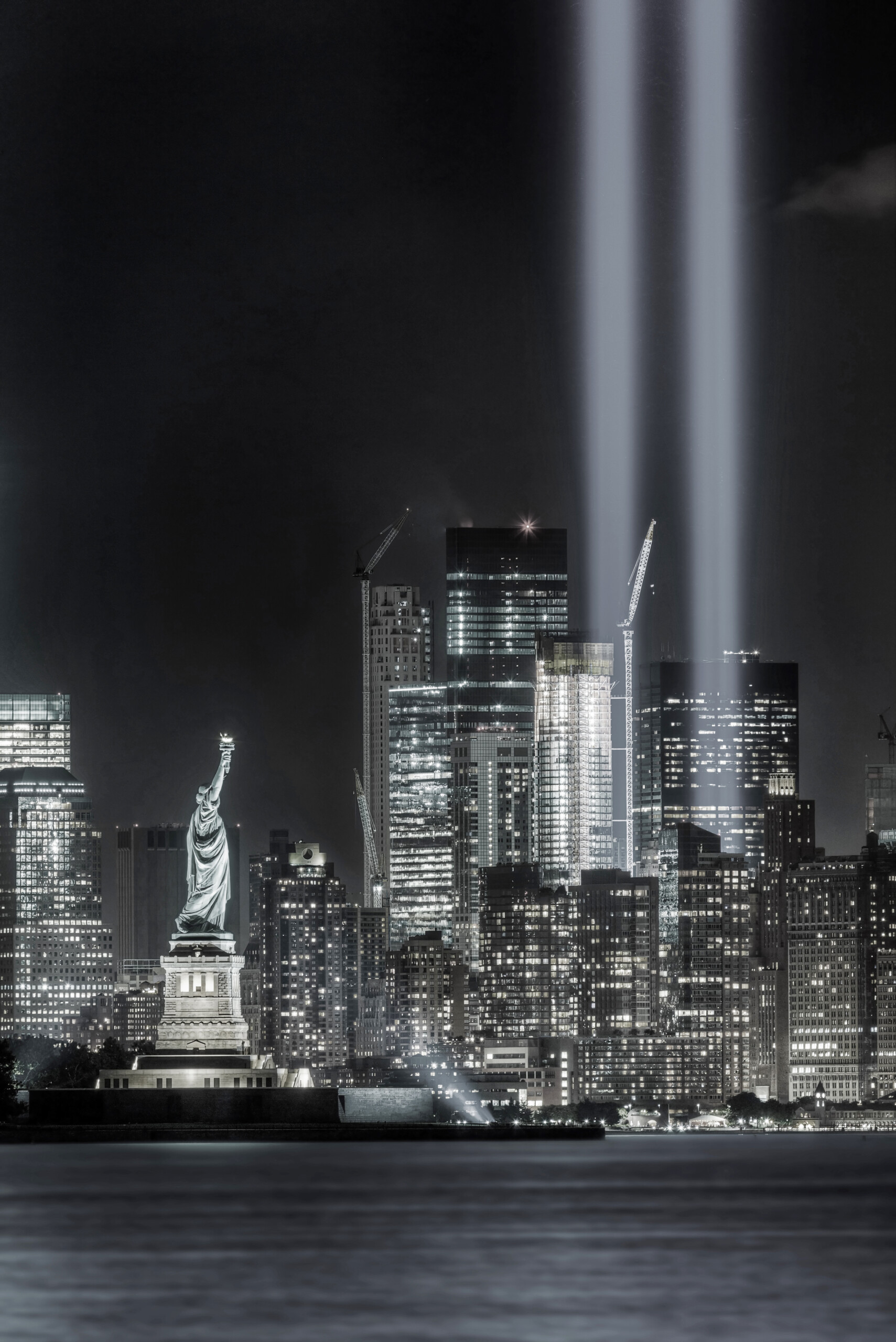
Photos by Adam Parent
September 11, 2001, was a beautiful day in the Northeast. “Bluebird” skies stretched over New York City, and the city sparkled in the early autumn sunlight. The morning commute was in full swing, and guests filled the popular “Windows on the World” restaurant on the 106/107th floors of the World Trade Center North Tower.
It was the kind of day one felt good to be alive. But before the morning was out, nearly 3,000 people would perish in a series of horrific terrorist attacks that spanned from New York City to Washington, D.C., to the rural countryside of Pennsylvania.
In South Portland, Maine, Winifred Trumbull of Wilmot Flat had spent the night at the Comfort
Inn, unknowingly sharing the location with Al Qaeda terrorists Mohammad Atta and Abdulaziz al-Omari.
Trumbull was en route to California with her sister-in-law. Her daughter, Meg Cowan, headed home as her mother flew to Boston. As she drove south on I-95, Cowan heard a newscaster say that a plane had hit the North Tower of the World Trade Center. It was 8:46 a.m. No further information was available, so she kept driving — surprised but not alarmed.
She stopped for coffee, and the shop’s TV broadcast was interrupted by news of a second plane hitting the South Tower at 9:03 a.m.; shortly after, another hit the Pentagon at 10:15. A fourth plane was missing in Pennsylvania. The United States was under attack. Air space would be shut down. Cowan remembers saying aloud, “What the heck is going on?” and then thinking, “Where is my mother?”
American Airlines Flight 11 First Officer Tom McGuinness had recently moved with his family to Stratham from California. A former Navy fighter pilot and Top Gun instructor, he loved flying, his wife, Cheryl, and his children Jennifer and Tommy. He was also a man of deep faith and active in his church. McGuinness had been with American Airlines for about 18 months and was happy to be closer to his Eastern roots, having grown up in Burlington, Mass., and attending Boston University. He would be among the first casualties of Sept. 11. He was 42.
Shortly after take-off, Atta and al-Omari used concealed weapons to kill several flight attendants, breach the cockpit and kill the pilots. Taking over the plane, they changed course for New York City. Flight attendant Betty Ong is credited for alerting authorities as to what transpired, using an AirFone to relay information on the hijacking. Her last words noted they were “flying very low” among the city’s tall buildings, ending with “Pray for us. Pray for us.”
Seated in Row 34 back in Economy Class on Flight 11 was Anna Allison of Stoneham, Mass. Allison had a computer consulting business and was flying to California to meet with clients. She was supposed to fly out on Monday, but changed her flight to give her another day to prepare, since she had been on vacation.
Her husband, Blake (now of Lyme), dropped her off at Logan and headed to work. As he was driving, his car phone rang. It was Anna.
“She knew I had a stressful day ahead, and told me to ‘keep her in my pocket’ — something we often said to each other,” he recalls. “It was so strange that she called, as we had already said good-bye, but I’m glad she did. Those were the last words I would ever hear from her.”
At about 9 a.m., a colleague told Blake Allison that a plane had hit the World Trade Center. They initially thought it was Boston’s World Trade Center in the Seaport district, so he was not concerned for Anna. As he was listening to a WBZ radio newscaster talk about the North Tower, the second plane hit the South Tower. The on-site reporter said, “That was no accident.”
“When I realized the first plane was from Logan, I knew it was Anna’s flight and that she was dead,” Blake says. “She had an empty row and wanted to sleep so I pray she never woke up. She was far back in the plane, so may have never known what happened.” Anna was 48.
Robert “Bob” LeBlanc, a professor emeritus of Cultural Geography at the University of New Hampshire, was on United Airlines Flight 175 heading to California for a conference. His wife, Andrea, was at their home in Lee, as a builder worked on their deck. Suddenly, he said, “Turn on the TV; the radio says a plane just hit the World Trade Center.”
Andrea turned it on just in time to see the second plane, Robert’s plane, hit the South Tower, although she did not yet know it was his. Initially, she heard his plane landed in Ohio. It will be hours before the fate of his flight is confirmed. By nightfall, she knows the truth. Robert was 70.
Tragedy strikes
As firefighters arrive at the Twin Towers, the upper floors are engulfed in flames. There is the repeated thunk of bodies hitting the ground after plummeting from the highest levels of the towers as workers choose to jump rather than burn. No one above the plane in the North Tower will survive; miraculously, 18 make it down from the South Tower thanks to one open stairwell.
Inside the North Tower, Port Authority worker Frank De Martini is on the 73rd floor. He notices that the heat from the 2,000-degree inferno above is causing the floor trusses to sag and the building’s steel frame to warp. The building will fall. He alerts authorities. At 9:50 a.m. the South Tower collapses with a roar,
sending a violent cloud of ash and debris through the area. At 10:28, the North Tower followed. (Martini would not survive the attack.)
Meanwhile, Cowan finally learns that her mother’s plane touched down in Detroit, forced to abort its trip due to the closing of American air space. It is days before her mother can get home due to repeated flight cancellations, but she is ultimately bussed back to Manchester. Sadly, another woman from Wilmot Flat, Thelma Cuccinello, 71, is not so lucky. En route to California to visit her sister, she is on Flight 11, which crashed into the North Tower.
On Flight 93, the passengers learn the fate of the other planes and vow that theirs will not be weaponized. They will storm the cockpit. On board is Linda Gronlund, whose sister lives in Amherst. An attorney for BMW, she is on her way to California. Fifteen minutes before passengers act, she leaves a voicemail for her sister, calling to say good-bye. The passengers thwart the attack, but at 10:03 a.m. the hijackers crash the plane into a remote field near Shanksville, Pennsylvania. All are killed. Gronlund was 46.
In the hours that follow, America shuts down. No planes streak the skies. Highway traffic is limited. Schools close. Offices close. The rubble in New York and D.C. smolders. In the coming days vigils are held as the enormity of the losses sinks in. Only 20 survivors are pulled from the wreckage of the towers. America has lost her innocence.
Legacy of the Lost
Today, 25 years after the tragedy of 9/11, the families still grieve those lost that day and strive to understand what happened.
“Who wanted to murder my wife?” Blake Allison says. “I will never make sense
of it.”
What sustains them is keeping alive the memories of their loved ones — ensuring they are remembered for who they were and what they achieved and not as statistics from an unthinkable tragedy.
The McGuinness family lost a father who was fun, fearless and strong in his faith. His family took courage from that. Cheryl wrote a book, “Beauty Beyond Ashes: Choosing Hope After Crisis” and became a caring voice for other widows seeking a path forward. In later years, their son, Tom, would become a pilot for American Airlines like his dad. Jennifer married a pilot for American Airlines. She
is a mother of two and an esthetician.
The LeBlanc family made a conscious decision to talk about Bob, making him real for the grandkids he never knew, and not letting 9/11 define his life.
“They talk about him as if they knew him,” Andrea says. “They’ll say ‘Grampa would have loved this’ and they are as curious and intrepid as he was in seeing the world. Bob was fascinated by everything. He first studied geology, then history, then ultimately geography. How the Earth formed, its peoples and their cultures intrigued him.”
Bob LeBlanc was fascinated about the impact people have on where they live and how it changes them, she says.
“He was constantly inspiring his students to travel, to go to unusual places where people spoke a different language and their perceptions would be challenged. He was an obsessive traveler and never worried about not speaking the language. On trips, you might find him off in a field somewhere trying to communicate with a farmer or engaging a shopkeeper. He loved that — making connections with real people.”
After LeBlanc’s death, the family set up a scholarship for UNH students seeking funds to study abroad.
As a result, students have explored countries around the globe, learning about the world he was so
passionate about.
Anna Allison was “vivacious, fun, and outgoing,” her husband, Blake, says.
“We met when she was a student in my wine course. We had a lot in common — a love of cooking, travel, gardening. She worked in the emerging tech industry in quality assurance — basically trying to break software programs that engineers dreamed up. She loved the challenge. Anna was joyful, hopeful and she lived life to its fullest. I remember her looking out at our gardens and saying, ‘Sweetie, isn’t this so beautiful?’ She saw beauty everywhere.”
Linda Gronlund loved sailing, swimming, snorkeling — anything involving water. She was accomplished in karate and playing the guitar, but her real passion was working on foreign cars. It was this that led to her job at BMW. Gronlund is memorialized by the Linda Gronlund Nature Preserve in Peconic Bay in New York State, an area she loved as a teen.
And in tiny Wilmot Flat, there is a memorial to Thelma Cuccinello. A devoted grandmother, avid quilter and hobbyist, she had recently taken up golf and was eager to play with her sister. She had been married to her husband, Albert, for more than 40 years.
For the families, there is the never-ending sadness of holidays and family celebrations that those they lost can never attend.
Of milestones never observed. Of years that should have been shared but were cut short. But beyond these personal tragedies, there is the ultimate tragedy of such collective potential destroyed when thousands
of dynamic lives were snuffed out.
“Every year in Boston they have a tribute to 9/11 victims,” Blake Allison says. “They show a montage of their photos and it gets to me, as you see pictures of everyone so happy and full of life. Many of the victims were relatively young with much ahead of them.”
No More Death
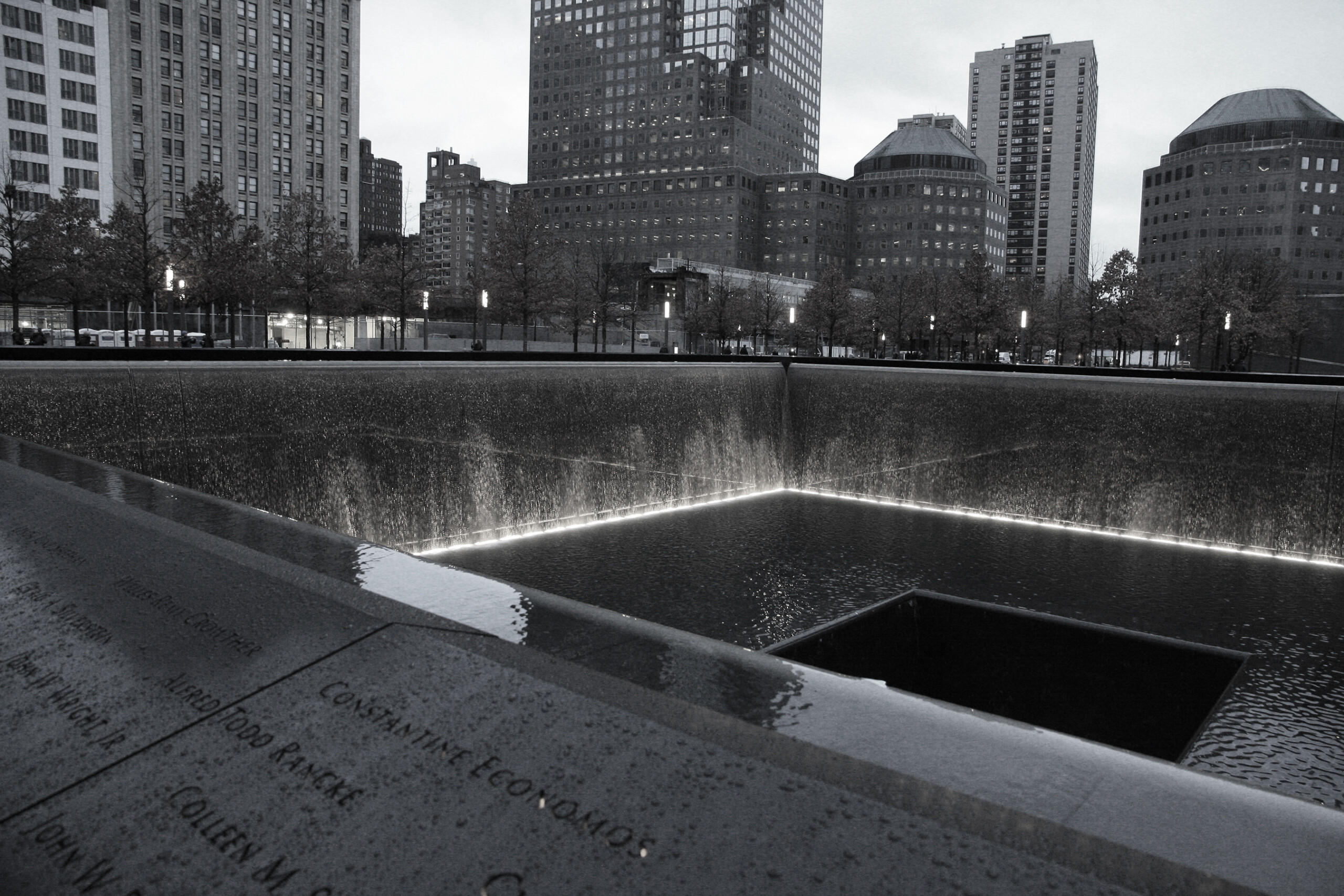
The National September 11 Memorial & Museum is a memorial and museum that is part of the World Trade Center complex in New York City. It was created to remember the September 11, 2001 terrorist attacks which killed 2,977 people, as well as the February 26, 1993 World Trade Center bombing, which killed six. Photo by Adam Parent
Andrea LeBlanc, Blake Allison and a number of other 9/11 families did not want revenge for the terrorist attacks that killed their loved ones.
“It’s not what Bob would have wanted, and it wouldn’t bring him back,” LeBlanc says. “He would have been horrified to have any particular group of people targeted because of what a few terrorists did. He would not have supported hatred or war. He was always pushing for solutions to global problems, for better understanding among different peoples.”
Allison has a similar outlook. “I believe in punishment for the terrorists, but not more killing. Imprisonment, but not more death. There has been enough death.”
Their viewpoints have not always been understood or popular, but both take comfort in the fact that they are not alone. They, and many others, belong to a group called “September 11th Families for Peaceful Tomorrows,” an organization founded by the victims’ families that works to support global peace through education, advocacy and activism.
“I have found great community there,” LeBlanc says, adding, “although we are all in a club we never wanted to join.”
Allison and LeBlanc have spoken out about their personal experiences, even when reliving 9/11 still brings pain, in order to help others. “I knew Anna would want me to go on,” Allison says. “I thought if I spoke out perhaps it would help others get on with their lives as well.”
Both are mindful of the passing years, and Allison fears that the impact of 9/11 will be forgotten as those who experienced it age. He notes that there are still terrorists imprisoned at Guantanamo Bay awaiting trial. “We are getting older,” he says. “I wonder if we will live to see this resolved.”
For now, they continue to tell their stories and hope for peaceful tomorrows.