Great Whites Off the Coast of NH
The return of great white sharks is a story of conservation success. Now, researchers are left to fill in the missing pieces of the East Coast puzzle.

With the engine roaring, Capt. Jack Farrell and his Boston Whaler, the Shining Star, cruise up the New Hampshire coast. Today, he’s accompanied by Nathan Furey, a UNH professor of fisheries biology; Mark Cotreau, the (now former) Rye fire chief; and two members of the NH Beach Patrol, Capt. Jeff Kelley and Chief Patrick Murphy. They’ll be placing five seasonal acoustic telemetry receivers along the shores of New Hampshire’s most popular beaches in Hampton and Rye. These receivers will spend their summer deep underwater, listening for the unique pings emitting from a tagged animal.
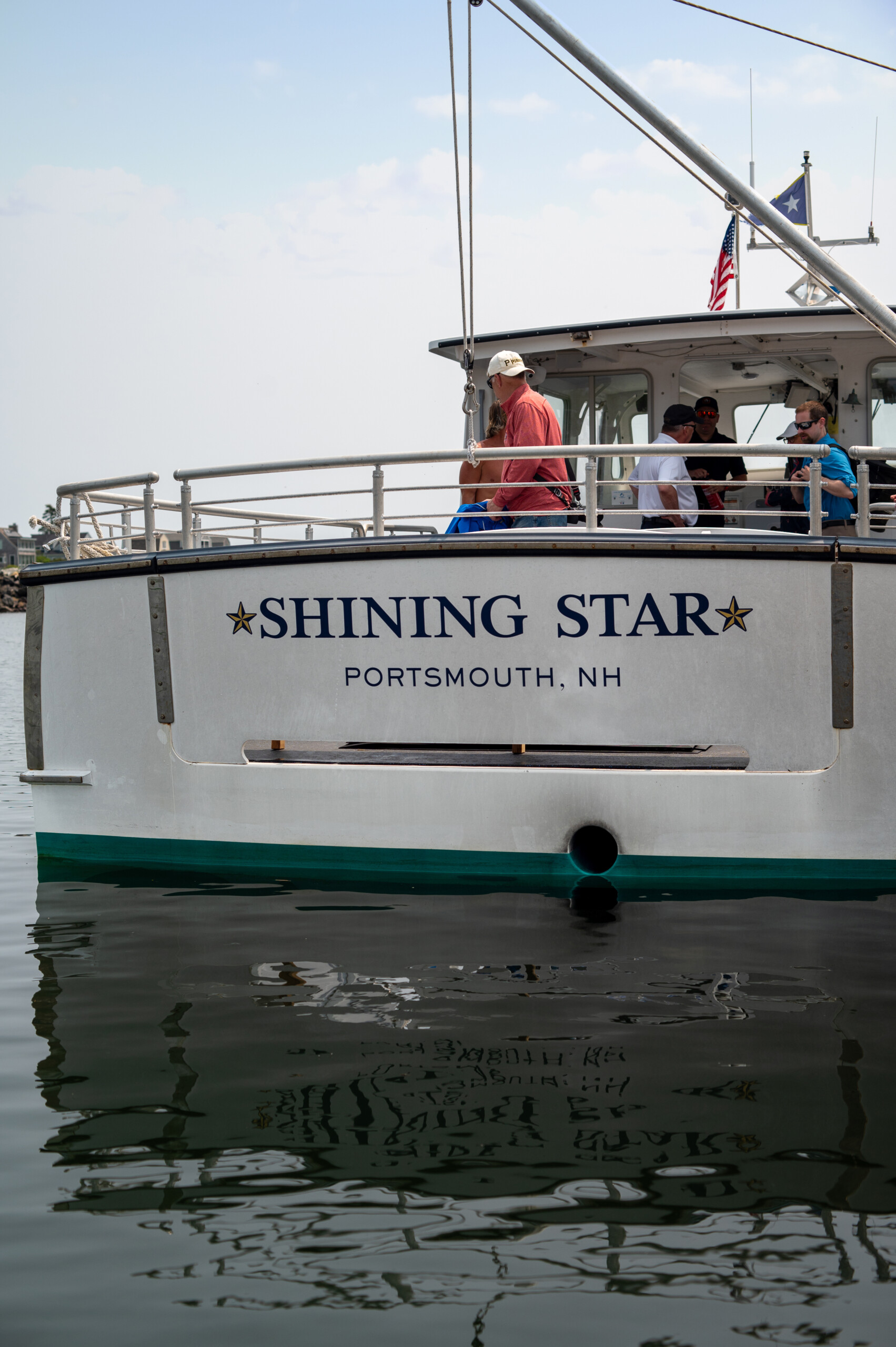
The Shining Star is a private charter boat based out of Portsmouth, capable of carrying 49 passengers.
These five receivers are joining the ranks of around 50 that cover the East Coast from Great Bay and the Isles of Shoals up through Portland’s Casco Bay. The other 50 receivers were placed with the intention of tracking various fish, from rainbow smelt, cod and more. But the five placed along New Hampshire’s coast at the beginning of every summer are listening for something much larger and more mysterious — the great white shark.
“Each tag is like a unique ID,” Furey said. “These tags are sending out little chirps or pings, like Morse code.” He explained that the receivers listen for the pings, and when heard, they’re recorded into a database that lets researchers know which tagged animal was near which receiver, when and for how long.
“Everything we’ve learned about white sharks, we’ve learned in the last two decades or so,” said white shark expert, Greg Skomal, a shark biologist for the Massachusetts Division of Marine Fisheries. “Everything we knew until the last two decades was based on dead fish.”
Megan Winton, another leading white shark expert and senior scientist with Cape Cod’s Atlantic White Shark Conservancy, said that it wasn’t until white sharks returned to the Cape, and it became a hotspot, that researchers had predictable access to the species in the Atlantic.
“Of the subpopulations of white sharks around the globe, the Northwest Atlantic population was the most mysterious on the planet,” Winton said.
Pulling back the veil on the mystery of the Northwest Atlantic white shark is due thanks to the grey seal population’s rebound over the last 15 years.
“It’s very much a conservation success story for both species,” Winton said. “We’re a couple of decades beyond putting that protective legislation in place, and we’re starting to see the recovery of that population, which is awesome from a management perspective and demonstrates that fisheries management can work — even though New England is a very complicated place for fisheries management.”
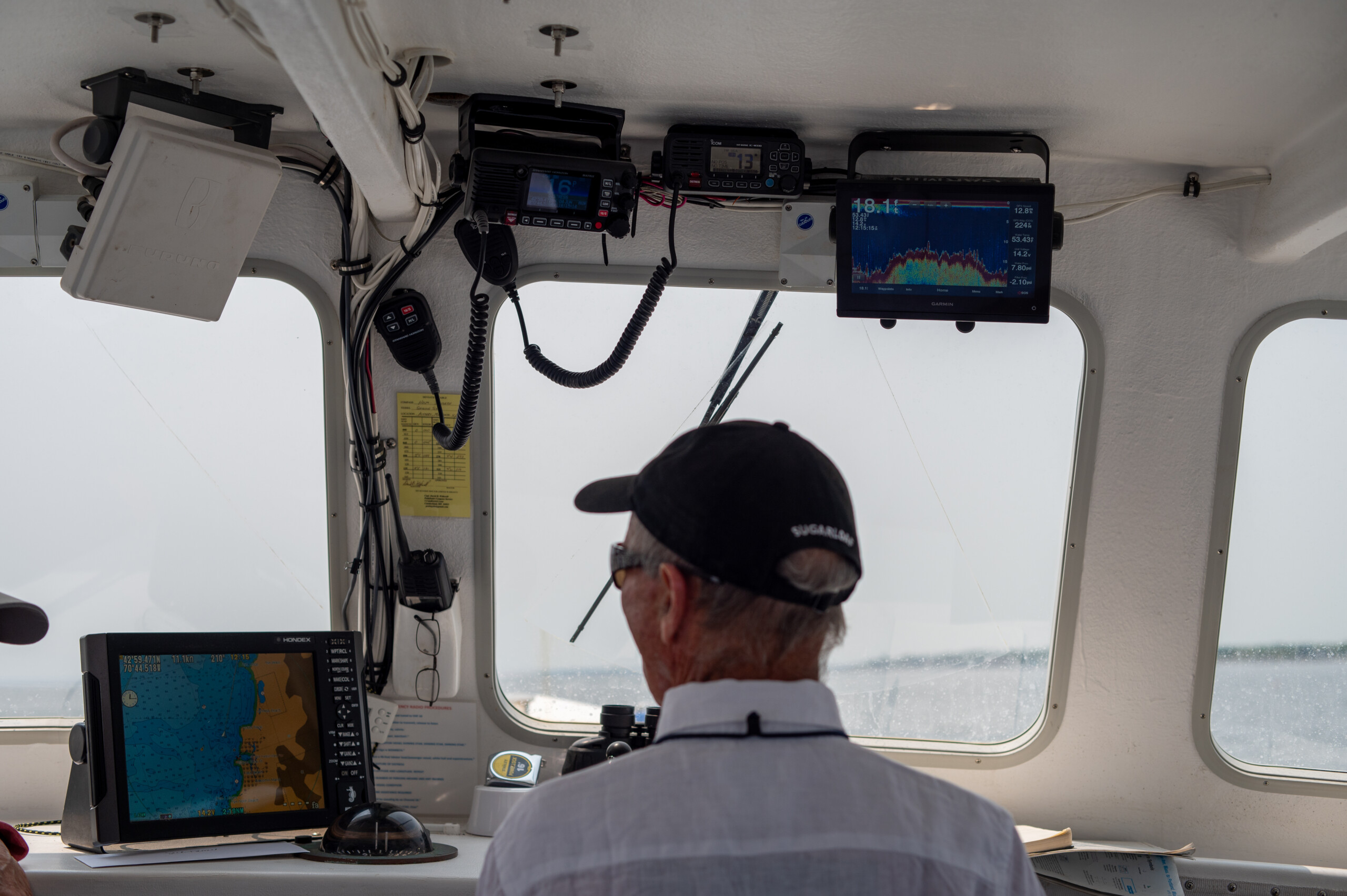
With Capt. Jack Farrell at the helm, the Shining Star is capable of traversing the Piscataqua River and ocean coastline.
Now, with an abundant population of gray seals on Cape Cod, and with gray seal colonies growing up the East Coast, researchers have entered a rapid period of being able to ask and answer basic questions about white sharks. With technological advances in tagging and acoustic telemetry receivers, marine researchers are able to track migration patterns, locate historical hotspots and identify any new migratory patterns and behaviors.
“Almost everything we’re doing has been new to shark science,” Winton said. “We’re seeing white sharks occur now in where they historically occurred, based on fisheries and sightings records.”
Much like how the Atlantic Ocean touches the shores of different states and countries, the researchers who study it work together without border, especially along the East Coast.
“Marine Fisheries has a really close working relationship with the Atlantic White Shark Conservancy,” Skomal said. “It’s a really good public and private partnership when it comes to better understanding white sharks in New England.”
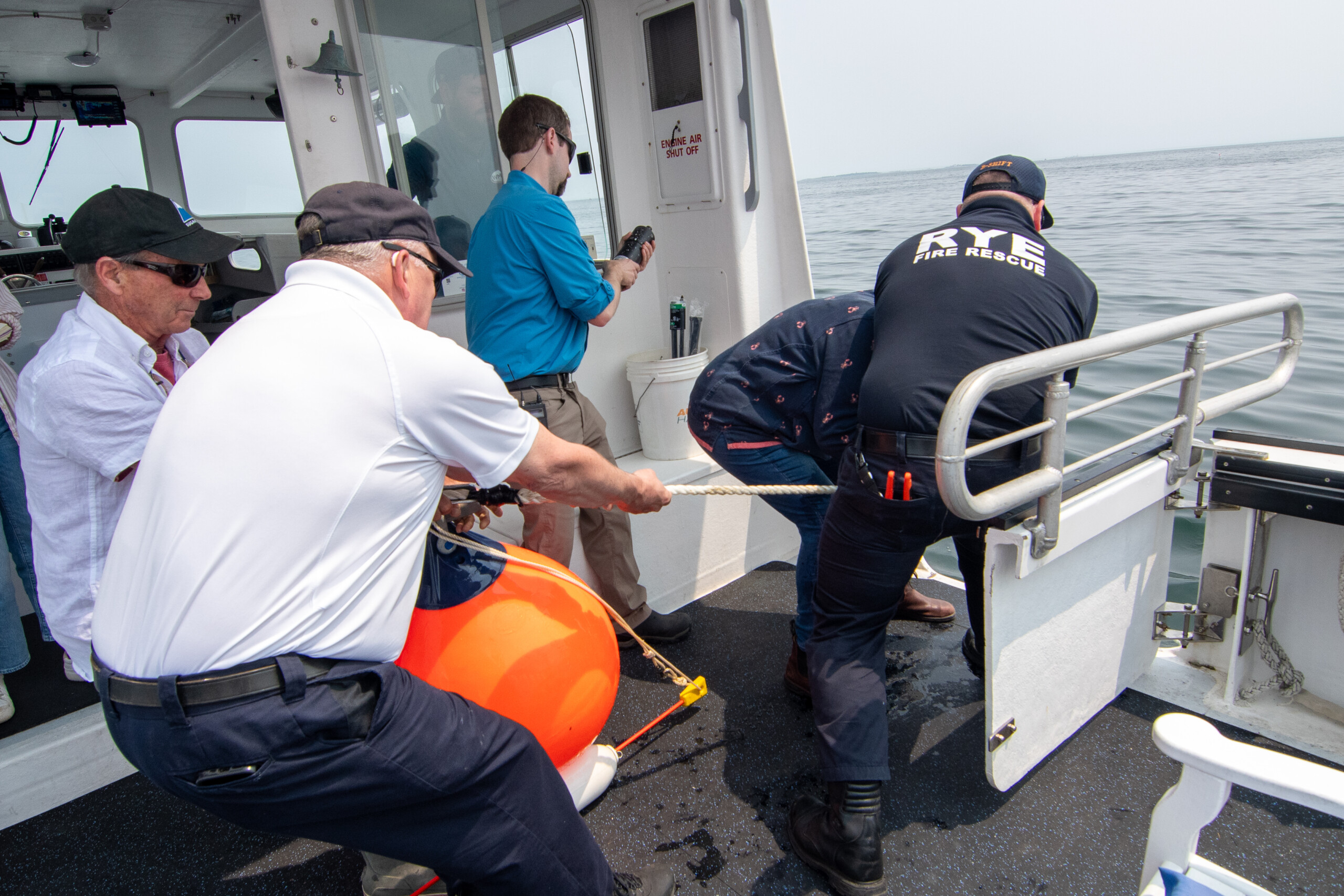
It’s all hands on deck reeling in buoys along the coast to attach the seasonal acoustic telemetry receivers. Once the receiver is zip-tied on and the buoy returned, UNH professor Nathan Furey will note the buoys’ locations and the attached receivers’ ID for the end-of-season retrieval.
For a while, New Hampshire was basically an 11-mile dead zone for acoustic receivers. On occasion, some of Furey’s receivers on the Isles of Shoals would log a ping from a white shark, but there weren’t many receivers between Cape Cod and the Shoals — until 2020, that is.
As part of the AWSC’s education and outreach initiatives, Winton gave a talk to the National Association of Lifeguards, who happened to have their annual meeting on Cape Cod. It was there that she met Pat Murphy and Jeff Kelley.
“Jeff approached me afterwards and said ‘Hey, would you guys be interested in putting receivers off the coast of New Hampshire?’ ” Winton said.
The duo had the safety of their beaches in mind, following a fatal shark attack off the coast of Bailey Island in Maine earlier that year. Knowing more about white shark activity in New Hampshire means that the NH State Beach Patrol is better equipped to train lifeguards and keep beachgoers safe.
“It’s the ocean,” Murphy said. “We’re always asking ourselves, ‘How can we better protect people?’ ”
“They expressed an interest in monitoring their more popular beaches for the presence of tagged white sharks,” Skomal said. “The logical step there was to provide them with acoustic receivers, which I did.”
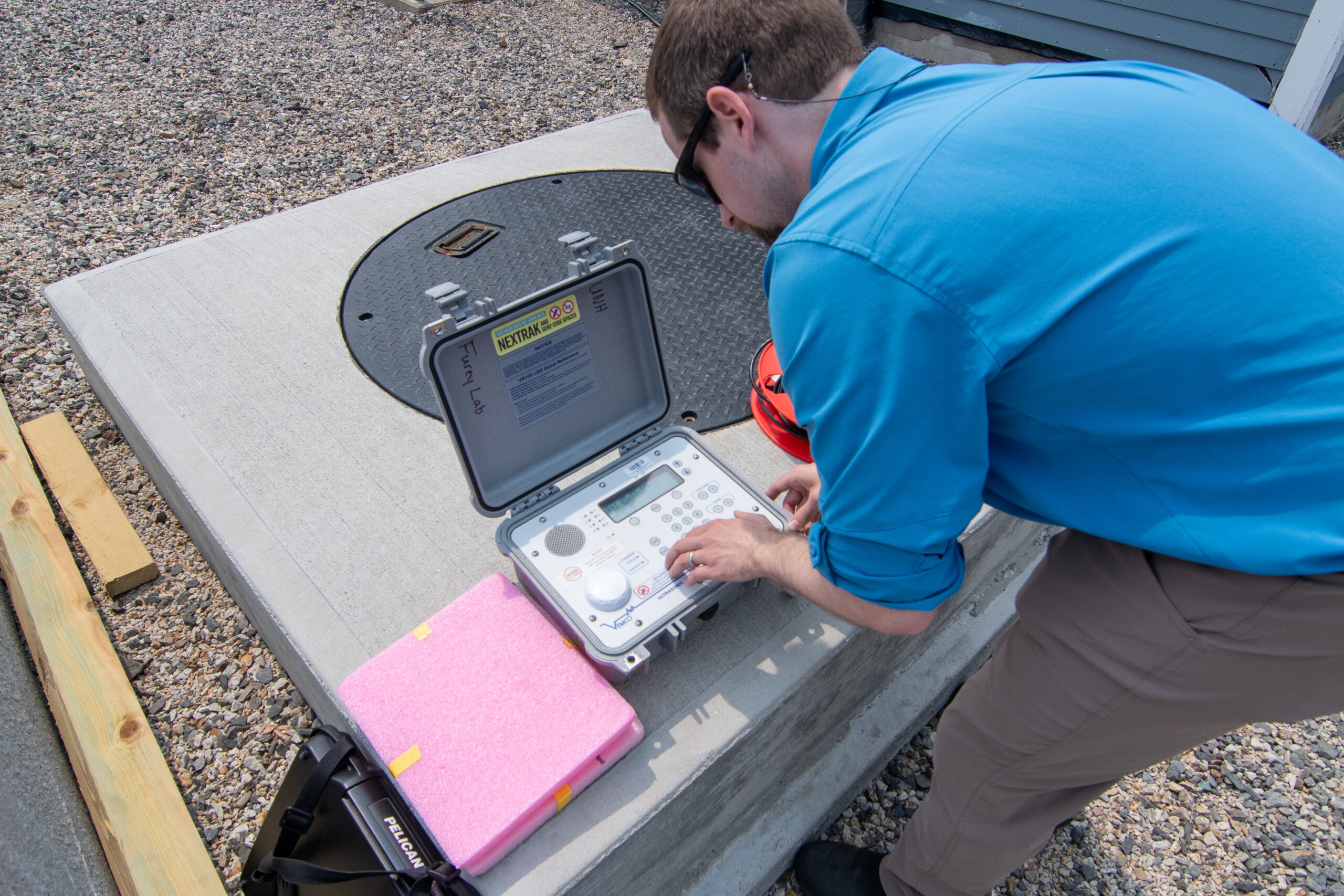
Nathan Furey fires up a VR100 Deck Box to listen to the unique pings each tag emits. Various tags that could be placed on marine life are housed in the pink foam that is used for this illustration.
NH State Beach Patrol was initially given two or three acoustic receivers to start with, but the process of deploying them, and receiving the data, is labor-intensive and requires an understanding of how the systems work.
At the same time, Furey was building his array of receivers for his research off the Isles of Shoals. To Skomal, the partnership was kismet.
“It was an organic relationship that built between us, Dr. Furey and the beach patrol folks,” Skomal said.
It’s also a symbiotic one. Winton, Skomal and their teams tag juvenile and teenage white sharks off the coasts of Cape Cod and South Carolina before they head north. Furey, the beach patrol and the Rye Fire Department work together to place the receivers and remove them at the end of the summer. Furey handles the data and shares any detections with Winton and Skomal, and they share any pings of Furey’s tagged fish with him. You hear that team harmony? It’s all acoustic.
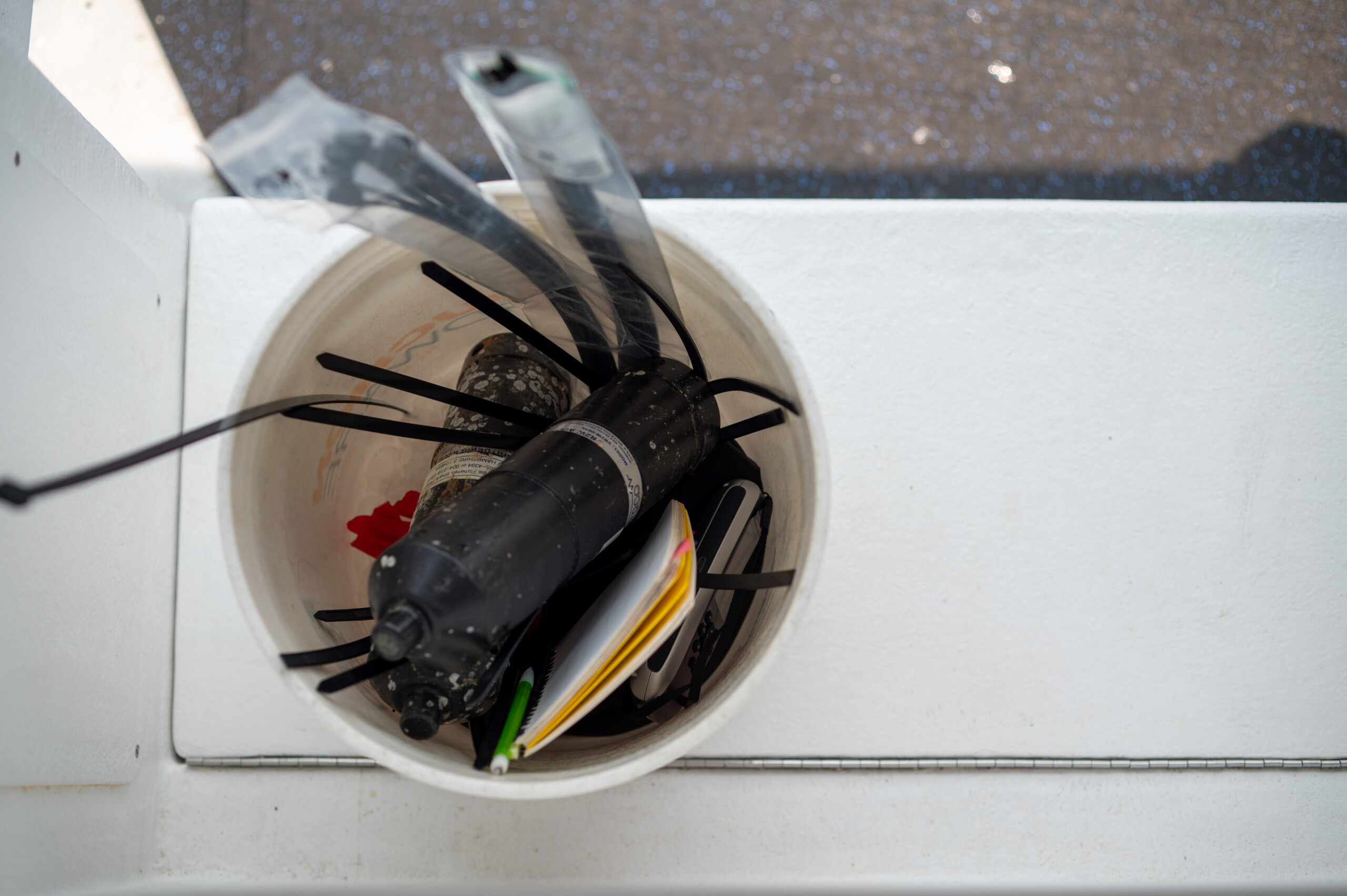
Nathan Furey’s goodie bag includes various zip ties, his notebook, and acoustic telemetry receivers waiting to be deployed off the coast of New Hampshire in the hopes of tracking tagged fish migration.
From a research standpoint, everyone had the same question. What exactly are white sharks doing in New Hampshire?
It turns out, they are doing the same thing as anyone who has sat in summer traffic just past the Hampton tolls on I-95 north is doing. They’re just passing through to spend their summer farther North.
“The Cape is a great buffet,” Winton said. “There are individuals that will stay here, but there’s lots of other food and resources out there. In New Hampshire, they’re pretty much cruising by — it’s so interesting to see the difference in how they’re using these areas.”
From mid-July through late fall (occasionally as late as November), Furey sees pings from tagged white sharks — though they aren’t usually close to shore, and they aren’t staying for long.
“We’ve only had two or three instances where we’ve detected the same animal for more than an hour,” Furey said. “Oftentimes, it’s very brief — 10 or 15 minutes. We hear more of white sharks from our receivers that we’re using for Atlantic cod right now, which are a few more miles offshore.”
Overall, it seems that white sharks treat New Hampshire’s waters as more of a rest stop along the aquatic I-95 corridor while they make their way into the Canadian Atlantic. The receivers filling in the gaps in New Hampshire and Maine have helped confirm that migratory pattern.
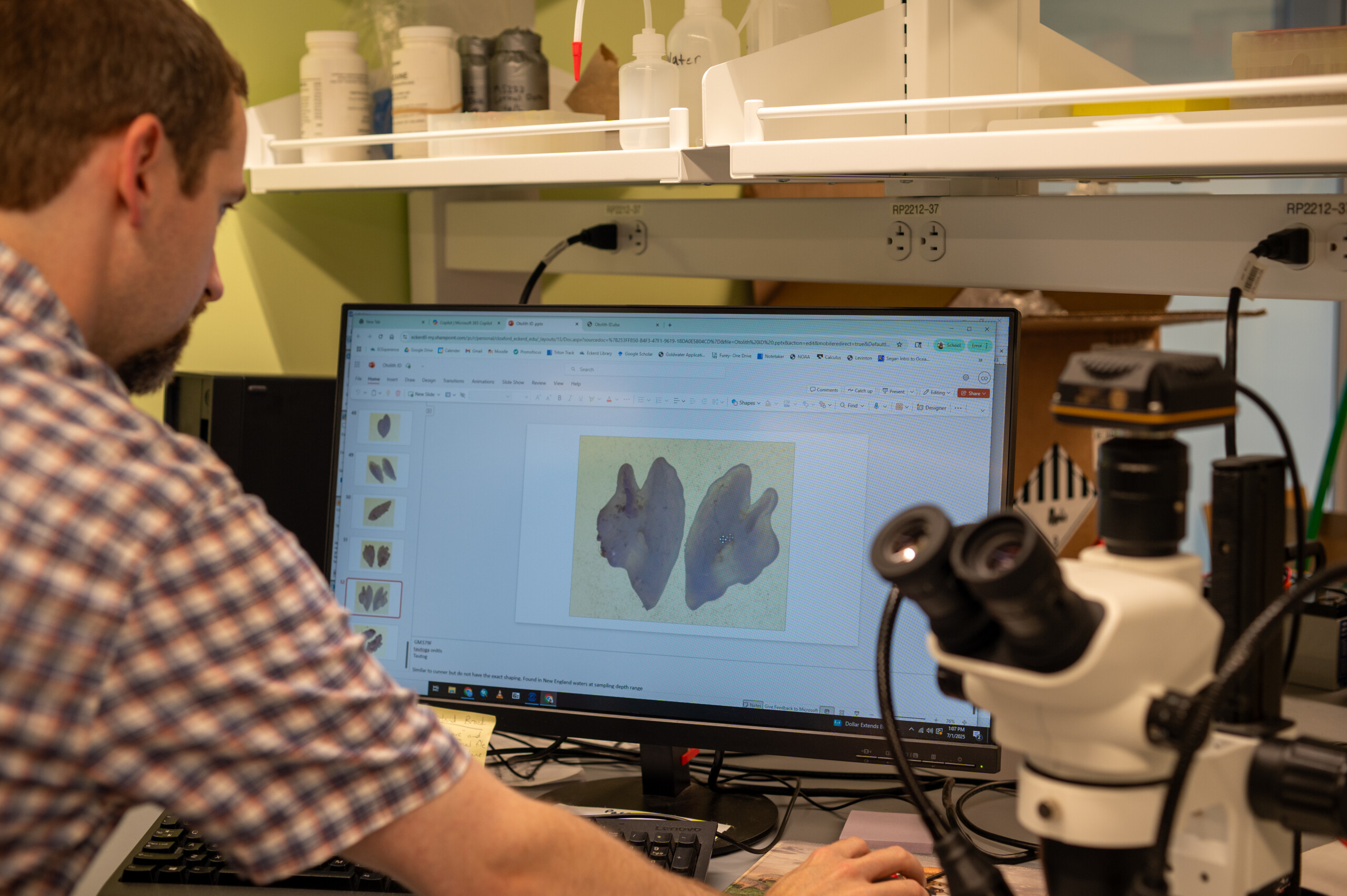
Furey looks at photos of a marine specimen that a student took through a microscope in the UNH lab.
“There’s a lot of shark activity in Nova Scotia and the Gulf of Saint Lawrence in the summer and fall, which really surprises people. One of the biggest white sharks ever caught was off of Prince Edward Island in the ’80s,” Winton said.
Winton said that the tagging technology has been super cool, and helpful, in understanding where this species goes.
Of the 350 sharks that they’ve tagged since 2009, some have been detected as far north as Nova Scotia, and as far south as South Padre Island, Texas.
“With the acoustic technology, we’re able to track sharks for a period of almost a decade to see what they do year-to-year,” Winton said. “We’ve really been able to document this recovering population kind of reclaiming its ancestral home.”
As the waters in the Gulf of Maine warm faster than anywhere else on earth, this data, and the partnerships it’s created, is more important than ever.
“The acoustic telemetry is really important for monitoring how that distribution might change in the future,” Winton said, “because the northwest Atlantic is one of the most rapidly warming portions of the global oceans and we’re already starting to see shifts in a lot of species. I’m glad we were able to lay this baseline distribution for what sharks as the species made a comeback.”
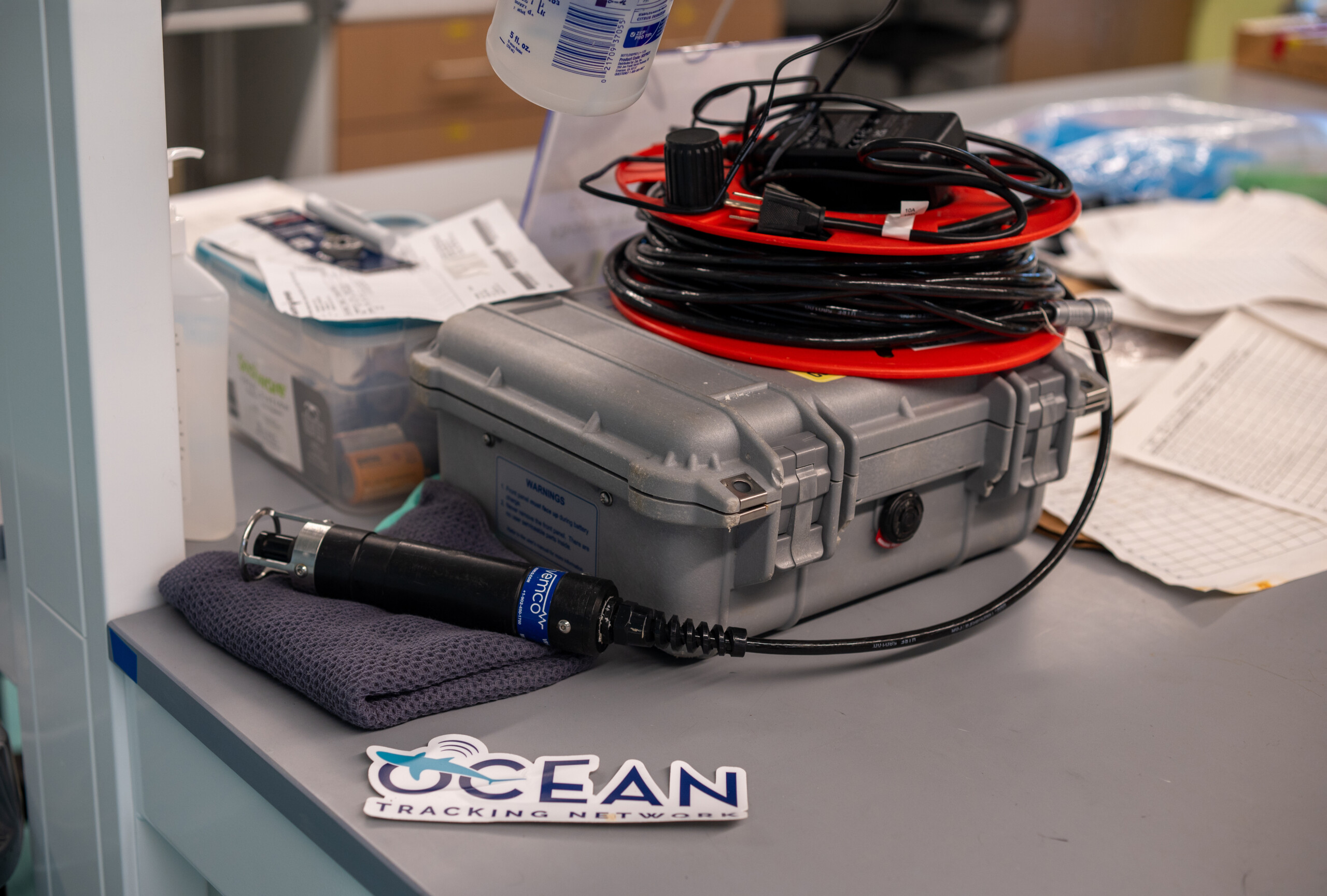
Among the items in Furey’s UNH Lab is a deck box, transponding hydrophone and a sticker for Ocean Tracking Network. OTC is based out of Nova Scotia, and is one of the many organization he has worked with in his studies of marine life.
Winton and Skomal’s partnerships extend across the entire Eastern Seaboard, including the Bahamas.
“The best scientific studies and long-term monitoring programs are always the result of big collaborative efforts,” Winton said. “We can learn so much more together than we can individually.”
“When you deal with a highly migratory species like the white shark, it’s critical, as far as I’m concerned, to collaborate with others,” Skomal said.
As if the traffic wasn’t a giveaway, it turns out everyone really does drive (or swim) north for the summer.
Sharks … With Cameras on Their Heads?
This isn’t some Austin Powers villainy. Advances in technology have allowed shark researchers to see the lives of sharks like they’ve never seen them before.
“It’s been very cool,” said Megan Winton. “We’ve been deploying camera tags on white sharks off of Cape Cod for the past couple of years, and we started working with the charter fishermen in South Carolina to do the same down south. Those tags record 10 or 11 hours of video footage.”
The view from the camera tags means that for about half a day, researchers are able to ride on the back of a great white, and see everything it does. While to us it may seem very “Big Brother,” the sharks don’t seem to mind.
“The camera tags have been a really transformative technology because they allow us to see what that animal is actually doing in different environments, and (the tags are) outfitted with an array of different sensors that record the animal’s movements and behavior and aspects of its physical environment 20 times a second, which is phenomenal and overwhelming,” Winton said.
The camera tags have given an eye-opening day-to-day view into the life of the great white, both dramatic and comedic.
“We saw one (great white) get shocked by a torpedo ray,” Winton said. “She kind of made a fool of herself. She swam down to look at this object on the bottom, and we realized it was a torpedo ray and it zapped her. She did not enjoy the experience.”
Winton hopes that the camera tags will also help inform public safety experts, as they learn more about how the sharks are hunting seals off the Cape.
“The technology is just going to keep getting better. I feel very lucky to be a scientist in this day and age because of some of the technology,” Winton said. “It makes me really excited for future generations of scientists, with the kind of technology they’re going to have at their disposal, and the sort of things that they’re going to be able to learn about these animals. It’s just a super exciting time.”