Spotlight on Rising Changemakers: Nicole Sublette
Profiles of New Hampshire leaders who are lifting up diverse voices in the Granite State and beyond
Since this magazine’s launch in the fall of 2021, it’s been 603 Diversity’s mission to share stories so that the people of New Hampshire could get to know their neighbors better, especially those who may be newer to the state or whose lives are underrepresented in other media. That goal continues to guide our work today.
Recently, we reached out to past sources, frequent contributors and editorial board members to seek out people who are making a difference in diversity spaces of New Hampshire and who’ve not been in this publication before. What we received were the names of dozens of people who are entrepreneurs, advocates, artists and community builders who are creating spaces where people feel seen, supported and valued.
In this issue, we will highlight six of these “Rising Changemakers,” but you can expect even more in issues to come. If you know of someone who deserves some spotlight, please email us at editors@603diversity.com.

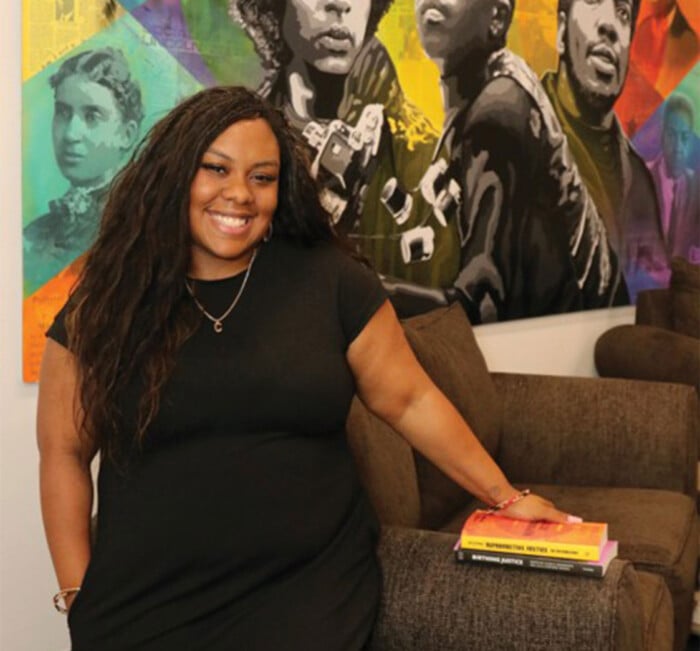
Nicole Sublette
City: Manchester
Passion areas: Mental health counselor
Q: How did you get the idea to start Therapists of Color New England?
Nicole Sublette: I remember that when the pandemic hit, I got 700 requests for services within a few months, and at that point, I had realized that it was something I necessarily couldn’t navigate by myself. It just showed me how many people needed support, and how many people were struggling.
At that time, I thought maybe I could expand to group practice, but I wasn’t sure. But what happened is that people were asking me if they could work for me, because they were looking specifically for supervision, for licensure from a person of color.
Even when I was micro and solo, I saw how systemic oppression continues to play out in our mental health systems. Evidence-based practices are studied on a specific population, which is typically middle-aged white men. And we’re taught in grad school that these are the evidence-based practices that have the highest efficacy. I was finding that, for people who face marginalization, those methods don’t always have the highest levels of efficacy, and so part of my service in practice is finding and redefining different ways to treat people who are struggling.
Q: Do you serve a lot of people of color and people who are LGBTQIA?
Nicole Sublette: We definitely do. I mean, we’re certainly niche like that. We’re the only group practice that specializes in folks of color and LGBTQIA in the intersections of those identities. People are naturally drawn to us.
Historically, in the medical fields and behavioral health fields, there has been a lot of harm done to folks who have faced any marginalization or oppression. There’s been a lot of mistrust due to historical harm being done in the helping and healing professions: Black women still die at higher rates than any other group. Even poor white women are dying at lower rates than affluent Black women.
There’s been a lot of overdiagnosis. Black men tend to be diagnosed with psychotic disorders at higher rates, such as schizophrenia, than any other group.
People are coming to my practice because harm has been done. They know that they want support, they know that they’re seeking help, but they’re hoping, by seeing us, those same harmful patterns are not going to be repeated.
Q: Are there any unique needs when you’re trying to serve this population?
Nicole Sublette: Mental health is a medical-based system, but it’s also a deficit-based system, meaning if you’re coming to get therapy and you’re using commercial insurance or insurance such as Medicaid or Medicare, you must have a diagnosis. But what makes it unique to people of color is that sometimes it can further internalize their oppression.
If someone comes to me and they’re experiencing racism or discrimination at work, and then they’re coming to me and they want to talk about how harmed they’ve been by experiencing chronic racism, whether it’s at work or just in general, the harm is done, but now I must give them a disorder and pathologize them.
Q: What are you looking for when you’re looking to hire a therapist?
Nicole Sublette: First and foremost, we’re looking for a clinician who is on an anti-racist and anti-oppression journey, and we’re not necessarily looking for people of color. We’re looking for someone who understands how oppression impacts people, how systemic oppression impacts people, and how that impacts the physiology and mental health of someone.
When you’re in a therapeutic setting, there’s a hierarchy of power. The therapist has a lot of power, and we really need people who are aware of their intersections of identity, how their power and privilege play out in the treatment of the folks they’re serving.
Q: You’re also a Reiki Master and a transformation coach. How does having different disciplines and skill sets add to the work that you do?
Nicole Sublette: I identify as someone who is Black and queer and someone who holds oppression in my body. I recognize that talk therapy isn’t the only way to access healing within ourselves. We often talk about folks having resilience, but to me, resilience is like a salmon swimming against the dam during mating season — they swim against the dam, and they’ll bash themselves to death. It’s exhausting. For me, it’s about how we can incorporate different modalities to move from systems of resilience, into vitality, to wellness, into wholeness, into really living.