Our Town: Plymouth Rocks
Explore Plymouth, New Hampshire, a town whose state college grew into a university could soon see more big changes
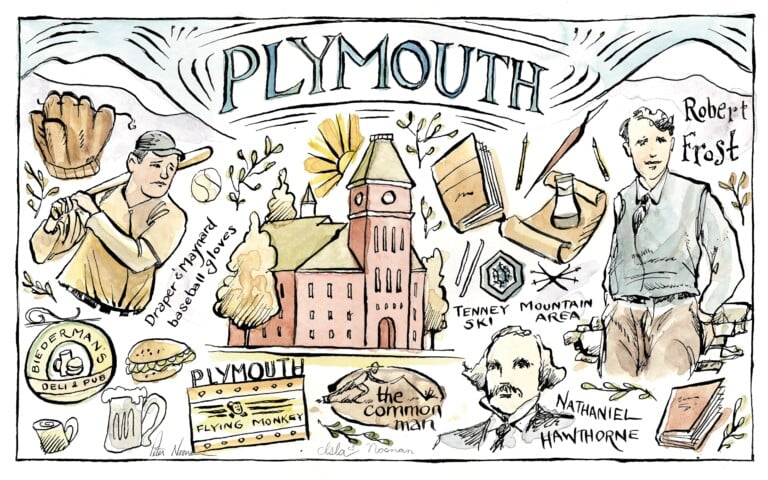
Plymouth, the town, and Plymouth State University, the institution of higher learning, are both famous for many reasons.
The former, incorporated in 1763, is the place where novelist Nathaniel Hawthorne died and where a Red Sox standout named Babe Ruth acquired his baseball equipment. The latter is where poet Robert Frost taught and is the alma mater of Ray Burton, the
longest-serving executive councilor in New Hampshire history.
In 1871, Plymouth became the home of the Plymouth Normal School, the first teacher’s college in the state and the precursor of Plymouth State College. The school, which became Plymouth State University in 2003, also has a tinge of the notorious. It was twice a Playboy magazine party school (1987 and 2010) and the place where decades ago, students at the end of the school year would place their old furniture in the street and set it on fire.
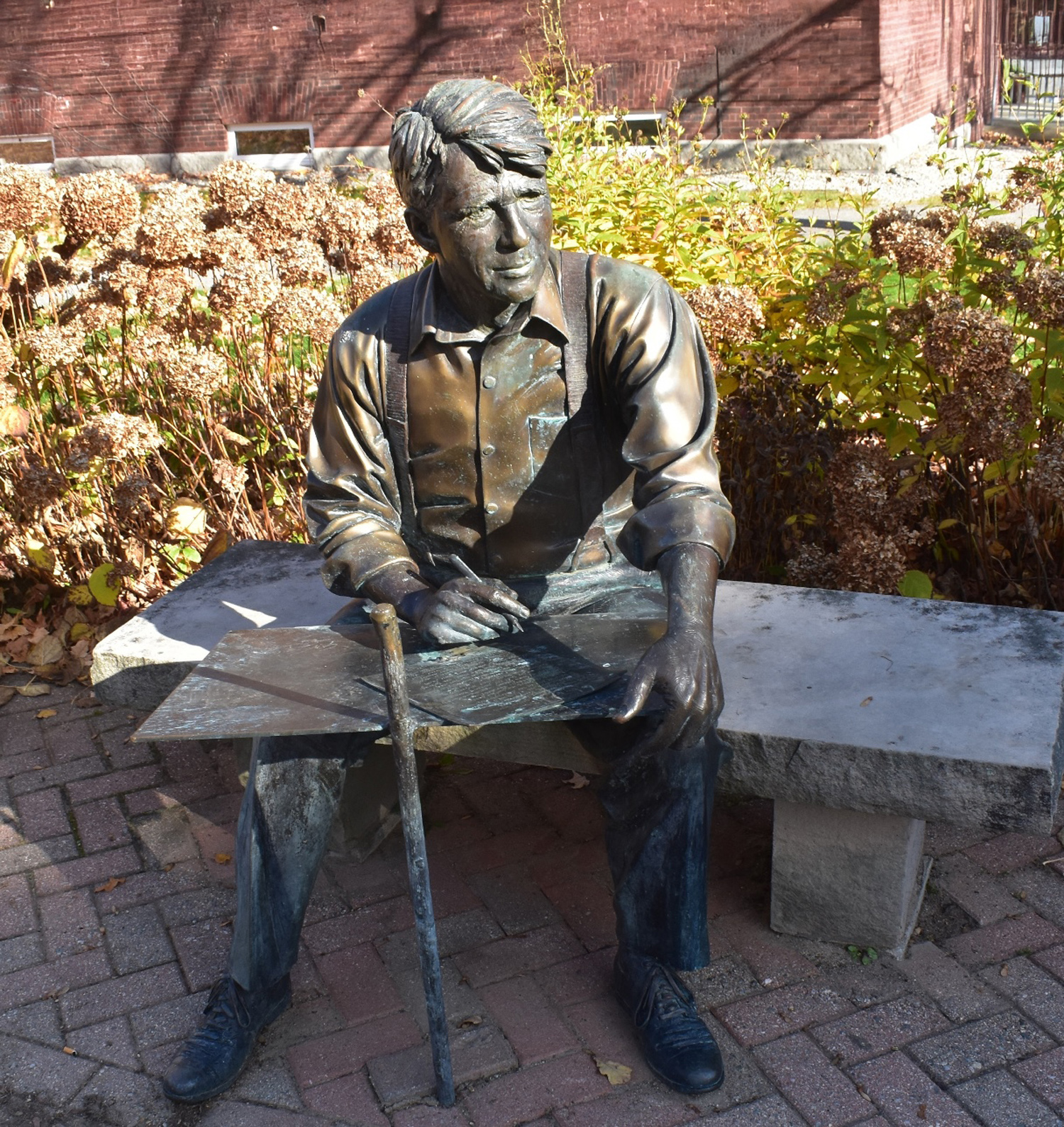
A bronze statue of poet Robert Frost outside Rounds Hall at Plymouth State University. Before he became internationally famous, Frost taught at Plymouth State during the 1911/12 school year. In the statue, Frost is looking to the south and is working on a draft of “The Road Not Taken.” Photos by John Koziol
The town has outgrown the shenanigans of flaming student furniture and could become the Northeast’s version of Chapel Hill, N.C., a community celebrated for its concentration of creativity, education, high tech and research facilities.
That effort, which is a long-term project still in the conceptual phases, is being spearheaded by Steven Kelly, the owner and CEO of Timberline Construction Corp., Timberline Communications Inc. and Tenney Mountain Resort, which is located in west Plymouth.
To date, Kelly said he has put “well over $20 million into the mountain,” which he wants to transform from just a ski area into
a four-season destination, complete with hotel and conference center. He also wants to build a technology park, sports academies and housing there.
He anticipates that the technology park will create up to 1,500 jobs directly and 400 jobs in the hospitality industry, which would undoubtedly further benefit the Common Man family of restaurants, which already enjoys a high profile in Plymouth.
“If you build an amenity-rich environment” in Plymouth, people will come, said Kelly, who sees Plymouth State as being a “good reason for why a tech campus could do really good there.”
Sean Brown, The Common Man’s chief operating officer, has worked for the company since 1995 when he was a student at Plymouth State. He said the town “makes sense” for The Common Man, which has multiple venues there: four restaurants, the Flying Monkey movie and performing arts center; and The Common Man Inn and two annexes. In total, he said there are 17 Common Man venues statewide, from Windham to Lincoln, most along the Interstate 93 corridor.
Plymouth is just one town over from Ashland, where The Common Man was founded by Alex Ray and is headquartered. “It really is a gateway to the White Mountains,” Brown said, with The Common Man restaurants and hotels in Plymouth serving people going up to the White Mountains and/or coming back from them.
He summed up that Plymouth “is also a great location,” although he acknowledged that high housing costs make it challenging for The Common Man to hire and retain employees.
Gathering at The Common
Less than a mile long, Plymouth’s downtown is eminently walkable and a fun place to explore on foot. The downtown is centered by The Common, and a plaque there announces that The Common remains “a work in progress of a proud community.”
An attractive place to enjoy an al fresco meal, The Common, which includes a bandstand and tables and benches, is also a great place to simply watch the world go by.
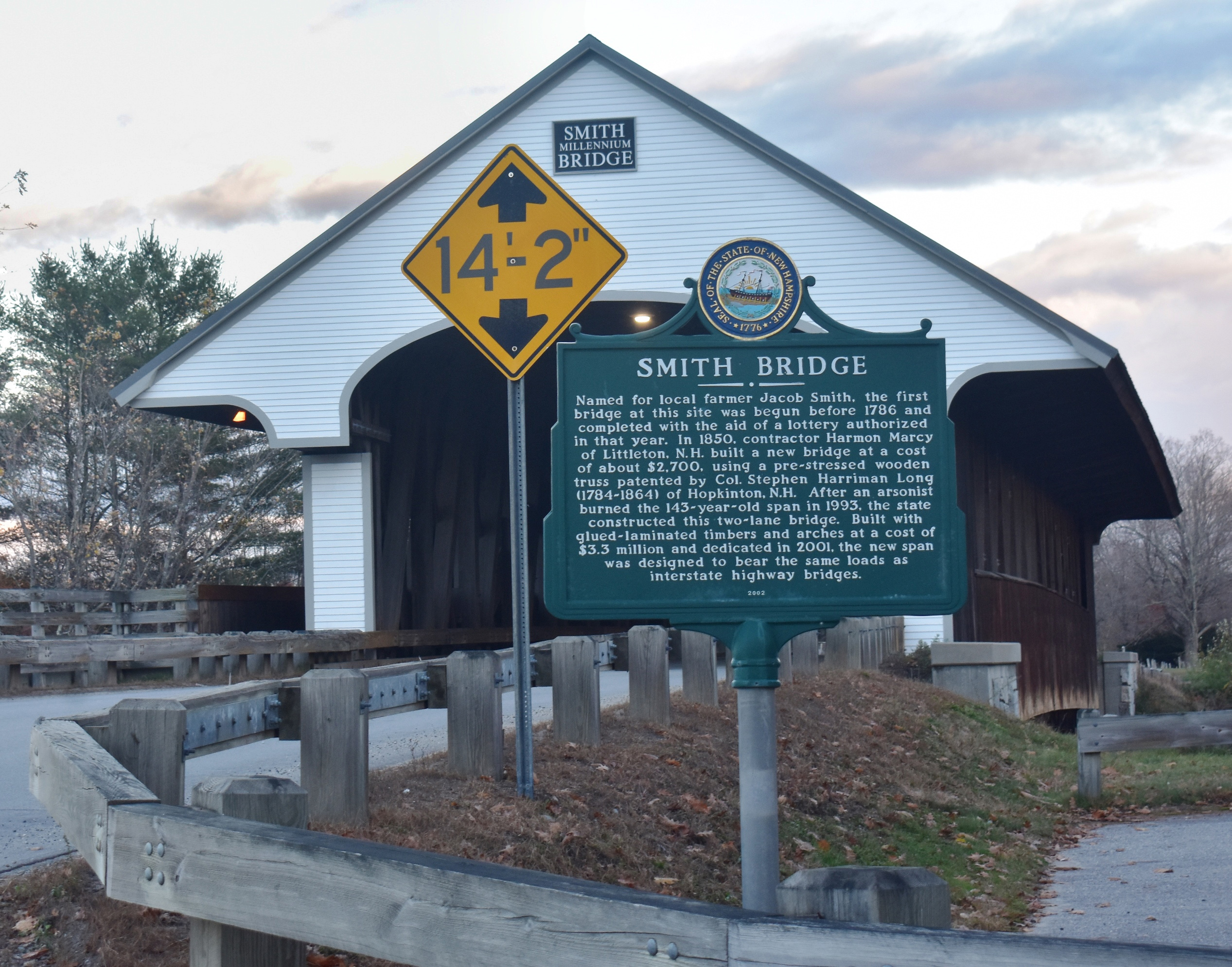
Destroyed by arson in 1993, the Smith Millennium Bridge in Plymouth over the Baker River was rebuilt in 2001 and is known as one of the strongest wooden covered bridges in the world.
A stone’s throw away is the Museum of the White Mountains, which, according to its website, “explores the region’s past, present, and future through high-quality exhibitions, interdisciplinary educational programming, and stewardship of our collections.”
A short distance from the museum, outside Rounds Hall on the Plymouth State campus, is a bronze statue of poet Robert Frost, who taught briefly at Plymouth State, working on a draft of “The Road Not Taken.”
The Plymouth Historical Museum & Memory House, right next to Town Hall, is where Daniel Webster first practiced law before going on to earn national prominence.
Below Main Street, there is an amphitheater on the west bank of the Pemigewasset River, which separates Holderness and Plymouth, and there is a concrete skate park at the southern end of the road, which is also known as U.S. Route 3A.
Off Tenney Mountain Highway, which is where several big-box stores and franchise eateries are located, is the Smith Millennium Bridge. Spanning the Baker River, the bridge is both attractive and, given its size, solidly imposing.
The legacy of Biederman’s

Zac Penn, left, and Ben Crosby stand outside the rear entrance to Biederman’s Deli & Pub in downtown Plymouth. Biederman’s is a Plymouth institution known for its sandwiches, on-tap local beers and a stuffed moose head mounted on its southern wall. Kissing the moose is a Biederman’s tradition.
Ben Crosby, who since 2022 has owned and operated Biederman’s Deli & Pub with Zac Penn, said there is no place he’d rather be.
Both Crosby and Penn are PSU alumni who previously worked at Biederman’s; later, each worked for a statewide beverage distributor.
The new owners never considered changing the name, but they added a patio out back, and boosted the number of beers on tap to 20, “focused on local,” Crosby said.
He said Biederman’s cellar-like location in the basement of the Rollins Building downtown is a powerful attractant — so powerful that it should expand. The downside of doing so, however, is that there is no room in the existing space to grow. He worries about not being able to recreate the vibe at a different location.
He remembers that when he was the general manager at Biederman’s, there was a conspicuous change in the volume of summer business. There were metaphorical tumble weeds blowing up Main Street then, he recalled, but none now: Biederman’s is busy year-round.
“We’re in the bosom of the White Mountains and the Lakes Region,” Crosby said with noticeable pride, adding that the reasons for Biederman’s success have remained a constant in the form of its beers, sandwiches, and welcoming feel as a “hang bar.” The place is decorated with classic beer trays and rock ‘n’ roll albums; a montage of the music is played regularly.
Biederman’s is delighted to be part of a vibrant community, said Crosby, adding that “It is a great spot to be. There’s just a lot of things going on. We have restaurants and art galleries and there’s a lot of stuff for families to do.”
Louise (nee Samaha) McCormack said downtown Plymouth remains the kind of place where chances are good that you will see a friend or neighbor.
A Plymouth native, McCormack grew up on Main Street where her family has run a convenience store since at least 1917.
She earned an undergraduate degree from Plymouth State; a master’s from Ohio State; and a doctorate in education from Boston University before returning to Plymouth, where she taught in the math and physical education programs at Plymouth State for 36 years before her retirement in 2016.
Its former vice president, she is now a member of the board of directors of the Plymouth Historical Society and one of her hometown’s most ardent supporters.
McCormack pointed out that while the Massachusetts Institute of Technology is well known for the surreptitious placement of objects atop the rounded roof of one of its buildings, Plymouth State’s tradition of putting pumpkins atop Rounds Hall annually is even older.
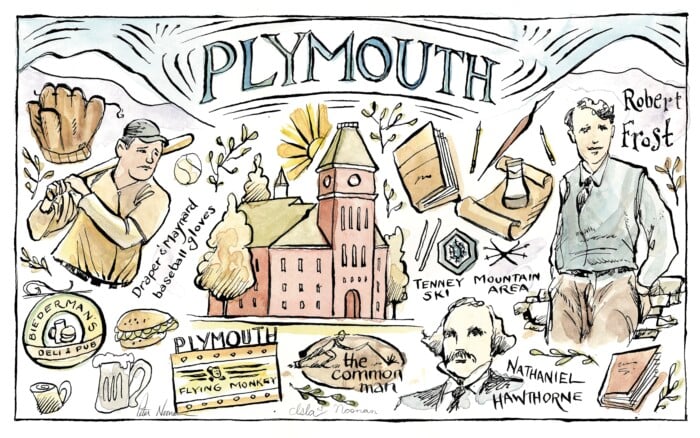
She noted that Plymouth also has the distinction of being where, at the former Draper & Maynard Sporting Goods Co., “the first baseball glove … the first padded baseball glove in the U. S.” was produced, a fact that in 1916 drew Babe Ruth and his teammates up for a visit.
“This is a friendly town. We love where we live,” said McCormack, who sees the town and Plymouth State as being inseparably linked.

The Common is at the heart of Plymouth’s downtown, offering a place to slow down. It includes a band shell, tables, benches and a plaque honoring author Nathaniel Hawthorne, who died at a local hotel in 1864.
Rodney Ekstrom, Plymouth State’s director of development and alumni relations, concurred with McCormack’s sentiment.
Plymouth State’s legacy of preparing “educators for New Hampshire’s classrooms,” endures to the present, he said in an e-mail, even though Plymouth State has undergone several name changes since its founding, including as Plymouth Teachers College (1939), Plymouth State College (1963), and since 2003, as Plymouth State University.
“Today, PSU offers a wide range of programs — from traditional disciplines to cutting-edge fields like robotics, cybersecurity, and game design — alongside accelerated 96-credit, three-year degrees designed for affordability and efficiency,” Ekstrom said.
Melanie Nelson, a 1997 graduate of Plymouth State College with a bachelor’s degree in travel-tourism marketing, earned a master’s degree in education from Plymouth State University in 2007 and now resides in Bend, Oregon. Nelson is an educator in that community.
Born and raised in Nashua, Nelson said that as she readied to continue her education after Nashua High School, her late father, Richard, informed her that she had three choices as to where she should apply.
“My dad said you could go ‘instate, instate or instate,’ ” said Nelson, meaning that he would pay for her to attend either Keene State College, the University of New Hampshire or Plymouth State.
After reviewing her options, Nelson settled on Plymouth State.
“I really love the town of Plymouth. It’s a beautiful town, and I absolutely loved it,” she said.
“During fall foliage, you didn’t have to worry about peak season and trying to catch it just right. You just stepped out the door.”