Murder Most Heard
True crimes in New Hampshire have fueled popular podcasts like "Missing Maura Murray," "Dirtbag Climber," "Bear Brook," and more
In the true crime podcasting world, there is the time before “Serial” and the time after “Serial.”
Released in 2014, and hosted by Sarah Koenig, “Serial” reexamined the case against Adnan Syed, as a potential wrongful conviction. Syed was convicted of the 1999 murder of his ex-girlfriend, Hae Min Lee, a high school senior.
His story captivated the world; there were more than 300 million downloads of “Serial” in its first season. Many point to “Serial” as ushering in an era of widespread interest — some might say obsession — with true crime podcasts and audio storytelling.
That interest hasn’t escaped New Hampshire, which has provided the setting for a handful of true crime podcasts since “Serial.”
“I think a lot of it is the lure of the White Mountains,” said podcaster Lance Reenstierna of Crawlspace Media. “New Hampshire has always been sort of an outlier.”

Tim Pilleri and Lance Reenstierna, of Crawlspace Media, hosted the podcast “Missing Maura Murray” which delved into the mystery of her disappearance. Courtesy Photo
His podcast partner, Tim Pilleri, also of Crawlspace Media, observes New Hampshire’s personality through the lens of growing up in Massachusetts.
“When I’m up there it seems like it’s a little more private and mysterious,” Pilleri said. “It seems a little wilder, maybe because of the cold. The people want to be left to themselves for the most part.”
The geography of New Hampshire lends itself to mysteries. “It has this ‘Twin Peaks’ type feeling to it, a lot of forests, a lot of places you can wander into,” Reenstierna said.
Jason Moon, senior reporter for New Hampshire Public Radio, is originally from Alabama and finds a strong sense of setting in New Hampshire towns.
“Each is a place unto itself,” said Moon, host of NHPR’s critically acclaimed “Bear Brook” true crime podcast. “Every town is its own little world with its own set of characters, its own small police department and its own mysteries.”
One of those towns is the rural community of Haverhill in the northwestern part of the state, which serves as the backdrop for one of the most baffling missing person’s cases in modern history — the disappearance of Maura Murray.
Haverhill isn’t as well-known as some of its Upper Valley neighbors. It’s a community where people work the land, meet up at the annual North Haverhill Fair, or stop for homemade ice cream at Hatchland Farms.
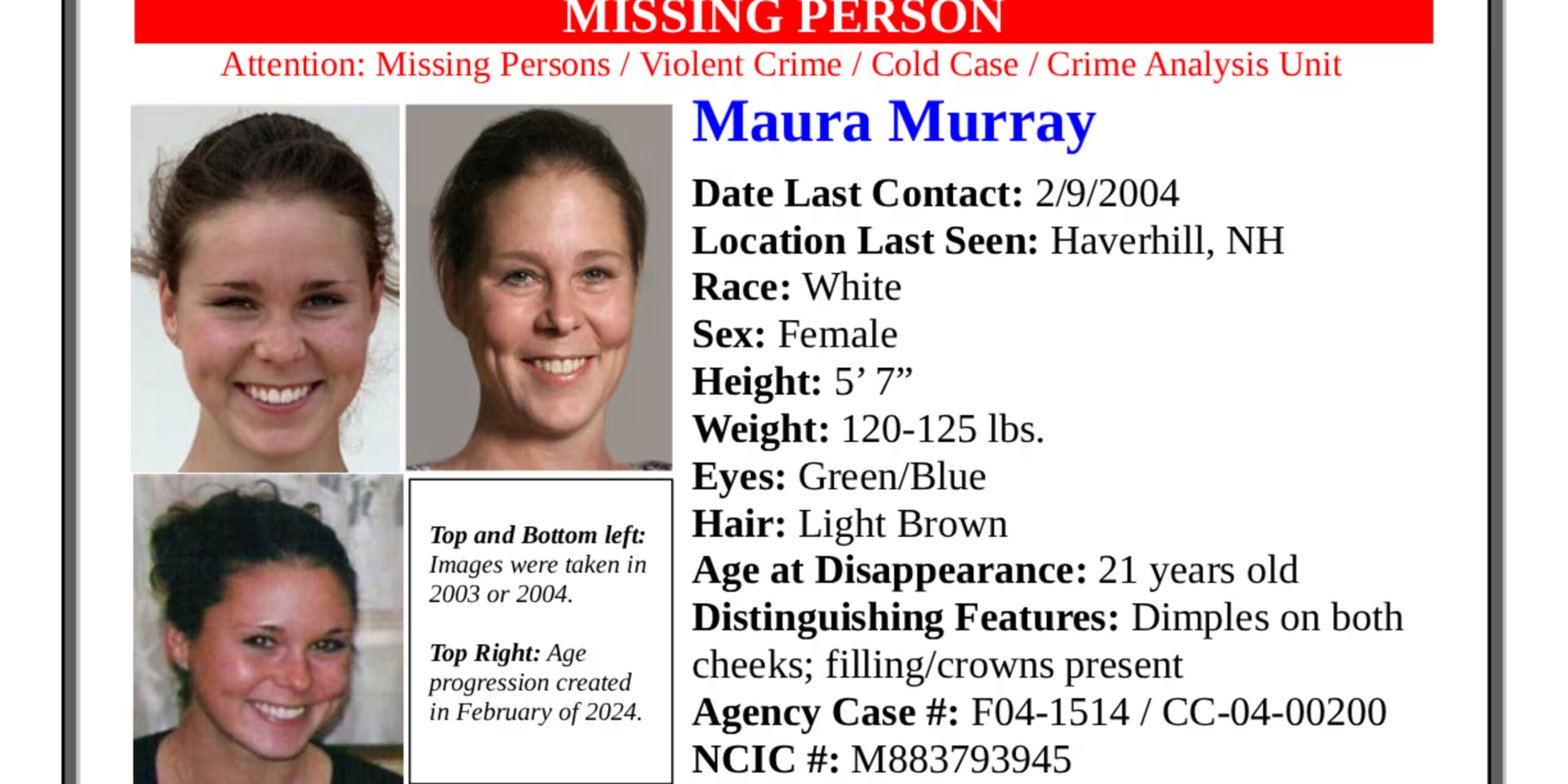
Maura Murray, who disappeared in 2004, is still considered a suspicious missing person’s case in New Hampshire. Courtesy Photo
On Feb. 9, 2004, Maura, then a 21-year-old nursing student at the University of Massachusetts Amherst, told her professors she would be absent because of a family emergency — there wasn’t one — and withdrew some money at the ATM. She got in her black-colored Saturn sedan and drove into the White Mountains. Around 7:30 p.m., she crashed her car along a desolate stretch of Route 112 in Haverhill, where she declined help from a passing motorist.
By the time police arrived at the scene, she was gone.
Despite massive search efforts and a police investigation, no trace of Maura was ever found. It was as if she simply vanished. In the years since her disappearance, her family, police and an army of amateur sleuths have attempted to find her, without luck.
Pilleri and Reenstierna began filming a documentary focusing on the armchair detectives who became increasingly obsessed with Murray’s disappearance in 2013, which segued into the podcast called “Missing Maura Murray” in 2015. After they began making the podcast, fervent followers of the case began reaching out with their own theories about what happened to her.
“People are inherently curious, they have this need to solve puzzles, there’s always a need to have an answer,” Reenstierna said. “She disappeared without having an obvious reason. There was no one obviously stalking her. There was no physical abuse at home. There was nothing like that.”
Maura’s disappearance has a lot of unanswered questions, like why she left or bought certain items, which captivates amateur sleuths.
“The more complicated people’s theories got, the more dug in they got,” Pilleri said. “You dig in so hard; it almost becomes your identity.”
The widespread interest in the case can prove challenging when theories and speculation commingle with facts. That’s when Reenstierna and Pilleri return to what they do know.
The search dogs lost Maura’s scent at a certain point. There were no footprints in the snow. He believes she was picked up by a car. But within those facts is room for interpretation.
“There’s another side to pretty much anything you say,” Pilleri said.
The investigation into Murray’s disappearance remains open and active as a suspicious missing person’s case with the New Hampshire Cold Case Unit, according to Senior Assistant Attorney General R. Christopher Knowles, chief of the New Hampshire Cold Case Unit.
“What we most want to publicize is our continued commitment to finding answers for Maura and her family,” Knowles said. “The single most helpful thing the public can do is report any information, no matter how small or insignificant it may seem, directly to us.”
The biggest challenge in the case is the passage of time.
“The public interest in Maura’s case, including documentaries and podcasts, has been helpful in keeping her case in the public eye and ensuring people are still thinking about her. This renewed attention can, and has, generated new tips,” Knowles said.
Jason Carroll
Ironically, it was publicity from the pod-cast “Undisclosed” that led New England Innocence Project (NEIP) Attorney Cynthia Mousseau to long-lost DNA evidence in the case of Jason Carroll.
Mousseau was at a court hearing for Carroll when the court clerk told her she knew about his case because she had listened to “Undisclosed.” She told Mousseau, “It’s so crazy, I was just in the basement and saw this big box of evidence with Jason’s name on it.”
Mousseau’s mouth dropped. “I go ‘wait, what do you mean there’s a box in the basement?’ ”
The clerk told her she didn’t know what was inside the big cardboard TV box, but that it had Carroll’s name on it.
Carroll has always maintained his innocence in the 1988 murder of Sharon Johnson, of Bow. The New England Innocence Project (NEIP) took on his case, saying the only evidence was a coerced confession, made after his own mother, a police officer, screamed at him during his interrogation.

In the eighth episode of the podcast, Jason Carroll’s attorneys find out about a missing box of evidence found in the basement of the courthouse. Photo Courtesy/ Bear Brook
The box in the basement could be valuable in proving his innocence. After talking with her supervisor, Mousseau made an unusual decision to ask NHPR’s Jason Moon to be a witness when she went to look at the box. Moon was featuring Carroll’s case in the second season of the “Bear Brook” podcast.
The two speculated about what might be inside. It could be papers, or files. “Or like Christmas, the thing you’ve been dying for; or it could just be underwear and socks,” she said.
They didn’t get their hopes up. The box was brought up. Butcher paper was rolled on two tables, where everything inside was laid out. “I remember being like ‘this is not paperwork,’ ” she said.
Within the items, Mousseau saw an envelope labeled “fingernail clipping.” It was the moment she realized they might have something that could be DNA tested. She looked at Moon, whose face flushed. “We were both like ‘Oh my God,’ ” she said.
It brought the reality of the situation front and center. “It was one of those moments where it really is unavoidable, the fact of what happened. Here you have the clothes a person was wearing when a person was horribly murdered right in front of you,” Moon said. “It was sobering. It was humbling.”
He continues to update the case in the “Bear Brook” podcast feed. Since the box was found in 2022, the New Hampshire State Police Forensic Lab confirmed there is DNA on several items, which had previously not been tested. Mousseau hopes to get some results in 2026.
“We got a lot of feedback on that podcast,” Mousseau said. “It’s not that everybody thinks that Jason (Carroll) is innocent, but it’s that everybody is thinking about false confessions, which are not as uncommon as people think.”
Dirtbag Climber

Journalist Steven Chua reported and hosted the podcast “Dirtbag Climber” released by the CBC. Photo by David Buzzard
Steven Chua was working as a journalist in British Columbia when he heard about the unsolved murder of Jesse James, a rock climber whose body was found in a burned-out GMC Yukon in Squamish in 2017. He has since reported and hosted the podcast, “Dirtbag Climber,” about the case, which traces the victim from his childhood as a Jewish kid in Massachusetts to his time as a neo-Nazi to his time as an internet scammer.
Though everyone realized James was not his real name, it took three years for his true identity to be revealed as Davis Wolfgang Hawke. Hawke was also known as Andrew Britt Greenbaum and Commander Bo Decker. Hawke was the mastermind behind a massive internet spam centered in Manchester in the early 2000s. In 2004, AOL won a $12.8 million judgment against Hawke, whom they accused of violating anti-spam laws by sending unwanted emails to its subscribers.
“He was hitting up an astronomical number of emails for different products. The greatest hit of them all was an herbal penis enlargement pill,” Chua said.
Hawke met Brad Bournival, a New Hampshire high school student, at a chess tournament in 2001, and recruited him to work for him. They expanded into a huge space in Manchester, which they filled with computers rigged to send spam emails around the clock during the days of dial-up internet.
“On top of it being a lot slower, the audience was a lot more naïve and willing to believe what showed up in their inboxes,” Chua said. “People would see these emails and think if it shows up in my AOL inbox, it must be legit.”
Hawke was reportedly making $500,000 per month, which he converted to gold and bitcoin. “He had perfect timing. He was very ahead of the curve,” Chua said.
Hawke vanished after the AOL suit, and Chua’s podcast traced his life in the years after, until his murder, which remains unsolved. The podcast has brought more attention to the case, though authorities remain tight-lipped about leads.
“Regardless of what you think of the guy, the fact that there is an unsolved murder out there is not a good feeling,” Chua said. “I do hope the podcast gives a bit more motivation to solve it.”
After AOL won their suit against Hawke, they announced their plan to search for the buried gold at his parent’s house in Massachusetts, but never did.
“Legend has it that the gold bars are buried somewhere in the White Mountains,” Chua said.
In researching his podcast, Chua interviewed Brian McWilliams, who profiled Hawke’s case in his book, “Spam Kings.”
“Brian McWilliams talked to one of their associates, and that associate said he was there when Brit brought the shovel to start burying the gold somewhere in the White Mountains,” Chua said. “As for where in the White Mountains, that’s still a mystery. It feels like one of those things that is an almost mythical story — you too could become a millionaire if you wander around the White Mountains of New Hampshire long enough.”
About the Author
Lara Bricker is a journalist, true crime author, licensed private investigator and certified cat detective. She has been writing and reporting on crime and justice issues since 1998. A community journalist at heart, Bricker is among those mourning the loss of resources for local journalism.
Her work has appeared in Woman’s World magazine, USA Today, Vulture, Boston Globe and more. In 2008, she covered the first death penalty case to go to trial in New Hampshire in almost 50 years for the Associated Press.
Bricker previously worked as a defense investigator for the New Hampshire Public Defender system for seven years. During that time, she was involved in investigating cases from misdemeanor assaults to felony murders. She is currently a licensed private investigator who works throughout New Hampshire on behalf of her clients.